If your back yard, driveway or paved area has turned green, black or slippery with algae and organic growth, you're not alone. In Greater Manchester the combination of rain, shade and temperature fluctuation means outdoor surfaces deteriorate faster than in drier parts of the country, and once biological growth takes hold it compounds quickly. A professional yard pressure washing service removes what domestic equipment can't quite reach — not just the surface layer of dirt, but the embedded algae, moss and lichen that make paving look permanently stained and genuinely dangerous underfoot.
This guide covers what the job actually involves, why different surfaces need handling differently, what it costs in this region, and when it makes more sense to call someone in than to keep attempting it yourself. There's no hard sell here — just straightforward information to help you make the right call for your property.
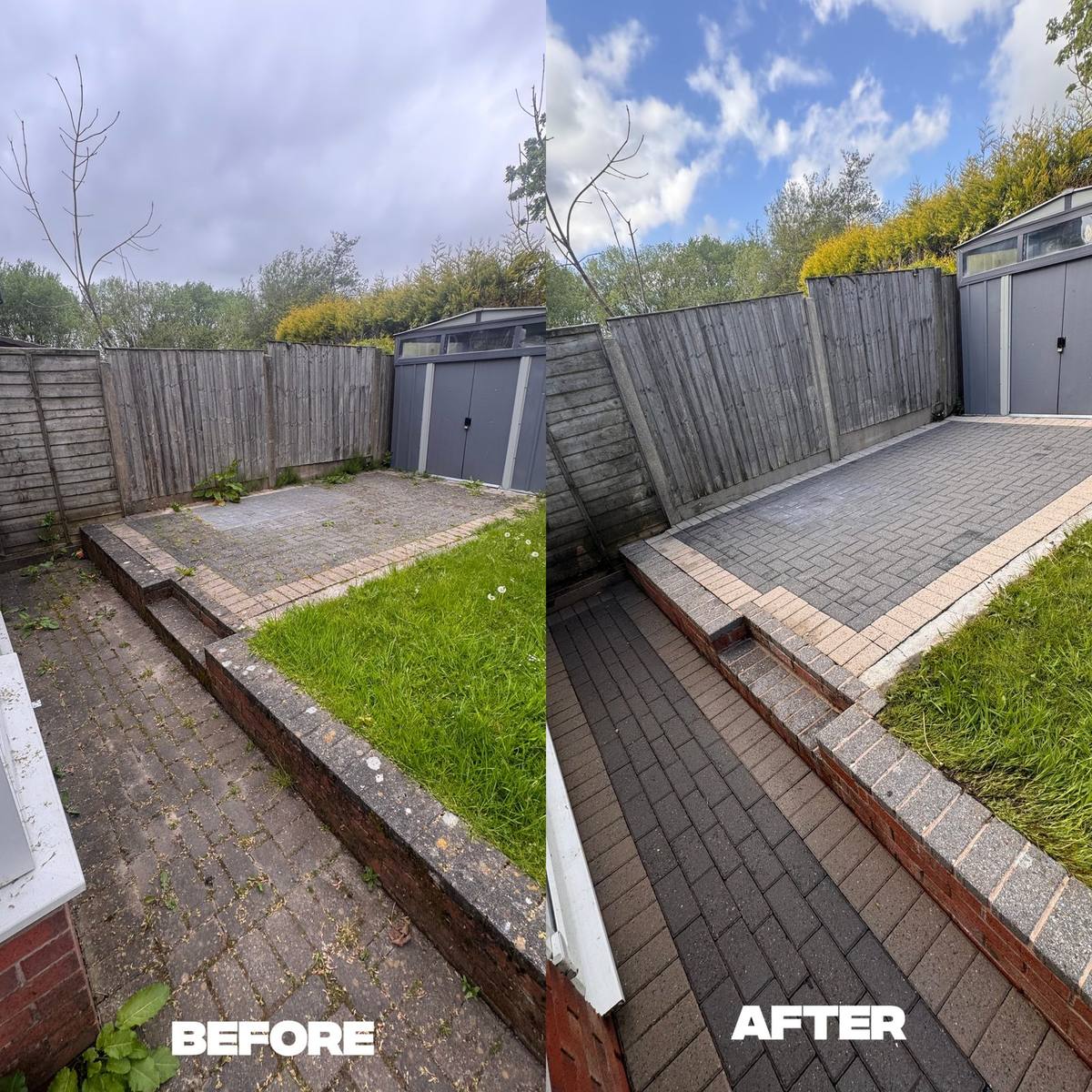
Rear yard block paving cleared of weeds, moss and years of grime. One visit.
Quick answer: A yard pressure washing service removes ingrained dirt, algae, moss and weeds from driveways, patios, paths and block paving using professional-grade equipment and surface cleaners. A good service leaves even coverage, no track marks and no damage to jointing sand — results a domestic machine rarely achieves.
What a Yard Pressure Washing Service Actually Involves
Most people picture a tradesperson with a lance blasting water at the floor. That's part of it, but a proper yard pressure washing service involves more than that. The job typically starts with a pre-treatment — a diluted biocide or detergent solution applied to the surface and left to dwell for ten to twenty minutes. That dwell time allows the chemical to break down algae, lichen and biological matter at the root rather than just cutting through the visible layer on top. Skipping this step is one of the main reasons green growth returns within weeks of a clean.
After pre-treatment, the main cleaning is done with a rotary surface cleaner rather than a direct lance in most cases. A rotary head maintains consistent pressure across the whole surface and avoids the track marks and uneven cleaning patterns that a freehand lance leaves on flags or concrete. Pressure settings vary by surface — more on that below — but the key point is that a good operator is adjusting throughout the job, not just pointing water and hoping for the best.
Finishing matters too. Loose debris is cleared, edges are detailed, and on block paving the joints need assessing for sand loss. If jointing sand has been blasted out during cleaning, that needs addressing before the job is considered done. You can read more about that process in our guide on how to clean block paving properly.
Why Your Yard Gets Into This State in the First Place
North West England is one of the wetter parts of the country, and Greater Manchester in particular gets consistent rainfall throughout the year rather than concentrated in one season. That sustained moisture is exactly what algae, moss and liverwort need to colonise paved surfaces. Shaded yards — north-facing, hemmed in by walls or overhanging trees — retain moisture for longer and tend to green up significantly faster than open, south-facing areas.
The biology is fairly simple. Airborne algae spores land on a porous surface, find moisture and organic material, and begin forming a colony. Once established, algae creates the ideal conditions for moss to follow, and over time the surface becomes progressively darker, more slippery and harder to shift with ordinary cleaning. The grout lines and texture of block paving and natural stone make particularly good habitats because they trap organic debris that feeds further growth.
Understanding this cycle matters because it sets realistic expectations. A clean yard in Oldham or Rochdale is likely to show early signs of regrowth within six to twelve months without any treatment to slow it. That's not a failure of the cleaning — it's just the environment. Annual maintenance is a reasonable cycle for most properties in this region.
Block Paving, Flags, Concrete and Tarmac — One Service, Different Approaches
Not every paved surface responds the same way to pressure washing, and using the wrong approach causes damage. Block paving is porous and holds kiln-dried sand in its joints — too much pressure blasts that sand out and leaves joints open to weed colonisation. The right approach is a moderate rotary clean at controlled pressure, working methodically so the surface is treated evenly. Our full guide on block paving cleaning explains the specifics in more detail.
Natural sandstone flags are softer than concrete products and can pit or spall under excessive pressure, particularly older or frost-damaged slabs. These typically need a lower-pressure clean with a stronger chemical pre-treatment to compensate. Imprinted concrete is similar — the surface can be cleaned effectively, but the sealer is almost always degraded by the process, so resealing is a practical necessity after cleaning rather than an optional extra. If you're unsure how pressure affects your specific surface, our guide on whether pressure washing can damage your paving is worth reading before you decide anything.
Tarmac driveways and plain concrete are generally more forgiving, though tarmac can soften and mark under sustained high pressure in warm weather. The general principle across all surfaces is the same: the right pressure for the material, adequate pre-treatment, and a finishing pass that doesn't leave the surface in a worse condition than you started.
Re-Sanding and Sealing: The Step Most People Skip
Pressure washing block paving removes jointing sand. Some of it was already compromised before the clean, but the cleaning process accelerates the loss regardless. Leaving joints empty after a clean is one of the most common mistakes — within a few weeks, wind-blown seeds settle into the open joints, and within a season you're back to weed growth. Re-sanding with kiln-dried sand is the correct finish to a block paving clean. It's a straightforward process but it needs to be done while the surface is dry, worked in with a brush and plate compactor, and the excess swept away cleanly. Our block paving re-sanding page covers the process in full.
Sealing is a separate question, and the honest answer is that it depends on your specific situation. A good quality penetrating sealer can slow biological regrowth, make future cleaning easier and protect against oil and fuel staining on driveways. However, some sealers alter the appearance of the surface in ways not everyone likes — a wet look finish on natural stone isn't universally popular — and all sealers degrade over time and eventually need reapplying. For a typical Greater Manchester yard that gets reasonable use and will be maintained annually, sealing is worth considering but isn't essential. For a driveway with significant oil staining or a patio that's heavily shaded, it makes more practical sense.
Kiln-dried sand must go into completely dry joints. If you re-sand in damp conditions or before the surface has fully dried after cleaning, the sand compacts in the joint rather than filling it evenly — and you'll end up replacing it again within a few months. On a typical Greater Manchester day, that means waiting for a run of dry weather before finishing the job properly.
How Much Does a Yard Pressure Washing Service Cost in Greater Manchester?
Pricing varies with surface type, condition and what the job involves, but to give you realistic figures: block paving cleaning starts from around £3.50 per square metre for a straightforward clean. If the surface needs a chemical treatment alongside the clean — which most algae-affected yards do — that's typically £4.25 per square metre. A full restoration including re-sanding runs to around £5.50 per square metre, and re-sanding alone on a previously cleaned surface is around £2.00 per square metre.
For a typical terraced back yard in Oldham or Rochdale — around 20 to 30 square metres — a clean with treatment will generally come out between £85 and £130 depending on condition and access. A larger driveway or combined front-and-back clean on a semi-detached property will sit higher, often in the £200 to £350 range depending on size and what the surface needs. These are honest working figures, not teaser rates — the actual quote depends on what your photos show.
The quickest way to get an accurate number is to send a few photos over WhatsApp. That usually gives enough information to quote accurately without needing a site visit first, which keeps the process straightforward for everyone.
When DIY Isn't Enough and It's Time to Call a Professional
A consumer pressure washer — the kind available from DIY sheds for £80 to £200 — runs at a fraction of the flow rate and pressure of trade equipment. For knocking mud off garden furniture or rinsing a car, it's adequate. For genuinely cleaning paving that's been left for several years, particularly with established algae and moss, it typically can't do the job thoroughly. The tell-tale signs are track marks left across the surface, areas that appear clean when wet but revert to green within days, and sand loss from block paving joints that keeps recurring because the surface is never fully clean to begin with.
There are also surfaces where consumer pressure washing is actively inadvisable. Render, for example, should not be pressure washed at all in most cases — the correct approach is softwashing with sodium hypochlorite, which kills the biological growth chemically without the mechanical stress that pressure causes. If you're dealing with a rendered wall, our guide on softwash versus pressure washing for render explains why that distinction matters. Similarly, roof tiles and roof surfaces need a controlled softwash approach — you can read more about that on our roof cleaning and moss removal page.
C&C Precision Pressure Washing covers the whole of Greater Manchester and can usually give a quote from photos sent over WhatsApp the same day. If the job is something a consumer machine could handle adequately, we'll tell you that honestly rather than take work that isn't worth your money.
Three Things to Do After Your Yard Has Been Cleaned
The most useful thing you can do in the weeks following a clean is deal with any biological regrowth early. A diluted sodium hypochlorite solution — available from cleaning suppliers — applied to early signs of algae greening will kill it before it takes hold again. This is far easier than waiting until the surface is fully colonised. Don't use household bleach at full strength on paving; it's not effective at the concentrations sold for domestic use and can streak certain stone types.
Check the jointing sand level a few weeks after a clean, particularly after a period of rain. Some settlement is normal, and topping up joints with kiln-dried sand before they fully empty is much easier than waiting until weeds have moved in. A stiff brush to work the sand in is all that's needed for a minor top-up.
Finally, once a year — usually late winter or early spring before growth season — give the surface a walk over and note where moss or algae is beginning to establish again. Catching it early with a biocide treatment means the annual maintenance clean is straightforward rather than remedial. How often you need a full clean depends on shade, surface type and how well it's maintained in between — our guide on how often patios should be cleaned goes into this in more detail if you're working out a maintenance schedule.
Frequently asked questions
How long does a yard pressure washing service take?
Most standard back yards or driveways take between one and three hours depending on size, surface type and how much organic growth has built up. A combined front and back clean on a larger property can run to a full day. We'll always give you a realistic time estimate when you send your photos over.
Will pressure washing damage my block paving or patio slabs?
Done correctly with the right pressure settings and a rotary surface cleaner rather than a direct lance, it won't damage sound block paving or patio flags. Where damage does happen it's usually because too much pressure was used on already-compromised surfaces, or jointing sand was blasted out and never replaced. We adjust our approach to the surface we're working on.
How soon will moss and weeds grow back after a clean?
In Greater Manchester's climate, some regrowth is inevitable — typically within six to twelve months on an untreated surface. Re-sanding block paving after a clean closes the joints weeds use to take hold, and a biocide treatment can slow algae returning on patios and paths. Most customers find an annual clean keeps things looking consistently good.
Do you cover my area in Greater Manchester?
We're based in Oldham and cover the whole of Greater Manchester including Rochdale, Bury, Bolton, Manchester, Tameside, Stockport and surrounding towns. If you're not sure whether you're in our area, just drop us a message — if we can get to you we will, and if not we'll tell you straight.
Want a fast price on your yard?
Send a couple of photos over WhatsApp and we'll come back to you with a straight price — no faff, no sales call.