If you've found yourself wondering how often should patios be cleaned, you're not alone. It's one of the most common questions we hear, and the honest answer is that it depends on your surface, your garden and where you live. There's no single right answer that fits every patio in every corner of the country, but there are some clear guidelines that apply to most homes in the North West.
What we can say with confidence is that leaving it to chance — cleaning whenever it starts to look bad enough to act — usually means you're already behind. Algae, moss and black spot fungus don't wait for a convenient time to appear, and once they're established they become harder and more expensive to remove. Understanding the factors that affect how quickly your patio deteriorates is the most useful thing you can do for it.
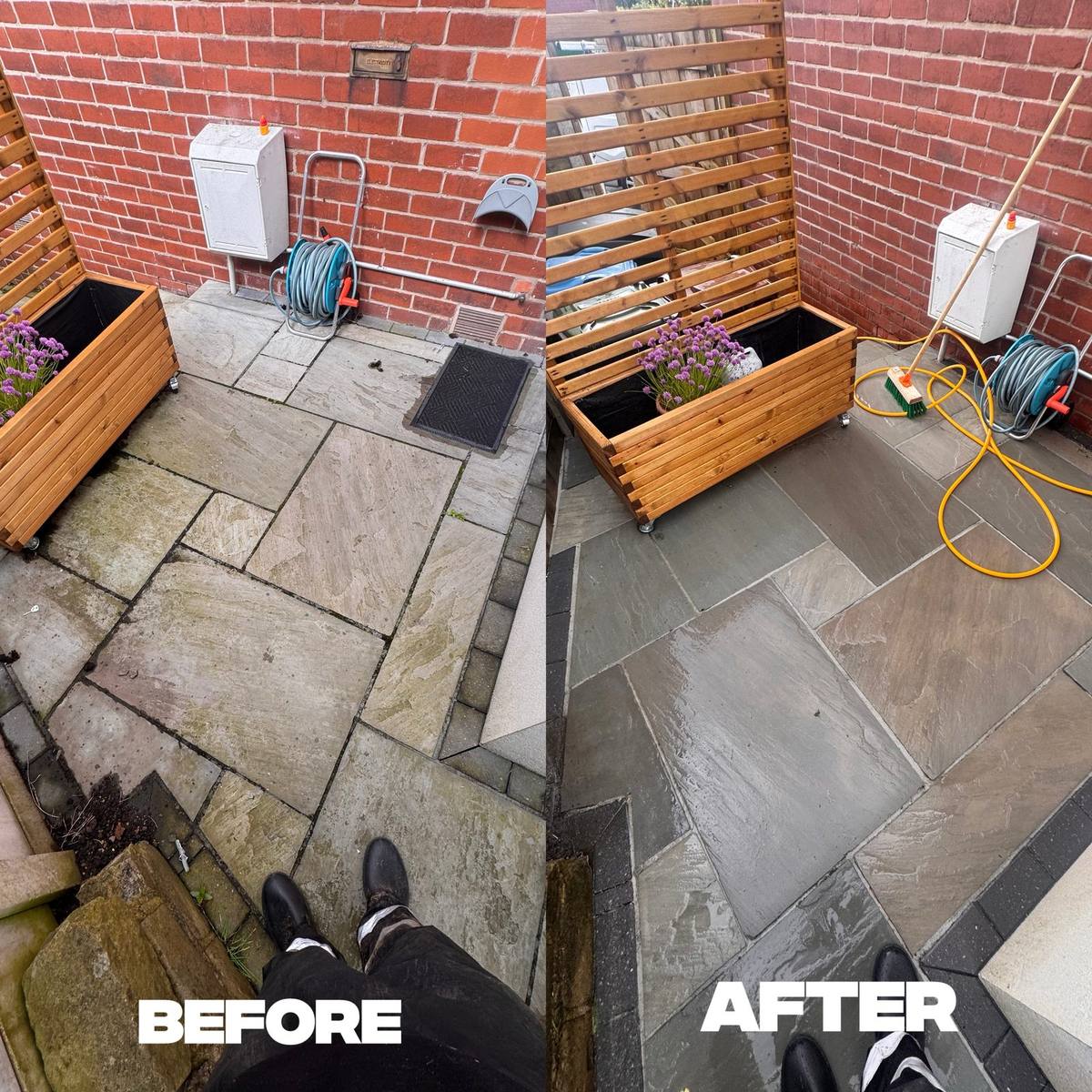
Indian sandstone patio in Greater Manchester — one annual clean keeps black spots and algae from taking hold.
Quick answer: Most patios should be professionally cleaned once a year, ideally in spring or early summer. Stone, concrete and block paving in damp northern climates like Greater Manchester can develop algae, moss and black spots quickly, so annual cleaning keeps surfaces safe, smart and structurally sound.
The Short Answer: Once a Year for Most Patios
For the majority of homeowners, a professional patio cleaning session once every 12 months is the right baseline. Annual cleaning sits in a practical sweet spot — frequent enough to stop biological growth from becoming deeply embedded, but not so frequent that you're spending money on a surface that doesn't yet need it.
A yearly clean also means the job stays manageable. A patio that's cleaned annually tends to respond well to treatment and comes up properly clean. One that hasn't been touched in three years often needs significantly more time, stronger chemistry and sometimes follow-up work — which means higher cost and occasionally results that fall short of what the homeowner was hoping for. Some deep staining lightens rather than disappears entirely, and the longer it's been left, the more likely that is to be the case.
So if you're looking for a single answer to how often should patios be cleaned, once a year is a reasonable, evidence-based starting point for most materials in most gardens. The sections below explain why that frequency might shift up or down depending on your specific situation.
Why the North West Climate Makes Patios Dirtier, Faster
Greater Manchester is not a forgiving environment for outdoor surfaces. The region is persistently damp, frequently overcast, and rarely gets the sustained dry periods or strong direct sunlight that would naturally inhibit biological growth. Those conditions — consistent moisture, limited UV exposure, mild temperatures — are almost ideal for algae, moss and lichen to colonise hard surfaces. If you're in Oldham, Rochdale, Bury or anywhere else in the Greater Manchester area, your patio is working against the climate from the moment it's laid.
Homeowners in drier parts of the UK, particularly in the south and east, can sometimes stretch to 18 months or even two years between cleans without seeing significant deterioration. That's rarely realistic here. The rain arrives regularly, water sits in joints and surface textures, and growth takes hold quickly — often visibly within a single season if conditions are right.
This is worth keeping in mind if you're comparing advice from general gardening guides written with a national or southern bias. The question of how often should patios be cleaned genuinely has a different answer in Greater Manchester than it does in Surrey, and erring toward annual rather than biennial cleaning is the sensible approach for most households in this part of the country.
How Cleaning Frequency Varies by Patio Surface
Indian sandstone and other natural stones are among the most porous materials used in garden patios, and they need the most attention. Moisture — and with it, organic spores — absorbs into the surface rather than running off, which means algae and black spot fungus can take hold below the visible surface layer. Annual cleaning is the minimum for sandstone in most North West gardens, and shaded or north-facing patios may need attention every nine months or so. Our stone cleaning service deals regularly with surfaces that have been left until the staining is embedded rather than surface-level, and the difference in the work required is significant.
Porcelain patio tiles are far less porous and generally the lowest-maintenance option. They don't stain in the same way as natural stone, but they still get a slippery algae film across them — particularly in damp, shaded conditions — and they look noticeably grubby if left for too long. Porcelain can usually be stretched to every 18 months in reasonably open, well-lit gardens, but annually is still tidier and keeps the surface safer underfoot.
Block paving has its own particular challenges. The joints between blocks are where moss and weeds take hold, and once the jointing sand starts to fail — either washed out by rain or broken down by root growth — water pools in the gaps and the problem accelerates. Block paving cleaning typically runs from around £3.50/m² for a straightforward clean up to £4.25/m² when chemical pre-treatment is needed for heavier growth, and £5.50/m² for a full restoration including re-sanding. If the joints are already failing, block paving re-sanding on its own is around £2.00/m² and makes a meaningful difference to how well the surface holds up going forward. Concrete flags green over quickly and are generally best cleaned annually.
Other Factors That Affect How Often Your Patio Needs Cleaning
Shade is probably the single biggest variable. A patio that sits in full sun for most of the day dries out quickly after rain and gets enough UV to slow biological growth. A patio that spends most of its time in the shadow of a fence, a house wall or a large tree stays damp far longer, and growth returns much faster. North-facing patios in particular can look as though they need cleaning six months after a professional visit.
Overhanging trees introduce another layer of problems. Falling leaves, especially from trees like oaks or sycamores, break down and release tannins that stain porous surfaces. Debris settles in joints, holds moisture, and provides organic matter that encourages moss spores to germinate. If your patio sits beneath or beside mature trees, expect to be cleaning more often — and to need more thorough treatment when you do.
Foot traffic matters too. A patio that sees heavy use — children, dogs, regular entertaining — has soil, grass and debris ground into it consistently. A rarely-used patio at the back of a garden might green over without accumulating the same surface grime, but it also benefits less from the natural disruption that keeps growth from settling. Either way, the practical reality is that some patios simply need attention every six to nine months, and inspecting yours each spring and autumn will tell you more than any fixed schedule.
What Happens If You Leave It Too Long
The consequences of leaving a patio for two or three years without a proper clean are real, and worth being straight about. Algae that starts as a light green film becomes deeply embedded in porous surfaces over time. Black spot fungus — a particular problem on Indian sandstone — pushes below the surface layer and can leave permanent marking even after professional cleaning. Surfaces that were once cleanable to near-original condition become surfaces where the honest answer is that they'll look better but won't look perfect.
For block paving, neglect compounds quickly. Moss in the joints breaks down the sand that holds the blocks stable, water infiltrates below the surface, and the structural integrity of the paving starts to be affected. What might have been a straightforward clean becomes a clean plus full re-sanding — more time, more cost, more disruption.
There's also a safety dimension that's worth mentioning plainly. Algae-covered patios become genuinely slippery when wet, which in a wet climate like ours means they're a hazard for most of the year. If you've found yourself stepping carefully across your own patio, it's already overdue. Our guide on how to clean slippery garden paths safely covers this in more detail if it's relevant to your situation.
When to Stop DIY and Call in a Professional
A garden brush and a hose are useful for keeping loose debris off a patio between professional visits, and that's genuinely worth doing. But they have a hard ceiling. They shift surface dirt; they don't remove embedded algae, black spot fungus or deep organic staining. A domestic pressure washer can do more, but it carries its own risks — too much pressure on soft or porous stone can damage the surface, and on block paving it strips out jointing sand that then needs replacing. If you're not certain about what pressure and nozzle angle your surface can take, it's easy to cause damage that costs more to fix than a professional clean would have. Our guide on whether pressure washing can damage your paving is worth reading before you reach for the machine.
The signs that a job is beyond DIY are fairly clear: persistent green or black growth that returns within weeks of brushing down, a surface that's slippery underfoot even after you've cleaned it, jointing that's crumbling or missing in patches, or any patio that hasn't had a proper professional treatment in over two years. These aren't cosmetic problems that a bit of elbow grease will resolve. C&C Precision Precision Washing covers the whole of Greater Manchester — you can send photos over WhatsApp and get a fast, honest quote without any obligation.
If you're not sure whether your patio needs professional attention, take a close look at the joints and the north-facing edges first. These are where growth takes hold earliest. If you see moss, crumbling sand or a black discolouration that doesn't brush away, it's worth getting it looked at before the problem goes any deeper into the surface.
Simple Steps to Keep Your Patio Cleaner Between Professional Visits
The most useful thing you can do between professional cleans is remove debris before it breaks down. Leaves left to decompose on stone or block paving release acids and tannins, and provide the organic matter that moss and algae need to establish. A brush-over once a week during autumn takes a few minutes and makes a real difference to how quickly growth returns.
Keep joints clear of weeds as soon as you spot them, before the roots go deep. A hand tool or a flat-bladed weeder is fine for this — you don't need chemicals for early-stage weed growth in joints. Pulling them before they establish means the jointing sand stays intact longer, which in turn means the block paving stays stable and is easier to clean properly when the time comes.
Standing water is worth dealing with where you can. If your patio has a low point where water pools after rain, that area will green over far faster than the rest. Sometimes this is a drainage issue that can be addressed when the patio is next cleaned and re-sanded; sometimes it's just a case of brushing water toward the drain after heavy rainfall. Either way, reducing how long moisture sits on the surface slows biological growth noticeably. Finally, if your surface type is suitable — porcelain, denser natural stone and some concrete products respond well — a sealant applied after a professional clean can meaningfully reduce how quickly dirt and algae return, and makes the next clean easier. It's not right for every surface, so it's worth asking when you get your quote.
Frequently asked questions
How often should an Indian sandstone patio be cleaned?
Indian sandstone should be cleaned professionally at least once a year because it's a porous surface that absorbs moisture and organic material quickly. In shaded or north-facing gardens in Greater Manchester, black spot fungus and algae can become visible within a single season. Leaving it longer than 18 months risks staining that's much harder and more expensive to shift.
Can I clean my patio myself instead of hiring a professional?
You can keep on top of loose debris with a brush and garden hose, and that's worth doing between professional cleans. But a domestic pressure washer is often underpowered for embedded algae and can actually damage jointing sand in block paving or lift the surface of softer stone if used incorrectly. For a genuine deep clean — especially if there's green growth, black spots or staining — a professional with the right equipment and knowledge of your surface type will get a far better result.
Is once a year enough, or should I clean my patio more often?
Once a year is the right starting point for most patios, but some need attention every six to nine months. If your patio is heavily shaded, surrounded by trees, or made from a porous material like sandstone, you'll likely see growth return faster. A quick check each spring and autumn will tell you what your patio actually needs rather than sticking to a rigid schedule.
Does a professional patio clean last longer than doing it yourself?
Yes, noticeably so. Professional equipment — particularly rotary surface cleaners and the correct pre-treatment chemicals — removes biological growth at the root rather than just knocking back the surface layer. That means regrowth is slower and the clean finish lasts longer. Some surfaces can also be treated with a sealant after cleaning, which adds further protection and reduces how quickly dirt and algae return.
Not sure how bad your patio has got?
Send us a photo on WhatsApp and we'll give you a straight answer and a fast quote — no fuss.