If your render has gone green, black, or patchy over the past few years, you're not alone. The North West's damp climate — long wet winters, mild temperatures, and plenty of overcast days — creates near-ideal conditions for algae, moss, and mould to take hold on external walls. Render cleaning in Manchester is one of the more common enquiries we receive, and most of it comes down to the same problem: biological contamination that builds up slowly until the wall looks decades older than it is.
The question most people ask first is whether they can just hire a pressure washer and blast it off. It's an understandable instinct — pressure washing works well on driveways and patios, so why not render? The answer matters more than most people realise, and getting it wrong can turn a cosmetic problem into a structural one.
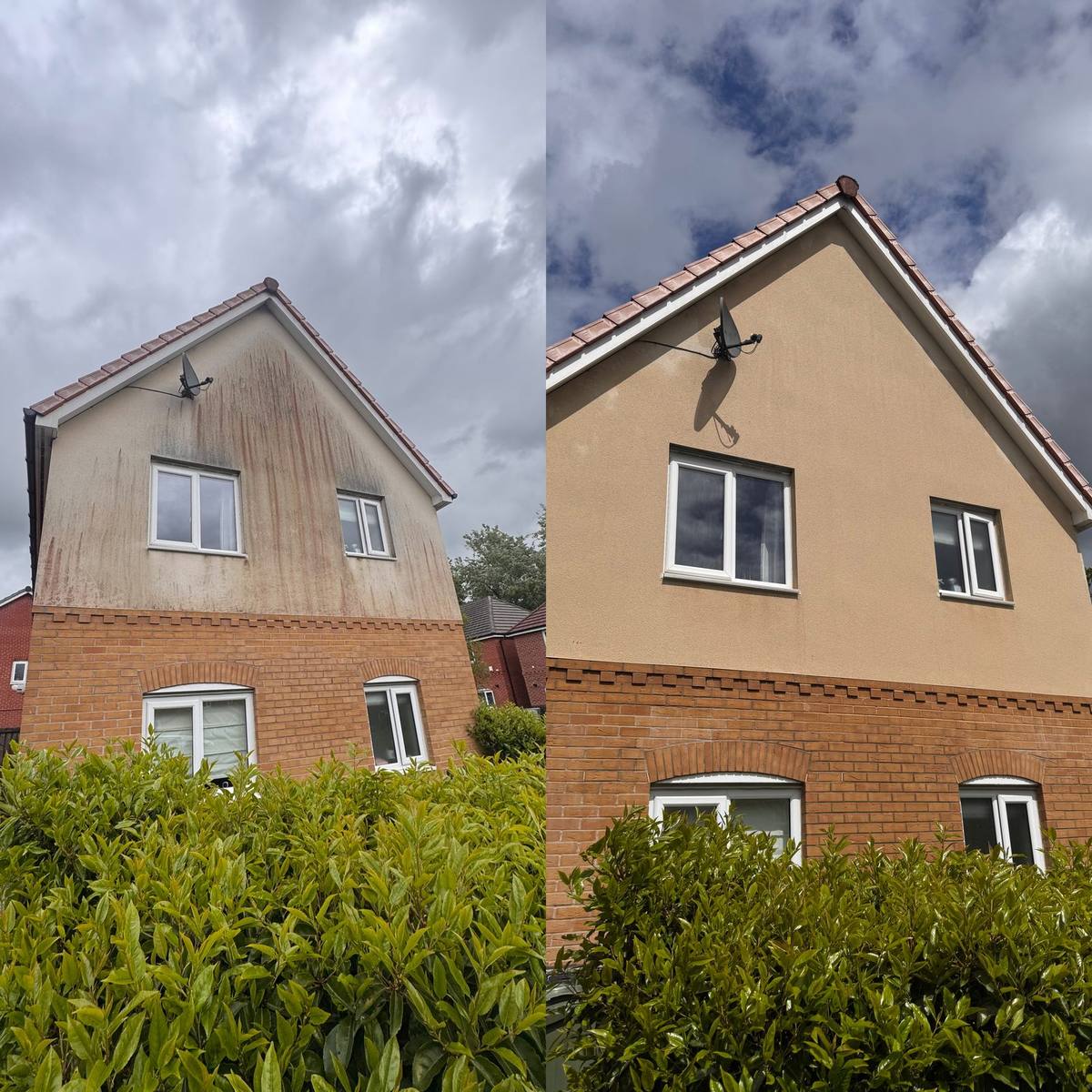
Before and after softwash render cleaning on a Greater Manchester home — red algae gone without touching the surface with high pressure.
Quick answer: Pressure washing render risks cracking the surface, forcing water behind the coating, and stripping the finish — especially on K-Rend and monocouche. Softwashing uses a low-pressure sodium hypochlorite solution to kill algae, moss, and black mould at the root, leaving render clean without any physical damage.
What Happens When You Pressure Wash Render
Render is not a solid, impermeable material. Even in good condition, it has a degree of porosity, and most modern finishes rely on a factory-set surface texture to shed water effectively. When you apply high-pressure water directly to render, you're not just cleaning the surface — you're forcing water into it at speed. That pressure can open hairline fractures that were previously stable, drive moisture behind the render coat, and begin to undermine the bond between the render and the substrate beneath.
The result isn't always visible immediately. A freshly pressure-washed wall can look clean for a few weeks, then start to show damp patches, bubbling, or hollow spots as trapped moisture works its way through the system. In older properties across Greater Manchester — Victorian terraces, 1930s semis, post-war pebbledash — the render may already have minor cracks or areas of movement. High-pressure washing accelerates any existing weakness rather than revealing it.
Beyond the structural risk, there's a practical one. Blasting biological growth off a wall with water doesn't kill it — it distributes it. Algae spores land on surrounding surfaces, and the organisms left in the pores of the render simply regrow, often faster than before because the surface has been roughened by the pressure. You end up with a wall that looks worse within a year than it did before you started.
The Types of Render Most at Risk
Traditional sand-and-cement render — the kind found on older properties across Rochdale, Bury, and Tameside — is relatively thick and has some tolerance for lower-pressure cleaning, though it's still not ideal. The renders that are most vulnerable are the thin-coat modern systems: K-Rend, Weber, and other monocouche products. These are single-coat finishes applied at around 15–20mm, and their surface texture is set during the application process. That texture is both the finish and the weathering layer — once it's gone, it's gone.
Tyrolean render — the rough, spattered finish common on 1950s and 1960s properties — and traditional pebbledash are also at risk from high pressure, though for slightly different reasons. With pebbledash, the aggregate is pressed into a base coat while it's still green. Pressure washing can dislodge stones from the surface, leaving bare patches that are difficult and expensive to match. With Tyrolean, the splatted peaks of the texture are fragile and break off under direct pressure.
If you're unsure what type of render your property has, a local contractor with experience of render cleaning in Manchester should be able to identify it from a photograph before any work begins. The method used should always follow from the render type — not the other way around.
What Softwashing Actually Is (and How It Works)
Softwashing is a cleaning method that uses a diluted sodium hypochlorite solution — the same active ingredient found in bleach, but mixed to a specific working concentration and applied at very low pressure, often no more than a standard garden hose. The chemical does the work, not the water pressure. It penetrates the biological growth, kills algae, lichen, moss, and mould at a cellular level, and breaks down the organisms so they can be rinsed away or simply weather off in subsequent rainfall.
The key difference between softwashing and pressure washing is that softwashing addresses the cause rather than the symptom. Algae and moss colonise render because the surface provides a damp, shaded environment with enough organic matter to sustain growth. Pressure washing removes the visible layer; softwashing kills the root structure and leaves a biocidal residue that slows recolonisation. You can read more about the process on our softwashing service page.
Application is typically done using a low-pressure pump or dedicated softwash rig. The solution is applied to the surface and left to dwell — the dwell time varies depending on the concentration used and the type of biological contamination present. Heavy lichen, which anchors itself into the surface, may need a longer dwell and sometimes a second application. Once the solution has done its work, the surface is rinsed down at low pressure. The whole process is quieter, gentler, and considerably less dramatic than pressure washing, which sometimes surprises customers watching it for the first time.
What Results Look Like on Real Manchester Homes
The contamination patterns we see most often across Greater Manchester follow a predictable logic. North-facing elevations get the least sun and dry out slowest, so they tend to develop the heaviest green and black algae growth. East-facing walls pick up the morning damp and often show streaky green runs below window sills and roof lines. Properties with overhanging trees, or those close to water — a canal, a stream, a poorly drained garden — almost always have worse contamination on the affected side.
Red algae is common on lighter-coloured renders and tends to look like a rust-coloured blush that spreads gradually across the surface. Black mould typically appears as spotting or streaking below gutters and down-pipes where water sits longest. Green algae is the most widespread and can cover an entire elevation within a couple of years in the right conditions. Before softwashing, these walls often look as though the render is failing or stained permanently. After a proper clean, the same walls frequently look close to the original colour — though it's worth being honest that very old, deep-set contamination may lighten rather than vanish entirely, particularly on textured surfaces where organisms have grown into the surface over many years.
Customers sometimes ask whether the result is instant. It isn't always — and that's actually a sign the chemistry is working correctly. Within a day or two of application, the algae begins to die and lose its colour. Over the following week or two, rain and drying cycles wash the dead material away progressively. The full result is usually visible within a fortnight.
How Long Does Softwashed Render Stay Clean?
This is where softwashing offers a clear practical advantage over any mechanical cleaning method. Because the sodium hypochlorite kills the biological organisms rather than simply removing them, the surface stays cleaner for longer. Most softwashed render in the Greater Manchester area remains visibly clean for three to five years before contamination builds back to a noticeable level, though this varies depending on aspect, shade, and the immediate environment.
A north-facing wall in a sheltered garden with trees overhead will recolonise faster than a south-facing elevation on an open street. Renders with a rougher texture — Tyrolean, pebbledash, or coarser monocouche finishes — give algae more surface to grip and tend to need attention sooner than smooth finishes. Properties near water or in lower-lying parts of the region, where humidity stays higher, will also see faster regrowth. These aren't reasons to avoid softwashing — they're just honest variables that affect how long any clean lasts.
Pressure washing, by contrast, leaves no biocidal residue and often roughens the surface slightly, which accelerates recolonisation. Many customers who have had their render pressure washed in the past find themselves looking at the same problem within twelve to eighteen months. That's not just frustrating — it adds up to more spend over time for a worse result.
When You Should Call a Professional Render Cleaner
DIY softwash kits are available online, and on paper the process sounds straightforward. In practice, getting the sodium hypochlorite dilution wrong causes real problems. Too strong and you risk bleaching UPVC window frames and fascias, damaging sealants around windows and doors, killing surrounding plants, or leaving pale streaks across the render surface that are difficult to correct. Too weak and the solution won't penetrate heavy biological growth, leaving you with a partially cleaned wall and a wasted afternoon.
There are also access considerations. Most domestic properties in Greater Manchester are two storeys, and reaching gable ends or upper elevations safely requires either scaffold, a cherry picker, or professional extension equipment. Working at height with a pump system and chemical solution is not a sensible DIY combination without the right training and equipment. If your render already shows hairline cracking, bulging, or areas that sound hollow when tapped, a professional should assess it before any cleaning begins — cleaning a wall that needs structural repair first is a waste of money and can make the underlying problem harder to diagnose.
If the contamination is heavy, the surface area is large, or the property has any difficult-access elevations, calling a professional render cleaner in Manchester is the straightforward option. C&C Precision carries £1,000,000 public liability insurance and covers the full Greater Manchester area — if you want to know what a clean would cost on your property, the quickest way is to send a couple of photos on WhatsApp for a same-day quote.
Practical Advice Before You Book Any Render Clean
Before you agree to any work, find out exactly what method the contractor intends to use. Ask directly: are you softwashing or pressure washing? If the answer is pressure washing, or if they seem unclear on the distinction, that's useful information. Any contractor experienced in render cleaning in Manchester should be able to tell you immediately which method is appropriate for your render type and why.
Before any softwash treatment begins, thoroughly soak all plants, shrubs, and lawn areas within splashing distance with plain water. This dilutes any overspray on contact. Cover particularly vulnerable plants with plastic sheeting if they're directly adjacent to the wall, and rinse everything down again once the job is finished. A good contractor will do this as a matter of course — but it's worth confirming in advance.
Check that the contractor is insured. Public liability cover is non-negotiable when chemical cleaning is involved — sodium hypochlorite can cause damage to adjacent surfaces, vehicles, and gardens if it's applied carelessly, and you want to know that's covered. Ask for the certificate, not just a verbal assurance. On the day of the clean, move any vehicles away from the property, close windows, and let the contractor know about any recent sealant work around windows or doors — fresh sealant can be sensitive to chemical contact.
If you're getting quotes from multiple contractors, send the same photos to each and ask each one to confirm the method they'd use. If you receive quotes that vary significantly, ask why — the answer will usually tell you something about the approach. Getting the method right matters more than getting the cheapest price. A softwash job done properly should last three to five years; a pressure wash job done cheaply might last eighteen months and leave your render in worse condition than before. For further detail on how quotes for exterior cleaning work in practice, our guide on how exterior cleaning quotes actually work is worth a read before you commit.
Frequently asked questions
Can you pressure wash K-Rend or monocouche render?
No — K-Rend and monocouche are thin-coat finishes with a factory-applied texture. High-pressure washing strips that texture, opens the surface to water ingress, and voids any warranty on the render. The correct method is low-pressure softwashing with a biocidal solution.
How much does render cleaning cost in Manchester?
For most semi-detached homes across Greater Manchester, a full softwash render clean typically runs from around £150 to £350 depending on the size, height, and degree of contamination. The fastest way to get an accurate price is to send a couple of photos on WhatsApp — we can usually quote the same day.
How long after softwashing will my render look clean?
The solution starts killing biological growth on contact, but render doesn't always look its best immediately — heavy algae and lichen can take a few days of rain and drying to fully clear as the dead organisms wash away. Most customers see the full result within one to two weeks.
Will softwashing damage my plants or garden?
Sodium hypochlorite can harm plants if applied carelessly, so a professional softwash job includes wetting down surrounding plants and masking vulnerable areas before application and rinsing them off thoroughly afterwards. We always factor this into the job — it's standard practice, not an afterthought.
Not sure what's growing on your render?
Send a photo on WhatsApp and we'll tell you exactly what method it needs and give you a fast, honest price.