If you've been searching for driveway cleaning in Stockport, you've probably noticed that driveways around here don't stay clean for long. The climate does most of the damage — persistent damp, low winter light and the kind of overcast skies that rarely give surfaces a proper chance to dry out. Algae, moss and general grime build up steadily, and by the time most people decide to do something about it, the driveway has been looking tired for a year or two already.
This guide covers what's involved in a professional driveway clean, which surfaces we work on, what the job actually looks like on the day, and how to get an accurate price without having to wait for a site visit. There are no hard sells here — just a straightforward breakdown of what the work involves and what you can realistically expect from it.
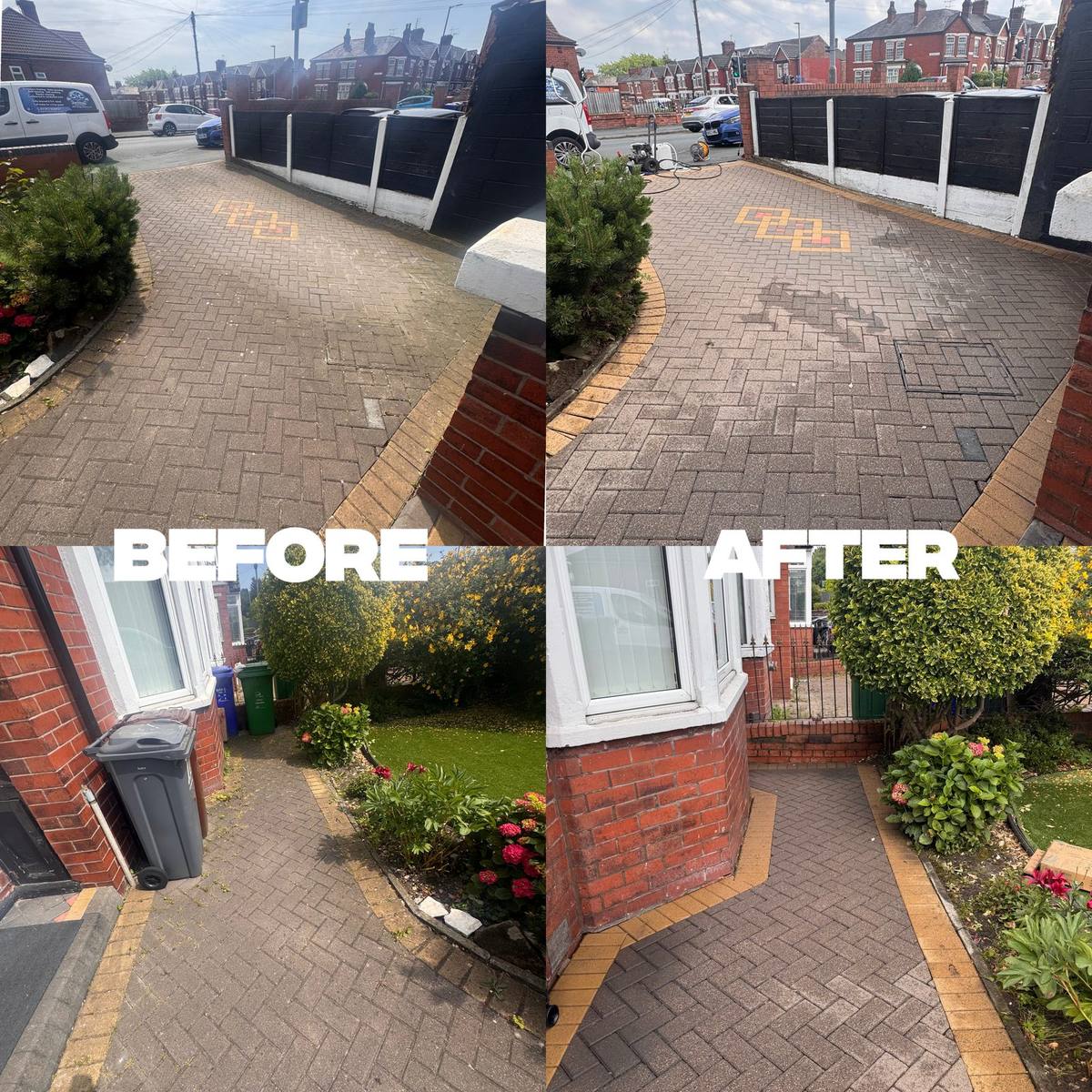
A typical wide driveway transformation — pressure washed and cleared of years of built-up grime.
Quick answer: Driveway cleaning in Stockport typically costs between £80 and £250 depending on size, surface type and condition. A professional will pressure wash the surface, clear moss and weeds, and can re-sand block paving joints. Most driveways are completed in a single visit, usually within a few hours.
Why Stockport Driveways Get Dirty So Fast
Stockport sits at the western edge of the Pennines, and the rainfall figures reflect that. The town gets significantly more precipitation than southern England, and more importantly, surfaces stay wet for longer. That persistent moisture is exactly what algae and moss need to take hold. A driveway that's in good shape in March can be visibly green by June, and heavily soiled by autumn. This isn't a maintenance failure on the homeowner's part — it's simply what happens when you live in the North West.
North-facing driveways are particularly affected because they get little or no direct sun during the winter months. Without UV light and evaporation to keep them dry, these surfaces stay damp almost continuously from October through to March. Heavy tree coverage compounds the problem further — leaves, seed pods and bark debris hold moisture against the surface and provide organic matter that feeds biological growth. What starts as a faint green tint becomes a slippery, embedded layer that's genuinely hazardous underfoot.
Ignoring the problem makes it significantly harder to fix later. Lichen, in particular, anchors itself into the surface over time and becomes progressively more stubborn to remove. Some older lichen staining will lighten rather than disappear completely, even with professional equipment — that's worth knowing before you book anyone. Catching biological growth early, while it's still algae rather than established lichen, gets the best results and tends to cost less.
What Types of Driveway Do We Clean?
Most driveways in Stockport fall into one of five categories: block paving, concrete, tarmac, resin-bound aggregate, or natural stone such as sandstone or Indian slate. We work on all of them, but the approach isn't identical across the board. Surface type matters — both for the pressure and technique used, and for the chemical treatments that are appropriate.
Block paving is by far the most common surface we deal with. It responds well to pressure washing with a surface cleaner and usually benefits from re-sanding afterwards. Concrete is tough enough to handle a hot wash where needed and often has embedded oil staining that requires a pre-treatment dwell before pressure washing begins. Tarmac is softer than people expect and needs a more controlled pressure to avoid surface disturbance. Resin-bound driveways are cleaned at lower pressure to protect the aggregate — the wrong technique strips the surface and can't easily be undone. Natural stone, which you'll see on a lot of the older and more recently renovated properties around Stockport, is typically treated gently and may benefit from a biocide application after cleaning to slow biological regrowth.
If your driveway is a mixed surface — block paving with a concrete border, for example — that's not a problem. We adjust on site. What we don't do is use the same setting on every surface and hope for the best.
What Actually Happens on the Day
The job starts with an assessment of the surface. If there's heavy moss, algae or lichen, a pre-treatment solution is applied and left to dwell — typically ten to twenty minutes — before any pressure washing begins. This breaks down the biological growth and makes it significantly easier to remove cleanly. Skipping this step and going straight in with pressure means working harder for a worse result, which is why a lot of DIY attempts fall short.
The main clean is done using a rotary surface cleaner rather than a lance. This is important on block paving in particular — a surface cleaner cleans evenly without blasting sand out of the joints, and it keeps overspray to a minimum. Edges, corners and areas around steps or walls are hand-lanced carefully. On block paving, the joints are inspected after cleaning to assess whether re-sanding is needed.
The job is noisy while the machine is running, and there will be dirty water run-off during the clean — that's unavoidable. We keep it contained where we can and clear up before leaving. Immediately after cleaning, the surface will often look slightly uneven in colour as it dries — this is normal and usually evens out within a few hours. We'll be straight with you if we think a stain is going to lighten rather than fully disappear.
Block Paving Re-Sanding: Do You Need It?
Pressure washing removes the kiln-dried sand that sits in the joints between block paving. That sand is doing a job — it holds the blocks stable, deters weeds from germinating in the gaps, and blocks the routes that ants use to undermine the surface from below. Once it's washed out, the blocks have more movement in them and the gaps become open invitations for weeds. You can read more about this in our guide on how to remove weeds from block paving.
Not every driveway needs re-sanding after a clean. If the jointing sand is still largely intact and the blocks are stable, topping up may not be necessary. But on older block paving — anything more than five or six years old that hasn't been re-sanded before — the joints are usually depleted regardless of whether pressure washing has happened recently. We'll check during the job and tell you honestly what we think, rather than automatically adding it to every quote.
Where re-sanding is needed, kiln-dried jointing sand is brushed across the surface and worked into the joints until they're fully packed. The excess is swept off and the surface is checked. The whole process is straightforward but it does add time to the job and needs to be done properly to be effective. Re-sanding is also covered in more detail in our guide on how to restore faded block paving, alongside other steps for bringing older driveways back.
How Much Does Driveway Cleaning Cost in Stockport?
Pricing is calculated per square metre and depends on the surface type, the level of soiling, and whether any additional work like re-sanding is involved. As a general guide: a straightforward driveway cleaning job on block paving starts from around £3.50 per square metre. If the surface has significant biological growth and requires a chemical pre-treatment, that moves to around £4.25 per square metre. A full restoration — pressure washing, chemical treatment and re-sanding with kiln-dried sand — is typically around £5.50 per square metre. Re-sanding on its own, where the surface has already been cleaned, is around £2.00 per square metre.
For a practical sense of what that means: a small to mid-size driveway of around 30 square metres might cost between £105 and £165 for a clean, depending on condition. A larger driveway of 60 square metres with heavy soiling and re-sanding included could be in the region of £300 to £330. These are indicative figures — the actual price depends on what we can see when you send photos over.
The fastest way to get an accurate price is to send two or three photos over WhatsApp — one from the street, one closer up showing the surface condition, and one showing the rough size of the area. That's usually enough to give a firm quote without a site visit.
If you're also thinking about the patio at the back, it's often worth combining both jobs in one visit. Our guide on patio cleaning costs gives a similar breakdown for what that side of the work involves.
When Should You Call a Professional Instead of DIYing It?
A domestic pressure washer from B&Q or Screwfix — the kind that costs £80 to £150 — simply doesn't have the flow rate or consistent pressure to shift embedded algae and moss from a full driveway. You can move surface dirt around, but the biological growth that makes driveways slippery and grey is going to resist it. More often than not, people spend a couple of hours on a DIY attempt and end up with something that looks marginally better wet but returns to its previous state within weeks. There's an honest assessment of this in our guide on DIY pressure washing versus professional.
The other risk is damage. The wrong pressure setting or technique on block paving blasts out jointing sand and can permanently loosen blocks. On resin-bound surfaces, holding a lance too close strips the aggregate from the binder and that damage can't be reversed with cleaning — it needs remedial repair. These aren't scare stories; they're things we're called out to fix on a fairly regular basis.
Where professional help makes clear sense: heavy moss or lichen growth that's been building up for more than a year or two; large driveways where the time and physical effort of a DIY job is simply impractical; block paving that needs re-sanding; or any resin or natural stone surface where the risk of damage from the wrong technique is too high. For straightforward small surfaces with light soiling, a capable domestic machine and some patience might get you through — but be realistic about what you're working with before you start.
How to Get a Quote from C&C Precision in Stockport
C&C Precision covers the whole of Stockport and the wider Greater Manchester area, including Oldham, Rochdale, Bury, Bolton, Manchester, Tameside and surrounding towns. Getting a quote is straightforward — send two or three photos over WhatsApp showing the surface from different angles and giving a rough idea of the size. In most cases that's enough to come back with a price, without needing to arrange a separate visit first.
The business carries £1,000,000 public liability insurance and holds a 5.0 rating on Google from verified customers. If you'd like to see what previous customers have said before getting in touch, the reviews page has those in full. And if you're curious about how the quoting process works in more detail, the guide on how exterior cleaning quotes actually work covers exactly that.
If you're also thinking about other exterior surfaces — a render wall that's gone green, a patio at the back of the house, or a roof with visible moss — all of that can usually be quoted at the same time from the same photos. The full list of services is on the services page.
Frequently asked questions
How long does driveway cleaning take in Stockport?
Most standard driveways take between one and three hours on site, depending on size and how dirty the surface is. A large block paving driveway that also needs re-sanding with kiln-dried sand will take longer — usually half a day. We'll give you a realistic time estimate when you send your photos over.
Will pressure washing damage my block paving or resin driveway?
Not if it's done correctly. We use a rotating surface cleaner on block paving rather than a lance, which cleans evenly without blasting out the jointing sand unnecessarily. Resin-bound surfaces are cleaned at lower pressure to protect the aggregate. Using the wrong equipment — like a domestic pressure washer held too close — is what causes damage.
How soon can I use my driveway after it's been cleaned?
You can walk on it almost immediately. For driving on, we'd suggest waiting a couple of hours to let the surface dry properly, especially if re-sanding has been done. The kiln-dried sand needs a little time to settle into the joints before it gets disturbed by vehicle weight.
Do you cover all of Stockport and the surrounding area?
Yes — we cover the whole of Stockport and all of Greater Manchester, including Oldham, Rochdale, Bury, Bolton, Manchester, Tameside and surrounding towns. If you're not sure whether we cover your specific postcode, just drop us a message on WhatsApp with your location and we'll confirm straight away.
Want a price for your Stockport driveway?
Send a couple of photos over WhatsApp and we'll come back to you with a fast, no-nonsense quote — no call needed.