If you've started looking into getting your patio cleaned and found wildly different figures online, you're not alone. Patio cleaning costs vary more than most people expect, and the range — anywhere from £60 to well over £300 — isn't just companies charging what they feel like. Surface type, size, the level of biological growth, and whether any additional work is needed all move the price around considerably. This guide breaks down what's realistic to pay across the Greater Manchester area, what drives the differences, and what to watch out for when getting quotes.
It's also worth being upfront about something: not every stain lifts completely. Old rust marks, deep tannin staining from leaves, or years of absorbed algae on porous sandstone may lighten significantly but not vanish entirely. Any company promising a spotless result regardless of the surface and its history is overstating what pressure washing and chemical treatment can do. What a proper clean will do is remove the vast majority of moss, algae, and biological growth, restore colour, and make the surface safe underfoot again — which is usually the main reason people book it.
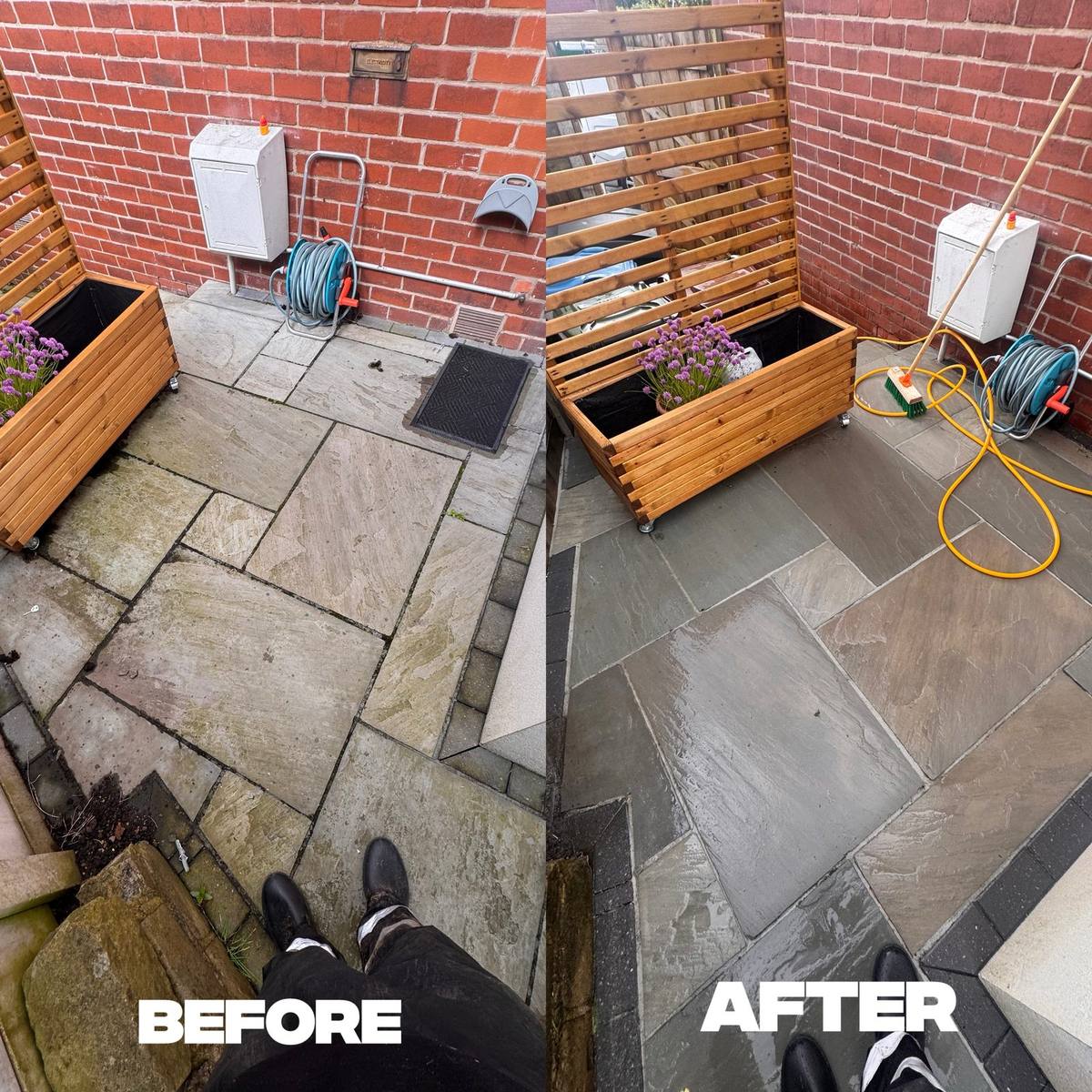
Indian sandstone patio — Oldham. Black spot algae removed with professional softwashing.
Quick answer: Patio cleaning in Greater Manchester typically costs £80–£250 depending on size, surface type, and condition. A standard 20–30 m² concrete or block paving patio usually runs £100–£150. Heavily soiled, mossy, or larger patios cost more. Most quotes are based on photos sent via WhatsApp.
Typical Patio Cleaning Costs at a Glance
Pricing across Greater Manchester tends to follow surface area fairly closely, with adjustments for condition and material. For block paving, a straightforward pressure clean starts from around £3.50 per square metre. If there's heavy biological growth requiring a chemical treatment as part of the process, that moves to roughly £4.25 per square metre. A full restoration including re-sanding the joints afterwards sits at around £5.50 per square metre, and re-sanding alone — if the surface has already been cleaned — is typically £2.00 per square metre.
To put that in real terms: a small patio of around 15 m² cleaned without additional work would usually come in at £65–£80. A medium patio of 25–30 m², which is fairly typical for a semi-detached in Oldham or Rochdale, usually falls between £100 and £160 depending on condition. A larger patio of 50 m² or more — common on newer builds or properties with extended outdoor space — will generally run from £175 upwards. These figures cover the clean itself; add-ons like sealing or significant weed clearance are separate and priced individually.
Sandstone and porcelain patios are typically quoted at the higher end of those ranges because the cleaning method is slower and requires more care. Concrete slabs sit roughly in the middle. More on that in the surface-type section below.
What Affects the Price of Patio Cleaning?
Size is the most obvious factor — more square metres means more time and water use — but it's far from the only one. Two patios of exactly the same size can differ by £80 or more in cost depending on what's on them. A patio that's been cleaned every year and just has a light green tinge from damp weather is a straightforward job. One that hasn't been touched in five or six years, with established moss, lichen, weeds pushing through every joint, and a thick black crust of algae on the surface, takes considerably longer to treat properly.
Access matters too. A patio at the back of a terraced house where equipment has to come through a narrow side passage, or one at the end of a long garden, adds time compared to a front-of-house area where the van can park directly alongside. Most companies won't quote a premium for this unless access is genuinely difficult, but it's worth mentioning when you ask for a price.
The surface material affects both method and time, which feeds directly into cost. And finally, any work needed beyond the clean itself — re-sanding, sealing, or removing a significant amount of debris — adds to the total. None of this should come as a surprise if your company is quoting properly upfront, which leads to the point about getting accurate quotes covered later in this guide.
Cost by Surface Type: Concrete, Sandstone, Porcelain and More
Concrete flags and standard block paving are the most straightforward surfaces to clean. They tolerate pressure washing well, and a rotary surface cleaner at the right pressure will shift most growth efficiently. Block paving cleaning on a well-maintained surface can move quickly; it's only when joints are packed with compacted moss or when the paving hasn't been touched for years that the job slows down significantly. Concrete is similarly forgiving — it's dense enough to handle the pressure needed to cut through embedded algae without risk of surface damage.
Indian sandstone and natural stone are a different matter. The surface is softer and porous, which means high pressure will erode the stone itself, opening up the surface and making it more susceptible to future staining. Stone cleaning on sandstone typically involves lower pressure combined with appropriate cleaning agents, and the work has to be methodical to avoid streaking — a common outcome when it's rushed or done with too much pressure. This takes longer per square metre, which is why the pricing reflects it. For more detail on working with natural stone, the guide on the best way to clean porcelain slabs covers the low-pressure approach in depth.
Porcelain is the most unforgiving surface. It's extremely hard — which is why it's durable — but the surface can scratch if the wrong brush or attachment is used, and the wrong cleaning chemical can affect the finish on some glazed tiles. Softwashing with a carefully diluted sodium hypochlorite solution followed by a gentle rinse is often the right approach for porcelain that has significant biological growth, rather than high-pressure cleaning. The process is slower but protects the surface. Professional patio cleaning on porcelain should always start with understanding exactly what type of finish is involved before any equipment is switched on.
Extra Costs to Be Aware Of
Re-sanding block paving joints is the most common additional cost people don't anticipate. Pressure washing block paving removes the kiln-dried sand from the joints — this is unavoidable, and it's not a problem as long as the joints are refilled properly afterwards. If they're left empty, weeds establish far more quickly, and the blocks themselves can shift over time without the jointing sand to lock them together. Re-sanding adds around £2.00 per square metre on top of the clean, so it's worth factoring in from the start. The guide on top signs your paving needs resanding is worth a read if you're not sure whether your joints are in decent shape or not.
Sealing is another optional extra that some customers ask about. A quality sealant applied after cleaning helps slow the return of moss and algae, makes the surface easier to clean in future, and can restore or enhance the colour of block paving and natural stone. It adds cost, typically calculated per square metre, and it's not essential — plenty of patios are cleaned and left unsealed with perfectly acceptable results. What sealing does do is extend the time between professional cleans, which can make it worthwhile on larger areas.
On heavily neglected patios, there can be genuine clearance work before cleaning even starts — removing thick moss that's built up into a mat, pulling weeds that have rooted deeply through the joints, or dealing with debris that's built up against the house wall. A reputable company will identify this on their initial assessment and include it in the quote rather than flag it on the day as an unexpected extra.
Before you book anyone, ask specifically what's included in the quoted price. Does it cover re-sanding? Weed removal beforehand? A post-clean biocide treatment? Getting clarity on this upfront means there are no surprises on the day, and it also tells you a lot about how the company operates.
DIY vs Professional Patio Cleaning: Is It Worth It?
A consumer pressure washer from a hardware shop will shift surface algae on a reasonably well-maintained patio — there's no point pretending otherwise. If your patio gets an annual scrub anyway and you're just looking to freshen it up, a decent domestic machine can do a reasonable job on concrete or block paving. The limitation is power and method. Consumer machines typically run at lower flow rates than commercial equipment, which means they take longer and often leave streaking on larger surfaces, particularly on uneven flags where the pressure inconsistency shows up clearly.
The more significant DIY risks are method-related rather than equipment-related. Blasting block paving joints with a lance strips the sand out unevenly, leaving gaps that will be colonised by weeds within one growing season. Using too much pressure on sandstone or porcelain causes surface damage that isn't always immediately obvious but shows up later as increased staining and a rougher texture. And without a rotary surface cleaner attachment, which most homeowners don't own, consistent coverage across a large area is genuinely difficult to achieve without leaving lines.
For a small, regularly maintained concrete patio, DIY is a reasonable option. For anything involving natural stone, porcelain, or block paving that needs re-sanding, or for a patio that hasn't been cleaned in several years, the result from professional equipment and technique is noticeably better — and less likely to cause problems that end up costing more to fix.
When You Should Call a Professional
Heavy black spot on sandstone is one situation where professional treatment is genuinely the better call. Black spot is a specific type of algae that embeds itself into the stone rather than sitting on the surface, and shifting it requires the right chemical approach — typically a diluted biocide with adequate dwell time — combined with careful low-pressure rinsing. A consumer pressure washer used at sufficient pressure to physically shift it will damage the stone surface. Done correctly with softwashing techniques, the staining lifts significantly, though on heavily affected stone some residual discolouration can remain.
Similarly, established lichen — the crusty, pale patches that attach to natural stone and older concrete — is difficult to remove mechanically without causing damage. Chemical treatment that kills the organism first, followed by appropriate cleaning, is the correct sequence. Trying to pressure wash lichen off directly tends to leave pitting or surface scarring on softer materials.
If your patio hasn't been cleaned in five years or more, or if it's shaded for most of the day — common in the terraced streets and closely-spaced housing of Greater Manchester — the level of biological growth is usually beyond what a domestic machine will handle effectively in a reasonable amount of time. The North West's damp climate means patios green up faster here than in drier parts of the country; an annual or biennial professional clean is the practical reality for most shaded outdoor spaces.
How to Get an Accurate Quote and What to Check
The fastest and most accurate way to get a realistic price is to send photos — ideally several, covering the full patio from different angles — along with a rough measurement. You don't need a tape measure; pacing it out and counting steps is close enough for an initial quote. Most companies in this area, including C&C Precision, give quotes directly over WhatsApp based on photos, which means you get a figure within hours rather than waiting for a site visit. If a company refuses to quote without a visit for a straightforward residential patio, that's not necessarily a red flag, but it does slow things down.
When you have a quote, check what it specifically covers. Does it include re-sanding if you have block paving? Is there a post-clean treatment with a biocide to slow regrowth? What happens if they find significant additional work on the day — will they call you before proceeding or just add it to the bill? These questions separate companies that operate transparently from those that don't.
Public liability insurance is non-negotiable. Any professional working on your property should carry at least £1,000,000 of public liability cover. Ask for evidence if it's not mentioned — a reputable operator will have no hesitation providing it. Finally, be cautious of quotes that seem unusually low. Patio cleaning costs at the very bottom of the market often mean skipped steps: no re-sanding, no chemical treatment, and equipment that isn't suited to the surface. You can read what customers have experienced by checking verified reviews before booking anyone.
Frequently asked questions
How much does it cost to clean a patio in Greater Manchester?
Most patio cleans in Greater Manchester fall between £80 and £250, with an average medium-sized patio (around 25 m²) coming in at roughly £100–£160. The final price depends on size, surface material, and how overgrown or stained it is. Sending a photo over WhatsApp is the fastest way to get an accurate figure.
How long does professional patio cleaning take?
A standard residential patio typically takes between one and three hours to clean properly. Larger or heavily neglected patios with deep moss or lichen buildup will take longer. If re-sanding block paving joints is included, add another hour or so depending on the area.
Will pressure washing damage my patio?
Done correctly with the right equipment and pressure settings, professional cleaning will not damage your patio. The risk comes from using too-high pressure on sandstone or porcelain, or blasting block paving joints and stripping all the sand out. A reputable operative will adjust the method to suit your surface.
How often should a patio be professionally cleaned?
For most patios in the north-west, an annual or biennial clean is enough to stay on top of moss and algae — the damp climate here means things green up faster than in drier parts of the UK. If your patio is shaded or under trees, yearly cleaning will keep it looking decent and prevent surface degradation.
Want a fast price for your patio?
Send a couple of photos on WhatsApp and we'll come back to you with a straight quote — usually same day.