The question of diy pressure washing vs professional comes up constantly, usually from homeowners who've seen their driveway or patio gradually disappear under a layer of green algae and figured a weekend with a hire machine would sort it. Sometimes that's exactly right. Sometimes it turns a manageable cleaning job into a repair job. This guide lays out the honest differences — what each option actually costs, where the risks sit, and how to make the right call for your specific surface.
Greater Manchester's climate doesn't help matters. The North West is damp for a good chunk of the year, which means algae, moss and lichen establish themselves faster here than in drier parts of the country. What looks like a light green tint in April can be a firmly rooted biological crust by September. That context matters when you're deciding whether a hire machine with cold water and no pre-treatment is going to be adequate — or whether you need chemistry and the right equipment behind it.
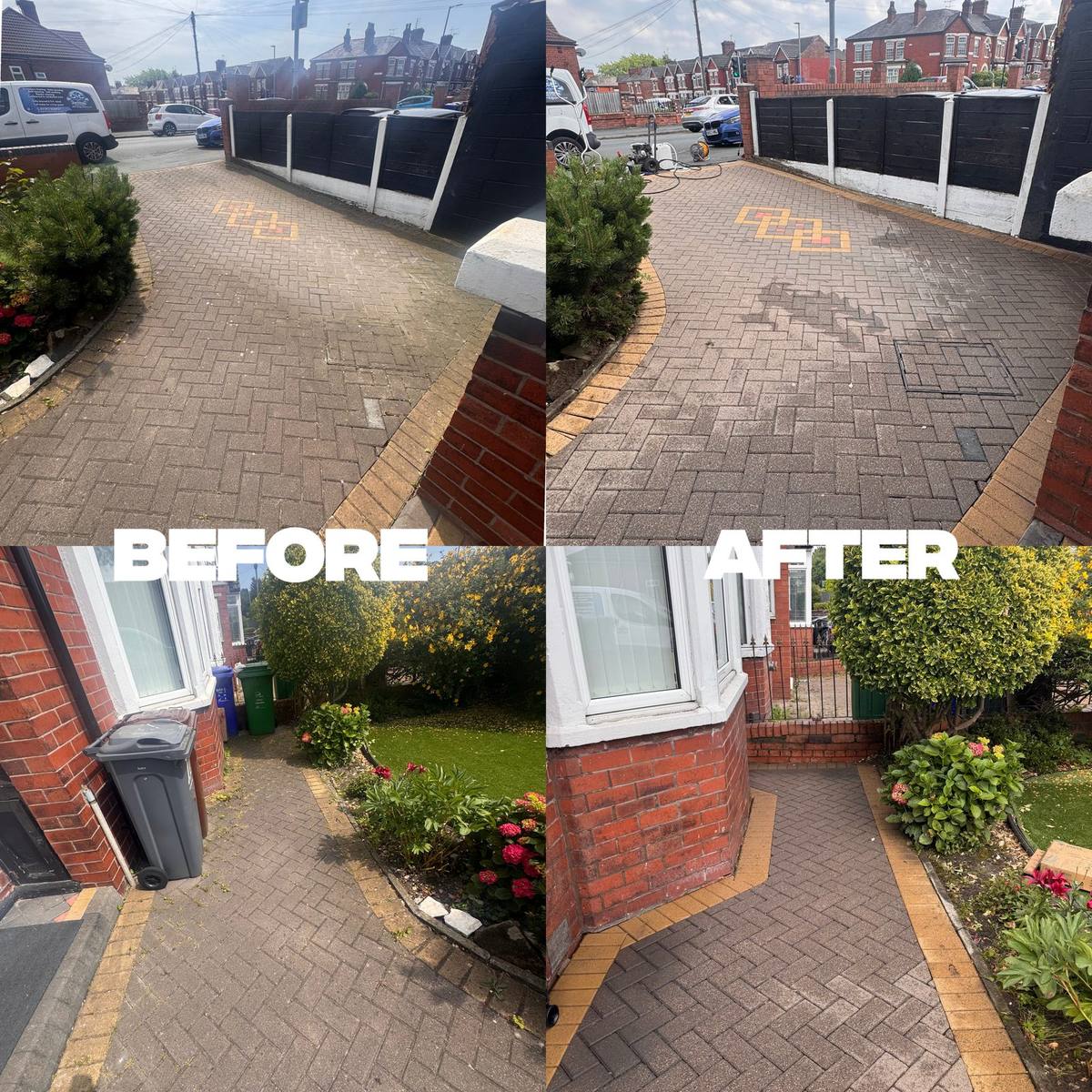
A wide concrete driveway cleaned by C&C Precision in Greater Manchester — the kind of result a hired consumer machine rarely achieves.
Quick answer: DIY pressure washing costs £150–£500 to hire a machine plus your time, but risks surface damage, missed treatments and voided warranties. For most driveways and patios in Greater Manchester, hiring a professional works out cheaper per square metre, lasts longer, and avoids costly mistakes — especially on render, block paving or delicate stone.
What Does It Actually Cost to Hire a Pressure Washer?
A day's hire for a decent petrol or electric pressure washer typically runs between £60 and £100 in the Greater Manchester area, depending on the supplier and machine spec. Add fuel if it's petrol-powered, a van or trailer if you can't transport it in your own vehicle, and you're often closer to £100–£130 before you've bought a single bottle of cleaning chemical. Weekend hire costs more at most depots, so if you're planning a Saturday job, factor that in.
The machines themselves are the other part of the picture. Consumer and light trade hire washers generally operate at 100–150 bar (roughly 1,400–2,200 PSI). Professional equipment runs significantly higher — typically 200 bar and above — and crucially, most professional setups include hot water capability and surface cleaner attachments that distribute pressure evenly across a wide head rather than concentrating it through a lance. That even distribution is what produces a consistent, streak-free result on driveways and patios.
None of this makes hire machines useless. It does mean they have real limitations on certain surfaces and job sizes, and understanding that upfront saves you wasted time and money.
What Does a Professional Pressure Wash Cost in Greater Manchester?
Prices vary by surface type, condition and access, but here are honest ballpark figures for this area. Driveway cleaning and patio cleaning on standard concrete or tarmac typically starts around £100–£150 for a small to medium area. Block paving cleaning runs from around £3.50 per square metre for a straightforward clean, rising to £4.25/m² where pre-treatment with chemical biocide is included — which on a heavily algae-stained driveway in the North West, it generally should be. A full restoration including re-sanding sits at around £5.50/m², and re-sanding only where the blocks are already clean is typically £2.00/m².
Render and softwashing jobs — where sodium hypochlorite solution is applied at low pressure to kill biological growth — are priced differently because the chemical does the work rather than mechanical force. Render cleaning costs depend heavily on house size and render condition, but a semi-detached with moderate algae growth is typically in the £200–£350 range. Roof cleaning and moss removal involves more access complexity and specialist biocide treatment, so prices reflect that.
What's included in professional pricing that hire doesn't give you: pre-treatment dwell time, weed and moss removal, surface cleaner technique, waste water management on commercial sites, and on block paving jobs — re-sanding the joints afterwards. That last point is one people frequently don't account for when comparing DIY versus professional costs.
The Hidden Costs DIY Guides Never Mention
The hire machine itself is just the starting point. Effective cleaning almost always requires pre-treatment chemicals — a sodium hypochlorite solution for algae, lichen and moss; a degreaser for oil stains on driveways; sometimes a proprietary algaecide for heavily affected surfaces. Bought separately in quantities adequate for a driveway or patio, these add £20–£50 to your spend depending on what you need. Without pre-treatment, you're relying on water pressure alone, which tends to remove surface growth without killing the root structure — meaning regrowth happens faster.
Then there's re-sanding. If you pressure wash block paving without replacing the kiln-dried sand afterwards, you've cleaned the surface and simultaneously created ideal conditions for weeds. The sand in the joints is what stabilises the blocks and prevents growth establishing between them. Blast it out and leave the joints empty or with compacted wet sand, and within a few weeks you'll be pulling weeds again. Kiln-dried sand and a plate compactor hire to bed it in properly add both cost and time to a DIY job — and skipping it defeats much of the purpose. If you want to understand whether your paving already needs attention to its joints, the guide on top signs your paving needs resanding is worth reading before you start.
Finally, honest time accounting. Cleaning a 50 square metre driveway properly — setting up, pre-treating and waiting for dwell time, running the surface cleaner, treating edges with a lance, cleaning the machine and returning it — is a full day of physical work. For some people that's fine. For others, the honest cost of their own time tips the balance.
What Can Go Wrong With a Hired Machine?
The most common problem we see is pressure lines — parallel tracks etched into the surface where someone has moved a lance too slowly or held it too close. On concrete this creates visible striping that doesn't fade. On Indian sandstone it can permanently alter the surface texture. The surface cleaner attachments on professional rigs exist precisely to avoid this, distributing pressure evenly and eliminating the risk of line marking.
Render is particularly unforgiving. Applying direct high-pressure water to painted or pebbledash render can delaminate the coating from the substrate, lift sections of the render itself, or force water behind it and cause damp problems internally. Softwashing exists for this reason — low pressure with sodium hypochlorite solution kills the biological matter without mechanical force, and is the correct method for any rendered surface. A hire machine used at full pressure on render can do damage that costs several times the cleaning job to repair.
Never use a high-pressure lance directly on mortar joints, render, or any surface with existing cracks. Water forced into these at pressure will widen the damage, and if frost follows before it dries out, that damage compounds significantly — particularly relevant in a Greater Manchester autumn or winter.
Block paving joints stripped of all their sand is another routine issue. Without the surface cleaner technique that professional equipment uses, lance cleaning tends to blast the jointing material out entirely. Conservatory roofs, polycarbonate gutters and brittle plastic downpipes are also vulnerable to direct lance pressure at close range — something easy to misjudge when you're working at height or reaching across an awkward angle.
Where DIY Pressure Washing Is Perfectly Reasonable
Not every job needs a professional, and it would be misleading to suggest otherwise. A garden path in good condition, a concrete fence panel, garden furniture, a wheelie bin store or a small rear yard — these are all reasonable DIY candidates. The surfaces involved are robust, the areas are small, and the consequences of an imperfect technique are minimal.
Flat concrete paths with no specialist finish are fairly forgiving. A hire machine with a surface cleaner attachment — rather than a bare lance — reduces the risk of marking considerably. If you're cleaning something like porcelain patio slabs, technique matters more, but the surface itself is hard and dense enough to take pressure without etching. A small timber-decked area or a garden wall that isn't rendered can also be done carefully with a lower-pressure setting.
The key variables are: surface type (hard and dense versus soft or coated), area size, and whether re-sanding or chemical treatment is going to be needed afterwards. If the answer to any of those factors adds complexity, the DIY calculation changes.
When You Should Always Bring in a Professional
Render cleaning and softwashing are non-negotiable cases for professional work. The sodium hypochlorite concentrations needed to treat established algae and lichen properly, applied at the right dilution and dwell time, are not something you can replicate with a hire machine and a bottle of household bleach. Get the concentration wrong and you damage the render or vegetation nearby. Get the dwell time wrong and the treatment doesn't work. The risk of structural damage from high-pressure application on render is also real and expensive to correct.
Roof moss removal sits in the same category. Access, correct biocide application and knowing how long to let treatment work before clearing — it's a job where the margin for error has expensive consequences and genuine safety risks. Block paving restoration on anything larger than a small courtyard is also best handled professionally, largely because of the re-sanding requirement. If you're considering whether to seal your block paving after cleaning, the guide on block paving sealing covers that honestly. Large driveways — say, over 50 square metres — quickly reach the point where the cost of a professional clean, including pre-treatment and re-sanding, is close enough to the DIY cost that the result difference makes the decision straightforward.
Indian sandstone and natural stone surfaces need particular care. They're porous, they mark easily, and restoring them after pressure damage isn't always possible. If you're thinking about a full driveway renovation beyond just cleaning, the guide on driveway kerb appeal upgrades puts cleaning in context alongside other options.
The Honest Verdict: DIY or Pro?
Here's a straightforward way to think about it. Small concrete or paved areas under roughly 20–25 square metres, robust surfaces with no specialist finish, no jointing sand to protect, no render or roof involved — DIY is a reasonable choice if you use a surface cleaner attachment rather than a bare lance and pre-treat the surface properly. For everything else, the cost difference between hiring and paying a professional is usually much smaller than people expect, and the risk of expensive mistakes is real enough to tip the decision.
Render, roofs, block paving requiring re-sanding, Indian sandstone, porcelain, and any large area: bring in a professional. The diy pressure washing vs professional question on these jobs isn't really about cost — it's about whether you want the job done correctly the first time. Getting render delamination repaired, or replacing block paving that's been etched, costs more than the original clean would have.
C&C Precision Precision Washing covers Oldham, Rochdale, Bury, Bolton, Manchester, Tameside, Stockport and the surrounding towns. If you're unsure which side of the line your job falls on, the fastest way to get a straight answer is to send a couple of photos on WhatsApp — a quote usually comes back the same day, and there's no pressure to proceed. Sometimes the answer genuinely is that a hire machine will do the job fine, and we'll say so.
Frequently asked questions
Is it cheaper to hire a pressure washer or pay a professional?
For small, straightforward jobs it can be cheaper to hire — but once you add machine hire, chemicals, your time and the risk of damage, professional cleaning is often better value on anything larger than a small path. For driveways and patios over around 30 square metres, the gap in cost is usually small and the difference in result is significant.
Can I damage my driveway or patio with a hired pressure washer?
Yes, and it happens regularly. Consumer hire machines can etch soft concrete and sandstone, blast jointing sand out of block paving, and leave visible striping lines on tarmac. Render and mortar joints are particularly vulnerable to direct high-pressure water at close range.
What pressure washer PSI do professionals use compared to hire machines?
Professional machines typically operate at 2,500–4,000 PSI with surface cleaner attachments that distribute pressure evenly, while most hire machines top out at around 1,400–2,000 PSI with a lance. The bigger difference is technique and the use of pre-treatment chemicals, which do most of the actual cleaning work.
Do I need to re-sand block paving after pressure washing?
Almost always, yes — pressure washing removes the kiln-dried sand that locks the blocks together and prevents weed growth. Skipping re-sanding after a clean is one of the most common DIY mistakes and means weeds return within weeks. A professional will include re-sanding as part of a proper block paving clean.
Want to know what a professional clean would cost you?
Send a photo of your driveway, patio or render over WhatsApp and we'll get you a fast, no-fuss quote — usually same day.