If you've been looking into driveway cleaning in Uppermill, you'll already know that keeping a driveway presentable up here takes more effort than it does in lower parts of Greater Manchester. The combination of elevation, frequent rain and the organic matter that drifts in off the surrounding moorland means hard surfaces deteriorate quickly — and what looks like surface dirt is often a layer of biological growth that needs treating properly, not just rinsing off.
This guide covers the main surface types you'll find on Saddleworth driveways, how they're cleaned correctly, what the work costs and when it makes sense to call a professional rather than reach for a hired machine. If you're trying to work out whether your driveway needs a straightforward clean or something more involved, the information below should help you make that call.
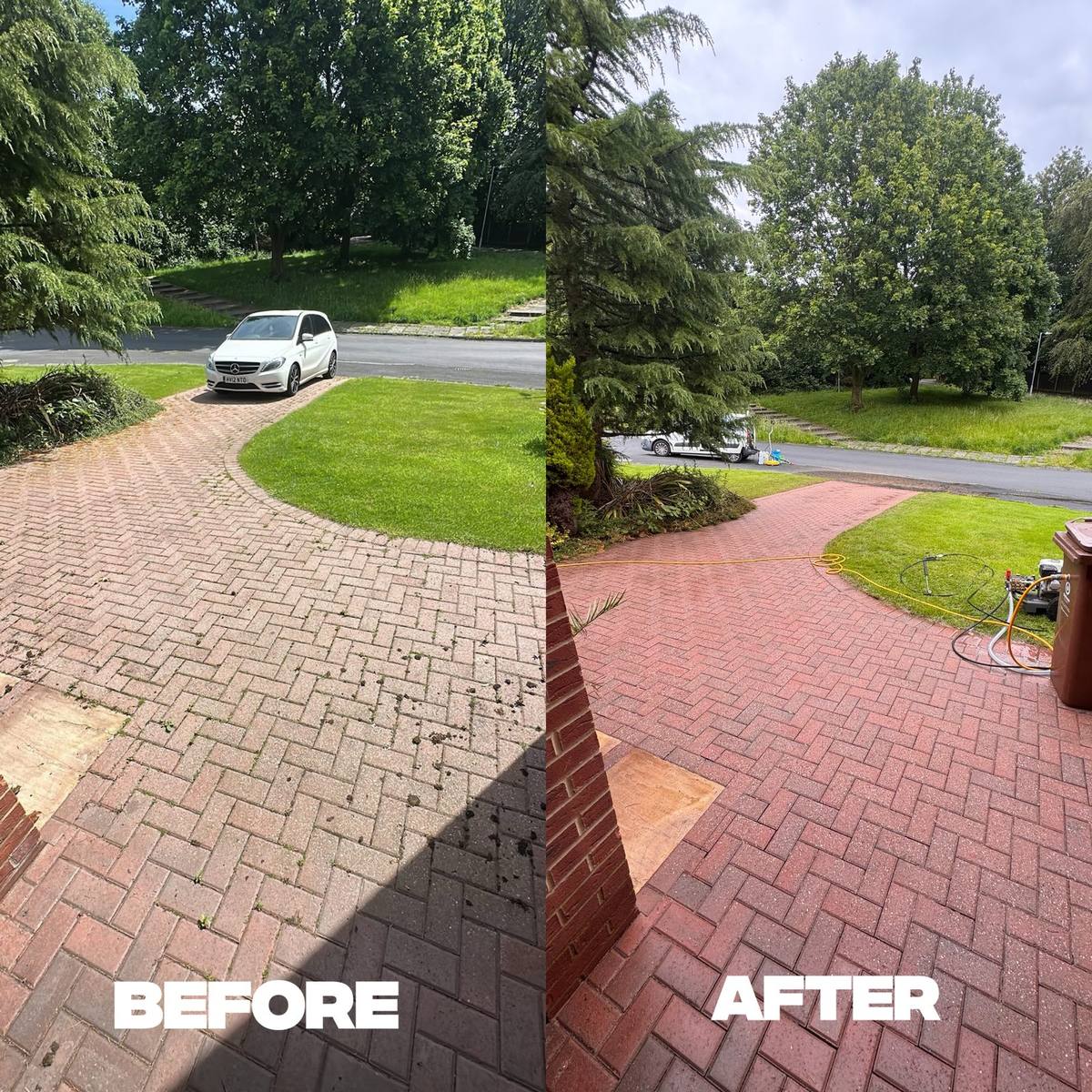
Block paving driveway after a full clean and re-sand — the kind of result common on Saddleworth properties.
Quick answer: Driveway cleaning in Uppermill typically involves sett, natural stone or block paving surfaces that collect heavy moss, algae and organic staining in Saddleworth's damp climate. A professional pressure wash restores appearance, removes slip hazards and can include re-sanding and sealing for block paving driveways.
Why Uppermill Driveways Get So Dirty So Fast
Uppermill sits at around 180 to 200 metres above sea level, and that elevation makes a real difference to how hard surfaces behave. The village catches more rainfall than lower parts of Oldham and Manchester, and the air stays damper for longer between wet spells. That persistent moisture is exactly the condition algae and moss need to establish themselves. On a driveway in a sheltered Manchester suburb, you might get a year or more before biological growth becomes noticeable. On an exposed Saddleworth driveway facing west, it can take just a few months.
There's also the matter of what blows in. The moorland edges around Uppermill, Greenfield and Dobcross shed organic debris throughout the year — fine particles, spores, broken-down vegetation — and it all settles on paving and sits in joints. That material feeds algae and provides a substrate for moss to root into. The black staining you often see on older driveways around here isn't engine oil or tyre marks; it's usually a dense colony of algae that's been building up through repeated wet seasons.
That biological layer is also what makes driveways genuinely slippery in wet weather. If you've noticed your drive getting hazardous underfoot, there's a fuller explanation of why that happens in this guide on why driveways become slippery and what can be done about it. The short answer is that cleaning it properly removes the risk — it isn't just cosmetic.
The Three Main Surface Types You'll Find on Saddleworth Driveways
Uppermill and the villages around it have a particular mix of driveway surfaces that you won't find in the same proportions elsewhere in Greater Manchester. The older properties — Victorian terraces, stone cottages and farmhouses — often have original Yorkshire sett, the small rough-hewn stone cobbles that were laid when the houses were built. These are robust, but they're set in sand or lime mortar that can be fragile after a century or more of movement and weathering.
Natural stone is also common, particularly sandstone and some granite. Many driveways were laid or relaid during the 1990s and 2000s using Indian sandstone or reclaimed stone flags. Sandstone in particular is porous, which means it stains and holds moisture readily. It cleans up well but needs a measured approach — too much pressure and you start to erode the surface or lift the pointing. Stone cleaning done properly uses lower pressures and, where appropriate, a biocide treatment to kill biological growth before the pressure washing begins.
The third category is modern concrete block paving, which is the most common driveway surface for houses built in the last thirty years. Blocks are durable and relatively easy to clean, but they have their own maintenance requirements around jointing sand and weed ingress that go beyond a simple wash. Each of these surface types needs a slightly different method, which is why the approach matters as much as the equipment.
How We Clean Sett and Natural Stone Without Causing Damage
The instinct when cleaning a dirty stone driveway is to turn up the pressure and blast the dirt off. On sett and aged natural stone, that's exactly the wrong approach. The jointing material between old sett — whether sand or lime mortar — can be eroded or dislodged by a high-pressure lance, and once the pointing starts to go, individual stones work loose. On sandstone, high pressure can visibly roughen the surface or strip it unevenly, leaving marks that are worse than the original staining.
The correct approach is to use a surface cleaner — a spinning bar tool that keeps the spray head at a consistent distance from the surface — combined with controlled, lower operating pressure. This gives an even clean across the whole surface without concentrating force in one spot. Where biological growth is heavy, a pre-treatment with a biocide or sodium hypochlorite solution is applied first and given dwell time to break down the algae and moss before the machine touches the surface. That chemical pre-treatment does a lot of the work, which means you need less mechanical force to finish the job.
It's worth being honest about results on some surfaces: very old, deeply stained sett may lighten considerably but not return to a pristine appearance, and sandstone that's been stained for many years may retain some discolouration even after a thorough clean. A good contractor will tell you what's realistic before starting, not after. You can see examples of what genuine results look like in this before and after driveway cleaning guide.
Block Paving Driveways: Cleaning, Re-Sanding and Whether to Seal
Block paving is straightforward to clean in comparison to natural stone, but a wash alone often isn't enough to leave the driveway in good shape. The kiln-dried sand that fills the joints between blocks is gradually washed out over time by rain and by pressure washing itself. When the joints empty, blocks start to rock slightly underfoot, weeds find their way in more easily and the overall structure of the surface weakens. Cleaning without re-sanding leaves you with a clean surface that will deteriorate again faster than it should.
A full block paving clean followed by re-sanding with kiln-dried sand addresses both problems. The joint sand is brushed in and worked down with a plate compactor or by hand, locking the blocks back into position and closing off the gaps that weeds use to establish. Pricing for this kind of work runs from around £3.50/m² for a straightforward clean, £4.25/m² with a chemical pre-treatment included, and £5.50/m² for the full clean and re-sand. Re-sanding on its own, where a previous clean has already been done, sits at around £2.00/m².
On sealing: it's a sensible option for some driveways but it isn't essential for all of them. A sealer slows biological regrowth and makes the surface easier to clean next time, but it's an added cost and needs reapplying every few years. If you want an honest take on when sealing adds value and when it doesn't, this guide on sealed vs unsealed paving covers the trade-offs clearly.
What Does Driveway Cleaning in Uppermill Actually Cost?
Most residential driveways in Uppermill fall somewhere between £100 and £300 for a professional clean. A compact front driveway on a semi-detached house — say 30 to 40 square metres — will sit towards the lower end of that range. A larger double driveway with heavy moss and block paving that needs re-sanding afterwards will be towards the top. The surface type, the degree of soiling, whether re-sanding or a biocide treatment is included, and the access to the site all affect the final price.
Stone driveways and sett tend to take longer than block paving because of the more careful approach required, so they may cost slightly more per square metre even if the overall price looks similar. The most reliable way to get an accurate figure is to send two or three photos via WhatsApp — one from a distance showing the full driveway, one closer showing the worst of the soiling. A price can usually come back the same day without any need for a site visit first. Details on how that process works are in this guide on getting a pressure washing quote on WhatsApp.
When to Call a Professional Rather Than Hire a Pressure Washer
Hiring a pressure washer from a local depot works reasonably well on a modern concrete driveway with straightforward soiling. If the surface is robust, the joints are in good condition and you're dealing with general dirt rather than entrenched biological growth, a DIY wash can make a visible difference. The limitation is that consumer and hire machines typically run at lower flow rates than commercial equipment, so they take longer and may struggle with heavy moss or deep-rooted algae.
Where DIY goes wrong is on older surfaces. On sett, on sandstone, or on block paving with failing joints, using the wrong pressure or the wrong nozzle at the wrong distance causes damage. Dislodged pointing on sett is expensive to reinstate. Uneven etching on sandstone is permanent. Block paving joints that were already weak can be washed out entirely, leaving the surface unstable. These aren't theoretical risks — they're the jobs that come in after someone has had a go themselves and made things worse.
C&C Precision Pressure Washing works across Uppermill and the wider Saddleworth area, and the team is familiar with the surface types common to the area. All work is carried out with £1,000,000 public liability insurance in place — if that matters to you, this piece on why fully insured pressure washing matters explains what that protection actually means in practice. You can also read what previous customers have said on the reviews page.
On sett and natural stone driveways, a biocide pre-treatment applied twenty to thirty minutes before pressure washing does most of the heavy lifting. It breaks down algae and moss at the root level, which means less mechanical pressure is needed to clear the surface — and less pressure means less risk of damage to old jointing and soft stone faces.
Practical Advice for Keeping Your Uppermill Driveway Cleaner for Longer
A professionally cleaned driveway in Uppermill will start accumulating biological growth again — that's just the reality of the local climate. What you can do is slow the rate of regrowth. Keeping gutters and downpipes clear means water isn't sheeting across the driveway unnecessarily. Sweeping away fallen leaves and organic debris before they decompose removes the food source that algae and moss need to establish. On block paving, keeping the joints topped up with kiln-dried sand limits the gaps where weed seeds can germinate.
If your driveway was treated with a biocide as part of the professional clean, there's usually some residual effect that slows regrowth for six to twelve months. After that, an annual or biannual maintenance clean is generally enough to keep on top of things, rather than needing a full restoration job every time. The interval depends on the surface type, the aspect of the driveway and how much shade and moisture it gets.
For driveways that have been sealed, the maintenance picture is slightly different — sealed surfaces shed water and organic matter more readily, which is why some homeowners find them worth the additional investment. On older natural stone or sett where sealing isn't appropriate, a biocide spray applied by hand every eighteen months or so can make a meaningful difference to how quickly the biological growth returns between professional cleans. It's a small, low-cost step that extends the results of a proper wash considerably.
Frequently asked questions
How much does driveway cleaning cost in Uppermill?
Most residential driveways in Uppermill come in between £100 and £300 depending on size, surface type and how much moss or staining has built up. Block paving that needs re-sanding afterwards sits at the higher end. The quickest way to get an accurate figure is to send a couple of photos on WhatsApp — we can usually turn around a price the same day.
Can you pressure wash old Yorkshire sett without damaging it?
Yes, but it has to be done carefully. Old sett is robust but the mortar or sand between the stones can be fragile, and using a standard high-pressure lance can dislodge pointing or undercut joints. We use controlled lower pressure with a surface cleaner on sett to get a thorough result without disturbing the structure.
Why does my Uppermill driveway go green and mossy so quickly?
Uppermill's elevation means it catches more rainfall and sits in damp air for longer than lower parts of Greater Manchester. Organic material from surrounding trees and moorland also settles on hard surfaces and gives moss and algae something to feed on. Once a driveway is professionally cleaned, the regrowth is usually slower — especially if the joints are re-sanded on block paving.
Do you cover Uppermill and the rest of Saddleworth?
Yes — we're based in Oldham and work across the whole of Greater Manchester including Uppermill, Delph, Dobcross, Greenfield and the surrounding Saddleworth villages. Travel isn't a problem and we're familiar with the types of driveways you find in the area.
Got a driveway in Uppermill that needs sorting?
Send a couple of photos over WhatsApp and we'll come back with a fast, honest price — no sales call, no obligation.