If you've ever stepped out onto your driveway on a wet morning and nearly lost your footing, you're not alone. It's one of the most common complaints we hear across Greater Manchester — and the answer to why is my driveway slippery is almost never what people expect. Most assume it's a build-up of general grime, oil, or simply that the surface has worn smooth over time. The real cause is usually biological, and it's something that gets worse every season if it isn't properly dealt with.
This guide covers what's actually making your driveway slippery, which surfaces are most vulnerable, why the North West climate makes the problem worse than in many other parts of the country, and what you can realistically do about it. There's no single magic fix, and we'll be straight with you about that — but there are effective solutions, and understanding the cause is the first step.
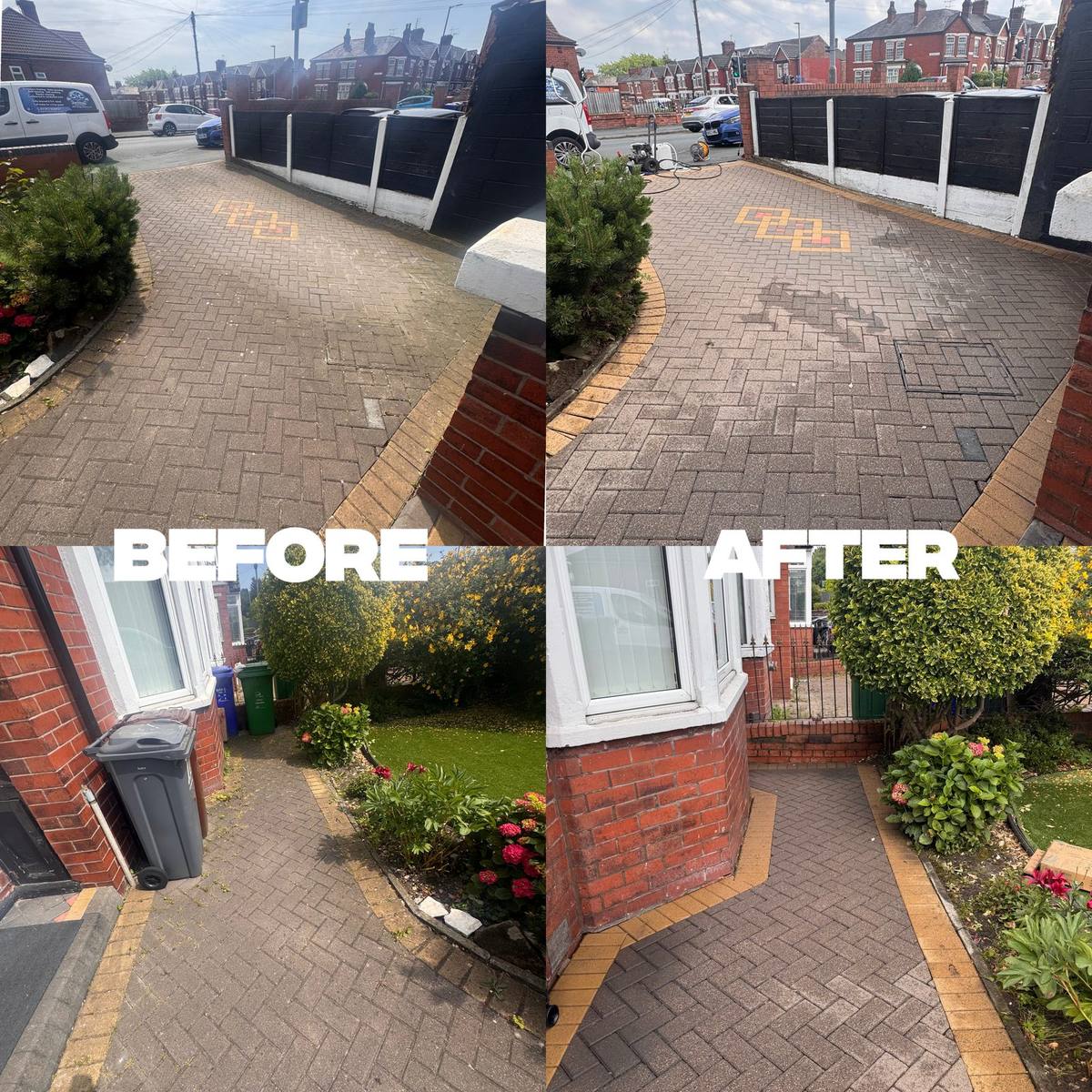
Before and after: the dark, slick surface on the left is classic algae and biofilm — exactly what makes driveways slippery.
Quick answer: A slippery driveway is almost always caused by algae, moss, lichen, or biofilm growing on the surface. These organisms thrive in damp, shaded conditions and create an invisible greasy layer on block paving, concrete, tarmac, and stone. Regular pressure washing or softwashing removes the growth and restores safe grip.
The Real Reason Driveways Get Slippery
Most people reaching for a bucket and brush assume dirt is the problem. In reality, the slipperiness almost always comes from biological growth — algae, moss, lichen, and bacterial biofilm colonising the surface of the paving. These organisms don't need much to get started: a bit of moisture, some shade, and a porous surface is enough. Once established, they spread steadily and quietly.
The reason they're so dangerous is that many forms of algae and biofilm are essentially invisible when the surface is dry. The paving can look perfectly presentable — maybe a little dull, perhaps slightly greenish near the edges — and then the moment it rains, the whole thing turns into something close to a skating rink. That's the biofilm rehydrating and becoming a low-friction layer between your shoe and the surface. It's exactly the same reason a mossy riverbank is so treacherous.
Understanding this is important because it changes what the right solution looks like. You're not just dealing with surface dirt that a rinse will shift. You're dealing with living organisms that have anchored themselves into the pores of the material, and they need to be killed at the root rather than simply displaced.
Algae: The Most Common Offender
Green or black algae is the single biggest reason driveways become slippery in the UK, and it's particularly prevalent across Greater Manchester. It spreads through airborne spores — they're constantly present in the atmosphere — and all they need to germinate is a surface that holds a little moisture. North-facing driveways, those overshadowed by walls or fences, and any area that doesn't get direct sunlight for much of the day are especially vulnerable.
The deceptive thing about algae is that it often isn't visible until it's well established. In the early stages it might look like nothing more than a slight darkening of the paving or a faint greenish tinge in the lower spots. On a dry day the surface might feel completely fine underfoot. But wet it down — or wait for rain — and the algae swells and becomes genuinely hazardous. This is why many people don't realise why is my driveway slippery until they're already sliding.
Black algae is particularly stubborn because it produces a protective layer that makes it resistant to light scrubbing and even to many consumer cleaning products. It can look like simple staining when it's actually a living film embedded in the surface. This is where sodium hypochlorite softwashing — applied at the correct dilution with appropriate dwell time — does what a pressure washer alone can't reliably achieve.
Moss and Lichen — Slower but Worse Long-Term
Moss tends to gather in the joints between block paving and in the low, damp spots where water pools after rain. It builds up gradually, and because it holds moisture so effectively, even a relatively small amount of moss can make a broad area of paving feel soft and unstable underfoot. Block paving with compacted or degraded joints is particularly prone to this — the moss roots into the sand and works its way across the surface over time. If you're seeing this pattern, a block paving clean followed by re-sanding is usually the right approach.
Lichen is a different challenge altogether. It grows more slowly than moss or algae, but it physically bonds to the surface of stone and concrete rather than simply sitting on top of it. Removing lichen properly takes a combination of chemical treatment and mechanical cleaning, and even then, residual staining sometimes remains — particularly on lighter-coloured stone. It's worth being honest about that: most lichen can be cleared significantly, but some surfaces will retain a faint ghost mark. What will be removed is the hazard.
Both moss and lichen left untreated don't just create slip risk — they cause long-term structural damage. Moss roots expand and contract with temperature changes, gradually lifting and destabilising block paving. Lichen produces acids that etch into natural stone over time. So addressing the problem isn't only about safety; it's about protecting a surface that's expensive to replace.
Surface Type Matters: Which Driveways Are Most at Risk
Not all driveway surfaces are equally susceptible to biological growth, and understanding where yours sits on that spectrum is useful. Older concrete and Indian sandstone are among the most porous materials commonly used for driveways in this part of the world — they absorb moisture readily and give algae and moss plenty of texture to grip. Block paving sits in a similar category, especially once the original sealant has worn off and the jointing sand has degraded or washed out.
Smooth tarmac and modern porcelain paving are less hospitable to biological growth simply because they offer less surface texture and absorb less water. That said, "less susceptible" doesn't mean immune — algae will colonise any surface that stays damp long enough, including smooth ones. And a smooth sealed surface with a thin layer of algae can actually be more slippery than a rougher one, because there's no texture at all to compensate for the reduced friction.
If you're not sure what's happening with your particular surface, the before and after results from similar driveways in the area can give you a realistic sense of what's achievable. It's also worth reading about sealed versus unsealed paving maintenance if you're considering whether to seal after cleaning — it makes a genuine difference to how quickly growth returns.
Shade, Drainage, and the Greater Manchester Factor
Greater Manchester is not a famously sunny place, and that matters for driveways. Persistent cloud cover through autumn and winter, high annual rainfall, and relatively low average temperatures mean that damp surfaces stay damp. There simply isn't enough drying sun to suppress biological growth the way it might be suppressed in the south of England or in more continental climates. A driveway in Oldham or Rochdale that's in partial shade can stay wet for days after rain — which is essentially ideal growing conditions for algae and moss.
Drainage plays a significant role too. Driveways that slope slightly away from the property and drain freely will dry out faster and support less growth. Those with low spots where water pools, or where overhanging trees drop leaf debris that retains moisture, will accumulate biological growth much more quickly. Leaf litter is particularly problematic — it decomposes on the surface, releasing organic matter that feeds algae, and it keeps the paving beneath it perpetually damp.
The practical upshot of all this is that driveways in the North West genuinely do need cleaning more frequently than in sunnier parts of the country. Where someone in the south might get away with a clean every three or four years, a shaded driveway in Greater Manchester might need attention every two years or less to stay genuinely safe. That's not a sales point — it's just the climate.
When Is It Time to Call a Professional?
A garden hose won't touch biological growth — it just wets the surface. A consumer pressure washer will lift some of the visible contamination, but it typically spreads spores around rather than killing them, and it doesn't reach the growth that's embedded in the pores of the material. If you've pressure washed your own driveway and noticed the green came back within a few months, this is why. The question of why is my driveway slippery often persists after DIY attempts precisely because the root cause hasn't been addressed.
Professional softwashing uses sodium hypochlorite at calibrated concentrations with a controlled dwell time — the chemical is allowed to sit on the surface long enough to kill growth at the biological level before it's rinsed away. This produces significantly longer-lasting results than pressure washing alone, particularly for algae and black spot. For heavily mossy driveways or block paving with compacted joints, a full driveway clean with re-sanding afterwards is the proper solution — not just aesthetically, but structurally.
C&C Precision Pressure Washing covers Oldham and the wider Greater Manchester area, and quotes are straightforward — send a couple of photos on WhatsApp and you'll typically have a price the same day. If the slip risk is a genuine safety concern, particularly heading into autumn and winter, it's worth getting it sorted before conditions deteriorate.
If your driveway feels fine on a dry day but turns slippery the moment it rains, algae or biofilm is almost certainly the cause — not the surface wearing smooth. The fix is a proper clean with chemical treatment, not just a rinse. A slippery driveway is a liability risk as well as a daily hazard, and it won't improve on its own through winter.
What You Can Do Right Now to Reduce Slip Risk
If a professional clean isn't possible immediately, there are practical steps worth taking. Keeping the surface clear of leaves and organic debris is the most straightforward — it removes the material that feeds algae and keeps the paving damp. A stiff brush and a proprietary patio cleaner applied according to the instructions will reduce surface contamination temporarily, though it won't kill embedded growth and won't last long in wet weather. It's better than nothing, but be realistic about what it achieves.
Improving drainage where possible makes a real difference over time. If there are low spots where water pools, filling them in or creating a channel to direct water away will mean the surface dries faster after rain. Cutting back overhanging vegetation reduces shade and leaf fall, both of which accelerate biological growth.
For block paving specifically, re-sanding the joints after a clean is one of the most effective long-term measures available. Kiln-dried sand packed properly into the joints reduces the gaps where moss and algae establish themselves and stabilises the surface. Block paving re-sanding on its own runs from around £2.00/m², while a full clean with re-sanding is typically from £5.50/m² — a reasonable investment given that it addresses both the safety issue and the structural integrity of the paving. If you want to understand more about how cleaned surfaces hold up over time, the guide on cleaning a mossy driveway safely covers the process in more detail.
Frequently asked questions
Why is my driveway slippery even when it looks clean?
Algae and biofilm can be virtually invisible on dry surfaces but become a greasy, low-friction layer the moment they get wet. If your driveway feels fine in dry weather but turns slick after rain, biological growth is almost certainly the cause. A professional pressure wash or softwash will confirm it — the difference before and after is usually dramatic.
Is a slippery driveway dangerous, and am I liable?
Yes, a slippery driveway is a genuine slip hazard, particularly for elderly visitors or anyone carrying shopping in wet weather. If someone falls on your property and you knew the surface was unsafe, you could potentially face a liability claim. Getting it professionally cleaned is straightforward and relatively affordable compared to that risk.
Will pressure washing stop my driveway being slippery for good?
Professional pressure washing removes the existing algae, moss, and biofilm and restores grip immediately. However, without a follow-up biocide treatment or sealant, growth will return — typically within one to three years depending on how shaded and damp the area is. Softwashing with sodium hypochlorite kills spores more thoroughly and gives longer-lasting results than pressure washing alone.
How much does it cost to get a slippery driveway cleaned in Greater Manchester?
The price depends on the size of your driveway, the surface type, and how heavily it's affected. The quickest way to get an accurate figure is to send a couple of photos on WhatsApp — we can usually turn a quote around the same day. Most standard driveways in Oldham, Rochdale, Bury, and surrounding areas are very competitively priced.
Is your driveway a slip hazard?
Send us a photo on WhatsApp and we'll give you a fast, no-fuss quote for getting it cleaned properly.