There's a reason so many homeowners search for before and after driveway cleaning photos before picking up the phone. They want to know whether the results are real, whether the difference is actually worth the cost, and whether their particular surface — whether it's twenty-year-old block paving or a wide concrete apron — is going to come up properly. These are fair questions, and the honest answer is that the results depend on what you're starting with. But on the whole, a professional clean transforms the appearance of a driveway more than most people expect.
This guide walks through what the cleaning process actually does to different surface types, what realistic before and after driveway cleaning results look like, and what the limitations are. Some stains — particularly old oil or deeply ingrained rust — will lighten rather than disappear entirely. Some surfaces hold discolouration even after a thorough clean. We'll be straight about that throughout.
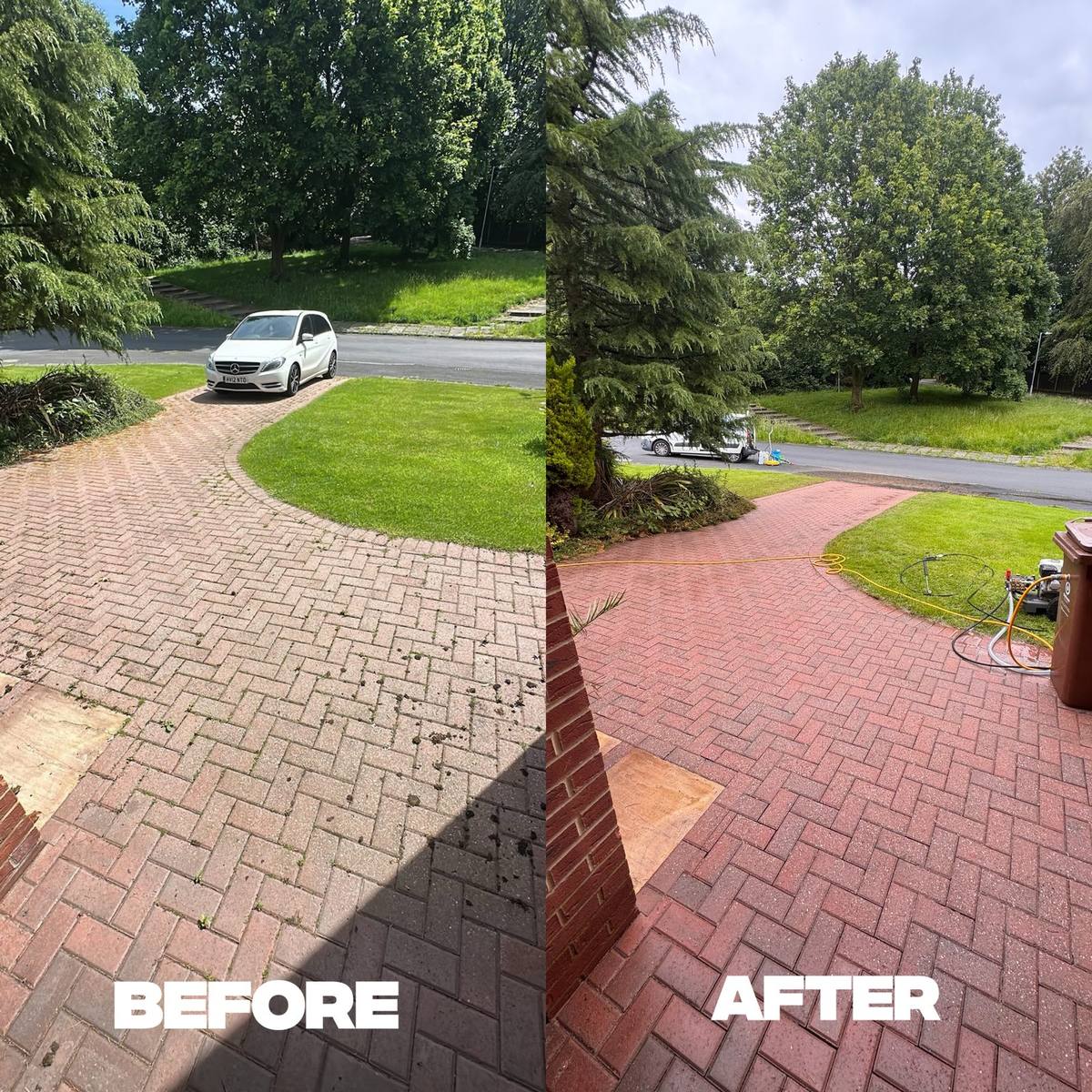
Red block paving driveway — before and after a single professional clean in Oldham.
Quick answer: Professional driveway cleaning removes years of black algae, moss, oil stains and ground-in dirt, typically restoring the original colour and texture of block paving, concrete or tarmac in a single visit. Most driveways in Greater Manchester look dramatically different within a few hours of treatment.
What Does a Dirty Driveway Actually Look Like?
In Greater Manchester, driveways deteriorate faster than in drier parts of the country. The combination of persistent damp, limited sunlight in winter, and the way rain sits on flat surfaces rather than draining quickly means organic growth — black algae, green moss, lichen — takes hold within a year or two on most surfaces. Block paving joints fill with compacted grime and weed root systems. Concrete goes from pale grey to almost brown-black across its face. Tarmac loses definition and starts to look uniformly dark and grubby rather than cleanly black.
Alongside the organic build-up, you'll typically find oil stains near where cars park, tyre marks, rust spots from garden furniture or metal bins, and in older driveways, the kind of ground-in grime that doesn't shift with a brush and a bucket. Weeds push up through block paving joints and, over time, the jointing sand washes out and leaves the structure loose. By the time most people call someone in, the driveway has been looking like this for a while. The key thing to understand before you look at before and after driveway cleaning results is that all of that build-up has usually been accumulating for two to five years — and a single clean addresses the surface, not the underlying drainage or root causes.
Block Paving Before and After: The Most Dramatic Results
Block paving tends to produce the most striking before and after driveway cleaning results, and there's a straightforward reason for that. The individual blocks are usually a mid-tone red, buff or charcoal when they were laid. After a few years of algae, moss and grime, they read as a uniform dark grey-brown — the original colour is almost entirely obscured. When that layer is removed, the colour contrast is significant. Even blocks that have genuinely faded over time come back noticeably brighter than they appeared when dirty.
The other factor is the joints. On block paving that hasn't been maintained, the joints are typically full of compacted dirt, weed matter and old sand that's gone dark. After cleaning, the joint lines read clearly again, which restores the pattern and structure of the driveway visually. This is part of why block paving cleaning looks so different before and after compared to a flat concrete surface — the geometry comes back. That said, if the blocks themselves are spalling, cracked or heavily stained with oil, cleaning will improve but won't fully restore them.
Block paving holds dirt differently to concrete because its surface is more porous and because the joints act as channels where organic matter accumulates and retains moisture. That moisture is what lets algae and moss get established so quickly. On shaded driveways — and there are plenty in the terraced streets around Oldham, Rochdale and Tameside where trees and walls limit sunlight — growth can return within twelve months of cleaning. You can read more about the specific challenge of organic growth on paving in our guide on what actually removes algae from paving.
Concrete and Tarmac Driveway Cleaning Results
Concrete driveways show dramatic improvement too, though the results depend more on the age and porosity of the surface than with block paving. A relatively new concrete drive that's become covered in algae and surface dirt will come back close to its original colour. An older, more porous slab that's been absorbing grime for fifteen years will improve substantially but may not return to a uniform pale grey — the deeper discolouration stays. That's worth saying plainly rather than setting unrealistic expectations from photos alone.
Wide driveways — the kind you see on newer detached houses and bungalows across Bury, Bolton and Stockport — benefit particularly from using a rotary surface cleaner rather than a lance, because the cleaning pattern stays consistent across the whole face. Lane marks and uneven cleaning lines, which are the telltale signs of a domestic pressure washer used by hand, don't appear when the right equipment is used. The surface comes up uniform, which makes a significant visual difference even when the overall colour shift is more modest than on block paving.
Tarmac is a different case again. Cleaning removes algae, surface dirt and moss from tarmac effectively, and the driveway looks clearly cleaner and better defined afterwards. But tarmac doesn't have the colour restoration element that block paving does — a clean tarmac drive looks like a clean tarmac drive, rather than a different surface. Results are real but more subtle. Oil staining on tarmac can be treated but, again, very old or large stains will lighten rather than vanish.
What Happens During a Professional Driveway Clean
The process starts before the pressure washer comes out. On block paving or any surface with significant moss or algae, a pre-treatment is applied — typically a biocide or diluted sodium hypochlorite solution — and left to dwell for ten to twenty minutes. This breaks down the organic matter at a cellular level rather than just lifting it mechanically, which produces cleaner results and slows regrowth. On lighter contamination, this step may be quicker, but it's not skipped.
Surface cleaning is done with a rotary surface cleaner — a flat spinning head that keeps consistent pressure across the whole area and doesn't blast sand out of joints the way a direct lance does. Edges and awkward corners are done by hand with an appropriate lance, taking care not to angle the jet in a way that displaces material from joints or borders. After the main clean, a post-rinse flushes loose debris off the surface and away from planted borders.
The difference between this and a hired jet wash is mostly in the equipment, the pre-treatment chemistry and the operator's knowledge of what each surface can handle. A hired machine with no pre-treatment on a heavily algaed driveway will move a lot of the surface growth but leave staining and regrow quickly. It can also damage softer block paving if the angle or pressure is wrong. For more on how the two approaches differ, our guide on pressure washing vs soft washing covers the reasoning in more detail.
Re-Sanding and Sealing: Why Cleaning Is Only Half the Job
Pressure washing block paving removes the kiln-dried sand from the joints — there's no way around this. The sand was what held the jointing material in place and, to a degree, what kept weeds from establishing easily. After cleaning, even a good clean, the joints are open. If nothing is done, weeds come back faster, water sits in the joints, and the blocks can start to shift slightly over time because the interlock is less stable.
Re-sanding after cleaning involves brushing kiln-dried jointing sand back into the joints, compacting it, and topping up until the joints are properly filled. It's a straightforward step but it makes a real difference to the longevity of the result. Block paving re-sanding on its own runs from around £2.00/m², and as part of a full restoration — clean, chemical treatment, re-sand — you're typically looking at £5.50/m². For context, block paving cleaning with chemical treatment is around £4.25/m², or from £3.50/m² for cleaning alone. For a fuller picture of restoration costs, the guide on block paving restoration in Manchester goes through this in more detail.
Sealing is a separate question and one where the honest answer is that it's not always necessary or cost-effective. A sealant does slow algae regrowth and staining, and it can enhance or stabilise the colour of the blocks. But it adds cost, it changes the surface appearance (some sealers leave a wet look that not everyone likes), and it needs to be reapplied every few years. On driveways that are heavily shaded or in spots that stay damp, a sealant can extend the time between cleans noticeably. On drier, sunnier driveways, the benefit is more modest. You can read more about how this affects maintenance in our guide on sealed vs unsealed paving.
When to Call a Professional Instead of DIY
A domestic pressure washer — even a reasonably powerful one — runs at around 100-130 bar. A professional surface cleaner operates at 200+ bar with a controlled rotary head, and with pre-treatment chemistry that a consumer machine typically isn't set up to apply or dwell properly. On a lightly dirty driveway that just needs freshening up, a decent consumer machine will do a reasonable job. On a driveway with established moss, black algae or deep organic staining, it will move some of the growth but leave staining, and the regrowth happens faster because the organic matter hasn't been treated at root level.
The other risk with DIY on block paving specifically is surface damage. The joints between blocks are relatively fragile, and directing a consumer lance at the wrong angle strips sand and can chip the arris — the edge — of softer pavers. This kind of damage is irreversible without replacing individual blocks. The visual result of an incorrectly pressure-washed block paving driveway is often a patchy, sand-depleted surface that looks worse for cleaning in places.
Compared to replacing a driveway — which in Greater Manchester typically runs from £3,000 upwards for block paving — a professional clean and re-sand is a straightforward investment. If a driveway is structurally sound but looks neglected, cleaning almost always makes more financial sense than replacement. C&C Precision Precision Washing cover the full Greater Manchester area, and because quotes are done from photos via WhatsApp, it's quick to find out whether a job makes sense before committing to anything.
Before booking any driveway clean, clear the surface of plant pots, bins and anything stored along the edges. It saves time on the day and means the whole surface gets cleaned evenly — including the areas that are usually covered and often the dirtiest.
How to Keep Your Driveway Looking Clean for Longer
The single most useful thing you can do between professional cleans is deal with leaves before they break down on the surface. Decomposing leaves leave tannin staining on concrete and block paving that is hard to shift, and the damp mat they create is exactly the environment algae needs to establish. A quick sweep in autumn — particularly under trees — makes a measurable difference to how quickly the driveway deteriorates.
Spot-treating weeds early, before the root system gets into the joints, keeps block paving joints more stable and means you're not fighting established weed growth between cleans. A proprietary path weedkiller applied carefully to the joints twice a year takes very little time. If the driveway has been re-sanded and sealed, weed establishment is slower anyway, but it still happens eventually in shaded spots.
In Greater Manchester's climate, most unsealed driveways benefit from a professional clean every one to two years. Sealed driveways often go two to three years without looking significantly worse. Driveways under heavy tree cover or in persistently shaded spots — common in the older residential streets around Oldham, Rochdale and across Tameside — may need attention annually. If you're in an area with particular conditions, the guide on how to clean a mossy driveway safely covers what works and what doesn't for persistent moss growth specifically.
Frequently asked questions
How much does driveway cleaning cost in Greater Manchester?
Most driveways in the Greater Manchester area come in between £80 and £250 depending on size, surface type and how much moss or organic build-up there is. The fastest way to get an accurate price is to send a photo on WhatsApp — we can usually quote the same day without needing to visit first.
Will pressure washing damage my block paving?
Done correctly with the right equipment and technique, pressure washing won't damage block paving — but a domestic pressure washer or incorrect angle can dislodge jointing sand and even chip softer pavers. We use a rotary surface cleaner rather than a direct lance, which cleans evenly without blasting sand out of the joints.
How long does a driveway clean take?
A standard driveway takes between one and three hours depending on size and condition. An average semi-detached driveway in Oldham or Rochdale is usually done in under two hours. If re-sanding is included, allow a little extra time for the sand to be swept in and compacted properly.
How often should I get my driveway professionally cleaned?
Most driveways in the north-west benefit from a professional clean every one to two years given the damp climate and fast algae regrowth. Driveways under trees or in shaded spots may need attention more frequently. A sealed driveway will generally stay cleaner for longer between visits.
Want to know what your driveway would look like?
Send a photo of your driveway on WhatsApp and we'll come back with a fast, honest price — no fuss.