If you've been searching for driveway cleaning in Stalybridge, you're likely looking at a surface that's seen a few too many wet winters. Stalybridge sits on the eastern edge of Greater Manchester, tucked into the Tame valley at the foot of the Pennines, and the combination of elevation, shade, and near-constant moisture means driveways here tend to deteriorate faster than in drier parts of the country. Black algae, green slime, moss-choked joints, and sand that's long since washed away — it's a familiar picture.
This guide covers what actually causes that deterioration, what a proper clean involves, and what you can realistically expect from the results. Some staining lifts completely; some lightens rather than vanishes — particularly old rust or deep oil penetration. That's worth knowing before you book anyone.
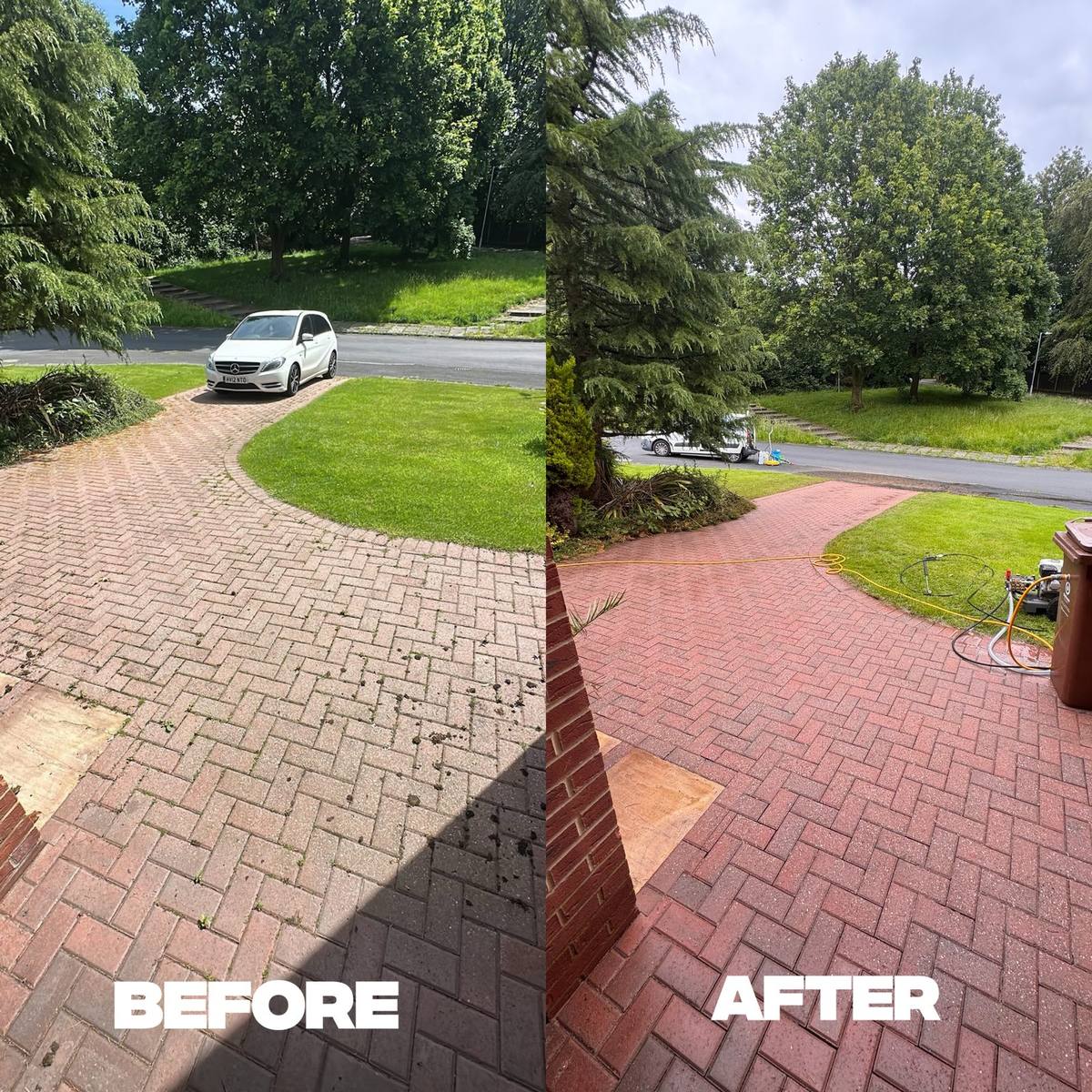
Block paving driveway cleaned by C&C Precision — colours fully restored after years of algae and dirt buildup.
Quick answer: Driveway cleaning in Stalybridge typically tackles black algae, moss, oil stains, and joint weed growth. A professional pressure wash with pre-treatment removes ingrained dirt safely. Block paving may also need re-sanding afterwards. Most driveways are cleaned and left looking restored in a single visit.
Why Driveways in Stalybridge Get Dirty So Fast
Stalybridge and the surrounding Tameside area average significantly more rainfall than much of England, and the Pennine topography means moisture lingers. Shade from houses, garden walls, and mature trees keeps surfaces damp for hours after rainfall, and that persistent damp is exactly what algae, moss, and lichen need to establish themselves. It doesn't take long — a summer of neglect in a north-facing driveway can produce a solid crust of black algae that feels almost rubbery underfoot.
Block paving is particularly susceptible because the jointing sand between pavers retains moisture and provides a ready growing medium for organic matter. But tarmac, imprinted concrete, and natural stone all suffer in their own ways — tarmac develops a slick green biofilm that becomes genuinely hazardous, and natural sandstone or limestone can absorb algae spores deep into the surface, making them harder to shift. The issue isn't laziness on the homeowner's part; it's just the climate doing what it does.
This is why driveway cleaning in Stalybridge isn't simply a cosmetic exercise. A surface that's heavily colonised by organic growth becomes slippery, can stain underlying surfaces permanently if left long enough, and in the case of block paving, begins to destabilise as joint sand disappears and weeds exploit the gaps.
The Most Common Driveway Problems We See Here
Black algae is the most frequent complaint — a dark, often shiny crust that builds up in layers over time and bonds tightly to the surface. It's more resistant than green algae and needs a proper chemical pre-treatment to loosen it before pressure washing. On shadier spots, particularly the edges nearest to walls or fences, green slime tends to dominate instead: softer, but equally slippery and just as stubborn in joints and texture.
Moss in block paving joints is almost universal on Stalybridge driveways. Once the jointing sand breaks down or washes out — which happens gradually with every heavy downpour — moss moves in first, followed by weeds. If you've noticed the pavers themselves starting to rock slightly underfoot, that's a sign the structural integrity of the joints has been compromised, and cleaning alone won't fix it without re-sanding afterwards. For more detail on that problem specifically, the guide on how to remove weeds from block paving is worth a read.
Oil staining and rust marks round out the list. Oil from vehicles, especially on older tarmac or lighter-coloured block paving, rarely lifts completely — it's honest to say that a good clean will reduce it significantly and remove the surface layer, but deep-set contamination that's been there for years may still show as a shadow. Rust from metal garden furniture or drain covers behaves similarly. Managing expectations on these two issues matters.
Does Every Driveway Surface Need the Same Approach?
No, and treating them all the same is where DIY jobs often go wrong. Block paving can handle relatively firm pressure from a rotary surface cleaner, but the angle and distance matter — blast it too hard at the wrong angle and you'll erode the surface of the pavers or blow the remaining joint sand out entirely. Tarmac is softer and more porous, and while it benefits from lower-pressure cleaning with a biocide pre-treatment, it's easy to damage the surface texture if you're not careful with nozzle choice.
Imprinted concrete — pattern-printed driveways with a resin or acrylic sealer — is probably the surface that causes the most problems when cleaned incorrectly. The sealer is what gives imprinted concrete its colour and pattern depth, and high-pressure cleaning at the wrong distance or angle can strip it, cloud it, or create uneven patches that then need a full re-seal to correct. Pre-treatment with an appropriate chemical loosens organic matter before the jet touches the surface, which means you can clean effectively at lower pressure and protect the sealer in the process. You can read more about the specific considerations for different surfaces in our full driveway cleaning overview.
Natural stone — sandstone, limestone, granite setts — often needs the gentlest approach of all. Some stone is soft enough that even moderate pressure will abrade the surface over repeated cleans. A lower-pressure wash combined with a suitable biocide or stone cleaner, and plenty of dwell time, tends to give better results than brute force. The stone cleaning page covers this in more detail.
What a Professional Driveway Clean Actually Involves
The process starts before the pressure washer comes out. A suitable chemical pre-treatment — typically a diluted sodium hypochlorite solution or a dedicated algaecide — is applied to the surface and left to dwell. Dwell time matters: giving the chemical ten to twenty minutes to penetrate and break down organic growth means it lifts far more effectively when washed off, rather than just being blasted around. This is a step that most DIY jobs skip entirely, and it's one of the main reasons professional results look so different.
The main clean uses a rotary surface cleaner rather than a lance — a spinning head that delivers consistent, even pressure across the surface without the streaking or channelling you get from a handheld nozzle. It's slower, but the results are uniform. After the main pass, edges and tight spots are detailed with a lance at appropriate pressure, and the whole surface is rinsed down thoroughly to remove chemical residue and loosened debris.
For block paving specifically, a post-clean inspection of the joints is part of the job — if they're empty or close to it, that's the point at which re-sanding should happen. Leaving that step means the work is only half done.
Block Paving Re-Sanding: Why It Matters After Cleaning
Cleaning block paving — even a careful clean — removes what's left of the jointing sand. That's unavoidable, and it's not a reason to avoid cleaning. But the joints need to be refilled before the surface is back in proper working order. Empty joints allow individual pavers to shift slightly under load, which over time causes unevenness, cracking at the edges, and further weed colonisation. It's a structural issue as much as an aesthetic one.
Kiln-dried sand — dry, fine, and free-flowing — is the right material for this. It's brushed into the joints in stages, compacted lightly, and topped up until the joints are properly filled. It needs to be done on a dry surface and ideally with a dry spell forecast, since the sand needs time to settle before rainfall. Re-sanding usually adds around £2.00 per square metre to the cost of a clean, and it's worth doing properly rather than skipping. The block paving re-sanding page has more detail on the process and what to expect.
If your block paving joints are completely bare and the pavers are already rocking, re-sanding alone won't resolve the movement — the pavers may need to be lifted, the sub-base checked, and the area re-laid in sections. A clean and re-sand is maintenance; it's not a substitute for remedial groundwork where that's what's actually needed.
When a DIY Pressure Washer Won't Cut It
Hired or domestic pressure washers are capable machines for light garden furniture, fencing, or a quick rinse-down of a patio that's been regularly maintained. For a driveway that hasn't been cleaned in several years, or one with heavy algae, oil staining, or compromised joints, they tend to fall short — not because the operator is doing anything wrong, but because the equipment isn't designed for that kind of work. Consistent surface pressure, appropriate chemical application, and a rotary head make a significant difference to the outcome. The guide on DIY pressure washing versus professional cleaning covers this honestly and in more detail.
The risk with a hired lance on block paving is channelling — the jet cuts a groove into the jointing sand or even into softer pavers if held too close or too long in one spot. On imprinted concrete, it can strip or cloud the sealer in patches, which then needs a full re-seal to correct. The cost of fixing those mistakes often exceeds what a professional clean would have cost in the first place. Some jobs are straightforward enough for a competent DIYer; a heavily contaminated Stalybridge driveway in its third or fourth year without cleaning usually isn't one of them.
Practical Advice for Keeping Your Driveway Clean Longer
The single most effective thing you can do is deal with organic growth early. A light dusting of algae on block paving in early autumn is easy to treat with a diluted biocide and a stiff brush. Leave it until spring and you're dealing with a fully established colony that's bonded to the surface and pushed into every joint. Catching it early is faster, cheaper, and kinder to the surface.
In autumn, brush leaf debris off the driveway regularly rather than letting it sit and decompose. Rotting leaves accelerate organic growth and can stain lighter surfaces, particularly sandstone or pale concrete. A stiff yard brush takes five minutes and makes a genuine difference over winter.
Avoid washing-up liquid or household bleach on block paving — both can strip jointing sand, affect the surface, and leave residue that encourages regrowth. If you want to apply something between professional cleans, a diluted patio treatment from a builders merchant, applied correctly and rinsed off, is a safer option. And if your driveway is in good structural shape after a full clean, sealing it is worth considering — a good quality sealant slows organic growth, makes the surface easier to maintain, and can enhance the colour. It's not a permanent fix, but it extends the interval between full cleans meaningfully. For context on how surface condition affects cleaning costs and outcomes, the patio cleaning costs guide is relevant reading even if it's your driveway rather than a patio you're thinking about.
Getting a Professional to Handle Driveway Cleaning in Stalybridge
If your driveway has reached the point where a proper professional clean is the right call, the process of getting a quote should be straightforward. C&C Precision Precision Washing covers Stalybridge and the wider Tameside area as part of its regular work across Greater Manchester — you can send a couple of photos on WhatsApp and get a same-day quote without any call-out fee or obligation. Pricing for block paving cleaning starts from around £3.50 per square metre for a standard clean, rising to £4.25 per square metre where chemical treatment is included, and £5.50 per square metre for a full restoration with re-sanding. Re-sanding only, if the surface has already been cleaned, is around £2.00 per square metre.
If you're comparing quotes or trying to understand what's involved before you commit, the guide on how exterior cleaning quotes actually work is useful background. And if you're also looking at a patio, render, or other surfaces at the same time, it's almost always worth combining jobs — the mobilisation cost is the same whether we're cleaning one surface or three.
Frequently asked questions
How much does driveway cleaning cost in Stalybridge?
Most residential driveways in Stalybridge fall between £80 and £200 depending on size, surface type, and how much organic growth is present. The quickest way to get an accurate price is to send a couple of photos on WhatsApp — we can usually turn a quote around the same day. We don't do call-out fees or obligation.
Can you clean imprinted concrete driveways without damaging the sealer?
Yes, but it requires the right technique. High-pressure rotary cleaners used at the wrong angle or distance can strip or cloud the sealer on pattern imprinted concrete. We pre-treat the surface first and adjust our approach to the condition of the existing sealer — and if it needs resealing afterwards, we can do that too.
Do I need to be home when you clean the driveway?
Not necessarily. As long as we have access to an outdoor tap and the driveway is clear of vehicles, we can carry out the work and send you before and after photos when we're done. We'll always confirm the details with you beforehand so there are no surprises.
How long after cleaning before I can use the driveway again?
You can usually walk on it straight away, and drive on it within a couple of hours once the surface has dried off. If we've re-sanded block paving joints, we ask that you avoid heavy rain or hosing it down for 24–48 hours to let the kiln-dried sand settle properly.
Want a fast price for your Stalybridge driveway?
Send a couple of photos on WhatsApp and we'll come back to you with a straight price — no sales call, no fuss.