If you've been putting off getting your driveway sorted, you're not alone. Driveways in Royton take a battering from the weather — the town sits high enough that damp sets in quickly, and once moss and algae get a foothold, they spread fast. Driveway cleaning in Royton is something we're called out for regularly, and the difference a proper clean makes is usually significant, even on surfaces that look like they're past it.
This guide covers what the job actually involves, what results you can realistically expect, and how much it typically costs. There's also some honest advice on when DIY makes sense and when it doesn't. If you already know you want a quote, the fastest way is to send a few photos over WhatsApp — you'll have a price back the same day without waiting for someone to come out just to look at it.
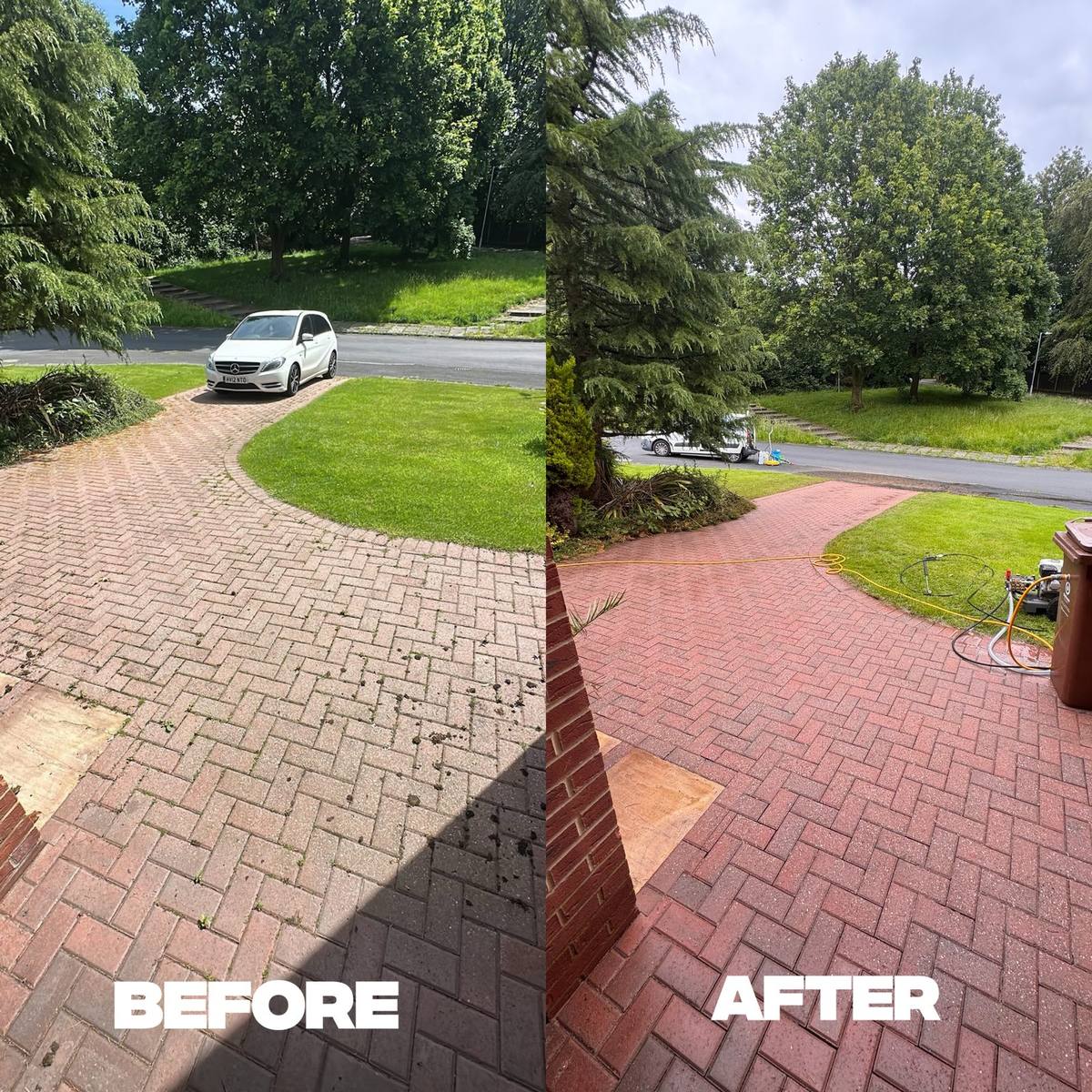
Block paving driveway cleaned by C&C Precision — typical result for Royton and surrounding Oldham streets.
Quick answer: A professional driveway cleaning service in Royton will pressure wash away moss, algae, oil stains and general grime from block paving, concrete or tarmac, leaving the surface clean and restored. Most driveways take one to three hours. You'll get a fast quote by sending a photo on WhatsApp.
What Driveway Cleaning Actually Involves
A proper driveway clean starts before the pressure washer comes out. The first thing is a look at the surface — what it's made of, how bad the organic growth is, whether there are any areas that need more care. Soft organic matter like moss and algae is usually treated with a biocide first and left to dwell. This kills the growth at the root rather than just blasting the top layer off, which matters because pressure alone spreads live spores rather than dealing with them.
Once the treatment has had time to work, the surface is pressure washed using the right nozzle and pressure for that specific material. Edges and joints get attention too — it's the corners and borders where dirt tends to accumulate and where a careless clean leaves the most obvious marks. After washing, the whole area is rinsed down properly and left ready to dry. On block paving, re-sanding the joints is often part of the job as well, which we'll come to shortly.
The honest version of what you get at the end is a surface that looks substantially better and is no longer slippery underfoot. It's not a restoration — it's a clean. If there's structural damage, deep staining or surface degradation, that won't be fixed by pressure washing alone.
Driveway Types Common in Royton and How They're Cleaned
Block paving is probably the most common driveway surface you'll see across Royton and the surrounding streets. It responds well to professional cleaning — the individual blocks can handle appropriate pressure, and the jointed surface gives the water somewhere to work. Block paving cleaning typically involves pre-treatment, a rotary surface cleaner for even coverage, and careful edge work. The main consideration is the sand in the joints, which we'll cover separately.
Concrete driveways are straightforward to clean but the results depend a lot on the age and finish of the concrete. Brushed concrete cleans up well. Older, pitted concrete will look noticeably better but may retain some discolouration in the surface texture — that's not a cleaning failure, it's just the nature of aged concrete. Tarmac needs lower pressure than block paving or concrete. Use too much and you start pulling the surface apart. A professional will drop the pressure and work more methodically to avoid that.
Imprinted concrete is the trickiest. The pattern is pressed into the surface and then sealed, so the cleaning process needs to avoid stripping the sealer. If the sealer is already worn or peeling, cleaning can lift it further — that's something worth knowing before the job starts, not after. We check for this at the survey stage and adjust the approach accordingly.
What Results Can You Realistically Expect?
Pressure washing removes moss, algae, lichen, general dirt, mud and surface contamination reliably well. In most cases, a driveway that's been neglected for a few years comes back looking dramatically better — not like new necessarily, but clean and safe to walk on. The slipperiness that builds up from algae growth disappears quickly once the surface is properly treated and washed.
What pressure washing doesn't fix: deep oil stains that have soaked into porous surfaces, rust marks from metal furniture or drain covers, cracks and broken sections, or the general colour fade that comes from years of UV and frost damage. Oil stains in particular are stubborn — a degreaser treatment can lighten them significantly, but anyone who tells you they'll vanish completely on an absorbent block paving or concrete surface is overpromising. We'd rather tell you that upfront.
If you want to see genuine before-and-after results from local jobs, our customer reviews give an honest picture of what people find at the end of a clean. Results vary by surface condition and age, which is why we look carefully at the photos before quoting.
How Much Does Driveway Cleaning Cost in Royton?
For block paving, a standard clean starts from around £3.50 per square metre. If the surface has significant moss or algae that needs chemical treatment as part of the process, that moves to around £4.25/m². A full restoration including cleaning and re-sanding the joints comes in at around £5.50/m². Re-sanding on its own, if the surface has already been cleaned, is around £2.00/m². These aren't figures plucked out of nowhere — they reflect the time, materials and equipment the job actually takes.
A few things affect the final price beyond just the area. Access matters: a driveway we can pull up to easily is quicker to set up on than one that requires carrying equipment through a gate or side passage. Condition matters too — a surface that's been cleaned within the last couple of years takes less work than one that's had a decade of growth building up. We factor all of that in rather than quoting blind.
The quickest way to get an accurate figure for driveway cleaning in Royton is to send photos over WhatsApp. Two or three shots — one from the top showing the full area, one closer up showing the surface — gives us enough to come back with a realistic quote the same day. No call-out charge, no obligation.
Block Paving Re-Sanding: Do You Need It After Cleaning?
In most cases, yes. Pressure washing removes much of the kiln-dried sand that sits in the joints between blocks. That sand does more than fill a gap — it locks the blocks together, stabilises the surface and acts as a barrier against weed germination. Once it's gone, weeds come back faster, the blocks can shift slightly underfoot, and water channels differently through the surface. Block paving re-sanding after a clean is one of the things that makes a real difference to how long the results last.
The process uses dry, kiln-dried jointing sand, which is brushed into the joints and compacted in. It needs to go in when the surface is properly dry — doing it on a damp day means the sand clumps and doesn't settle correctly. When it's done right, the joints are firm, flush and consistent, which also improves how the whole driveway looks, not just how it functions.
If you're thinking about sealing the block paving after cleaning, that's a separate decision worth considering carefully — our guide on whether block paving sealing is worth it covers the pros and cons honestly. Re-sanding should happen before sealing, not after, so it's worth thinking about the full sequence before committing to either.
If your block paving joints are showing bare soil or you can pull weeds out by hand, re-sanding isn't optional — it's overdue. Leaving it means the surface will degrade faster and weeds will be back within a season.
When to Call a Professional Instead of Hiring a Pressure Washer
Hiring a pressure washer from a tool hire place seems cost-effective on paper. The reality is that consumer and short-term hire machines are often higher pressure than they need to be, with fewer nozzle options and no real guidance on what's appropriate for your surface. Block paving, particularly older or thinner blocks, can be damaged by pressure that's too high or held too close — you end up with eroded block faces and sand blasted out of joints, leaving you worse off than before.
There's also the moss problem. Pressure alone, without a biocide pre-treatment, disperses rather than kills live moss spores. You clean the visible growth off, but you've potentially spread it to areas that were previously unaffected. A few weeks later it's back — sometimes across a wider area than before. That's a frustrating result for an afternoon's work.
Professional cleaning, done once properly, typically costs less in the long run than a DIY attempt that causes damage or needs redoing within a season. If you're unsure whether your driveway is a good candidate for DIY or professional work, it's worth reading about why insurance matters on this kind of job — not just for the contractor, but for you as the property owner if something goes wrong. C&C Precision Precision Pressure Washing carries £1,000,000 public liability cover on every job.
Practical Tips to Keep Your Royton Driveway Clean Longer
Oldham sits in a damp part of Greater Manchester, and Royton in particular gets its share of persistent drizzle and low light in the colder months. That combination is ideal for moss and algae. A professional clean every one to two years is a realistic maintenance cycle for most driveways in this area — more frequently if the surface is in shade for most of the day, less if it gets good sun and drainage.
Between professional cleans, treating early-stage moss growth before it sets is worth doing. A sodium hypochlorite dilution — the same chemistry used in professional softwashing — applied at low concentration and left to dwell will kill surface growth without needing pressure. Let it work, then rinse off. This isn't something to do without care or on surfaces that can't handle it, but on concrete and block paving it's an effective interim treatment.
Keeping the edges of the driveway clear makes a difference too. Soil and organic matter pushed up against the border from grass or planted beds is a constant source of contamination. Keeping that edge defined and clear means less material working its way onto the surface between cleans. It's a small thing, but it noticeably slows the rate at which moss and algae get re-established.
Frequently asked questions
How long does driveway cleaning take in Royton?
Most standard residential driveways in Royton take between one and three hours depending on size, surface type and how bad the build-up is. Block paving with heavy moss or weed growth will take longer than a relatively clean concrete driveway. We'll give you a realistic time estimate when you send photos over.
Will pressure washing damage my block paving or tarmac?
Using the correct pressure and nozzle for the surface, professional cleaning won't damage block paving or tarmac. The risk comes from DIY machines set too high or held too close, which can erode the surface and blast out the jointing sand. We adjust equipment to the specific surface every time.
Do I need my block paving re-sanded after cleaning?
In most cases, yes — pressure washing removes much of the kiln-dried sand that locks the blocks together and prevents weeds. Leaving it without re-sanding means weeds come back faster and the surface becomes slightly unstable. We can add re-sanding on the same visit and it makes a noticeable difference to how long the results last.
How do I get a quote for driveway cleaning in Royton?
The quickest way is to send two or three photos of your driveway on WhatsApp — one from the top showing the whole area, one closer up showing the surface condition. We'll come back with a price the same day, usually within a couple of hours. No need to wait for a site visit just to get a number.
Want a fast price for your Royton driveway?
Send a couple of photos on WhatsApp and we'll come back to you with a straight price — usually same day.