If you've been searching for driveway cleaning Middleton, you're probably looking at a surface that's gone green, lost its colour, or started to look more like a moss garden than a driveway. It's a common situation around here, and it's rarely down to neglect — it's mostly down to where we live. Middleton sits in a part of Greater Manchester where the weather does exactly what organic growth needs it to do: stay damp, stay grey, and stay that way for months at a time.
This guide covers what causes the problem, how professional cleaning actually works, and what you can realistically expect from the process. Whether your driveway is block paving, concrete, tarmac, or natural stone, the approach differs depending on the surface — and understanding that upfront helps you make a better decision about what your driveway actually needs.
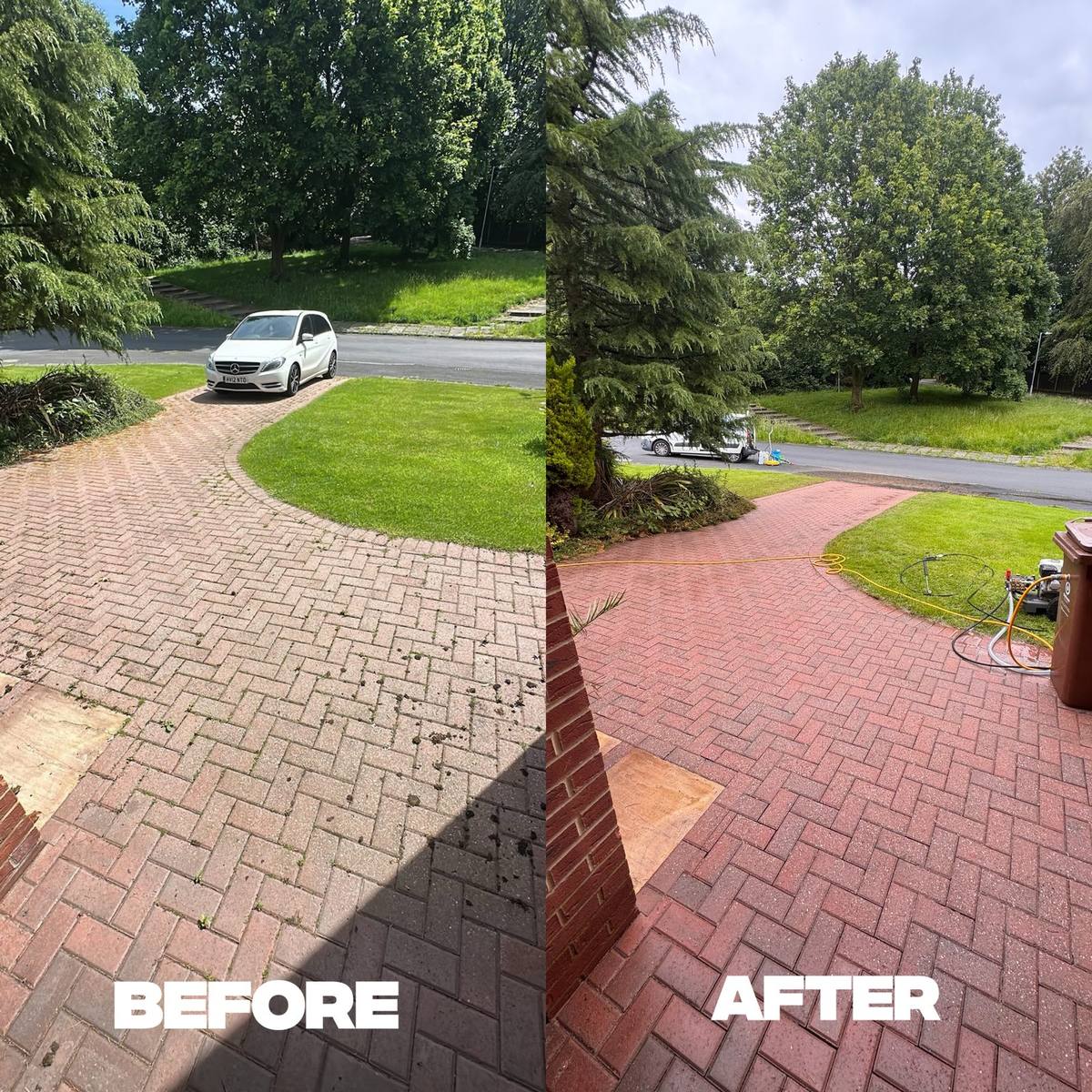
Block paving driveway in Greater Manchester — before and after a full clean by C&C Precision.
Quick answer: Middleton driveways commonly deal with green algae, black spot lichen, moss in joints, and traffic grime accelerated by the area's damp climate and older block paving. Professional driveway cleaning removes all of this using hot or cold pressure washing, leaving surfaces safe, clean, and restored typically within a few hours.
Why Middleton Driveways Get Dirty Faster Than You'd Think
Middleton sits in one of the wetter parts of Greater Manchester, caught between the Pennine foothills and the prevailing south-westerly weather systems that push damp air across the region almost year-round. Rainfall totals here are consistently higher than parts of Manchester city centre, and the low cloud that settles across the area through autumn and winter keeps surfaces persistently moist. That moisture is all algae, moss, and lichen need to get established.
Driveways that face north or east, or that sit under tree canopy, are particularly vulnerable. A north-facing block paving driveway in Middleton can go from freshly cleaned to visibly green within a single growing season if nothing is done to slow regrowth. South-facing surfaces in full sun fare better, but even those aren't immune once biofilm starts to form — it spreads across the surface gradually and is often well-established before it becomes visually obvious.
The damp conditions also accelerate sand loss in block paving joints. Water works its way into the joints repeatedly through freeze-thaw cycles over winter, gradually washing out the kiln-dried sand that holds everything stable. By the time a driveway looks dirty, the structure beneath is often already compromised in ways that aren't immediately visible.
The Most Common Problems We See on Local Driveways
Green algae is the most widespread issue on driveways across Middleton and the surrounding area. It's worth knowing that algae makes a surface dangerously slippery well before it looks severe — that faint greenish tinge on a driveway is a warning sign, not just an aesthetic problem. By the time a driveway looks heavily soiled, the algae layer underneath has usually been there for a long time.
Black spot lichen is a more stubborn problem that turns up regularly on block paving and natural stone. Unlike green algae, lichen physically bonds to the surface and requires either a prolonged chemical dwell time or significant mechanical force to remove. Even with professional equipment, deeply embedded black spot may lighten rather than disappear entirely — that's worth knowing before you go in expecting a perfect result on a surface that's been neglected for several years.
Traffic oil stains near the garage door, weed growth through joints, and significant sand loss between blocks are also extremely common on Middleton driveways, particularly those that haven't seen any maintenance in three or more years. Oil staining responds well to a hot wash with a degreaser pre-treatment, though very old, deep-set stains may not lift completely. Weed growth and sand loss are addressed as part of the re-sanding process after the main clean — if you're interested in understanding whether your paving needs that work, the guide on top signs your paving needs resanding is a useful reference.
Block Paving: The Surface That Needs the Most Attention
A large proportion of driveways in Middleton are block paved, and block paving comes with its own set of maintenance requirements that other surfaces don't. The joints between individual blocks collect debris, harbour weed seeds, and gradually lose the kiln-dried sand that was packed into them when the driveway was laid. Over time, without that sand, the blocks start to shift slightly, edges crack under load, and weeds root in with nothing to stop them.
For a straightforward clean with no re-sanding, block paving cleaning typically starts from around £3.50 per square metre. If the surface has significant organic growth and needs a chemical treatment as part of the process, that's more like £4.25 per square metre. Full restoration including a deep clean and re-sanding comes to around £5.50 per square metre — and re-sanding on its own, if the surface has already been cleaned, is typically around £2.00 per square metre. These are working figures; actual costs depend on the size and condition of the driveway.
It's also worth reading the guide on block paving sealing if you're thinking about what happens after the clean. Sealing isn't always necessary, but on a freshly cleaned and re-sanded driveway it does slow the rate at which organic growth returns, and it makes subsequent cleans considerably easier.
Concrete and Tarmac Driveways: Different Problems, Same Damp Cause
Concrete driveways in the Middleton area tend to accumulate streaky algae staining across the main surface and oil patches close to the garage door. The algae often runs in lines from where water drains off a wall or a downpipe, leaving dark streaks that look almost like the concrete is stained with something chemical. In most cases it's purely organic growth, and it responds well to a thorough hot wash with a rotary cleaning head.
Tarmac driveways can develop a green biofilm layer that gives the surface a dull, deteriorating appearance. That's almost always organic growth sitting on top of the tarmac rather than any breakdown in the material itself. Tarmac responds well to pressure washing without any need for additional chemicals in most cases, though very overgrown surfaces benefit from a biocide treatment first to knock back the growth before the main clean.
One thing to be clear about with both surfaces: old, deep-seated oil stains may lighten significantly but not vanish entirely. The driveway will look considerably better, but setting realistic expectations on oil-affected areas is more honest than promising results that depend on factors outside anyone's control.
What the Cleaning Process Actually Involves
For most driveway cleaning in Middleton, the process starts with assessing the surface and identifying any areas that need pre-treatment. Heavy organic growth — thick moss, established lichen, or dense algae — benefits from a biocide or surfactant applied ahead of the main clean, given time to dwell, and then worked in before the pressure washing begins. Rushing this stage produces worse results.
The main clean is carried out using a rotary surface cleaner rather than an open lance. A rotary head keeps the pressure consistent and even across the whole surface, which matters because uneven cleaning leaves visible track marks that are hard to explain to a customer. The rotary head also works at a safe distance from the surface, which protects the material underneath while still delivering the pressure needed to shift embedded soiling.
On block paving, once the surface is clean, the joints are blown clear and re-filled with kiln-dried sand. The sand is worked into the joints, the surface is compacted down, and any excess is removed. This is what stabilises the blocks, discourages weed regrowth, and gives the finished driveway the solid, settled appearance it should have. A driveway cleaning job that skips the re-sanding stage leaves the surface looking clean but structurally incomplete.
When It's Time to Call in a Professional Rather Than DIY
Domestic pressure washers are useful tools, but they have real limitations. The machines available for home use typically don't generate enough consistent pressure or flow rate to shift embedded lichen or deeply ingrained algae staining. More importantly, most people using them do so with an open lance rather than a rotary head, which leads to the familiar fan-pattern track marks across the surface — and those marks are difficult to remove once made.
If your driveway has black spot growth, significant sand loss, or hasn't been cleaned in several years, a professional clean will produce a significantly better result and avoid surface damage in the process. C&C Precision Pressure Washing covers Middleton and the wider Greater Manchester area — quotes are straightforward, and sending a photo over WhatsApp is usually enough to get an accurate price without anyone needing to visit first.
For context on what professional driveway cleaning looks like in practice across similar local areas, the guides on driveway cleaning in Royton and driveway cleaning in Uppermill cover much of the same ground and are worth a look if you want more detail before deciding.
Practical Advice: Getting the Most Out of a Driveway Clean
Timing matters more than most people realise. The best window for driveway cleaning Middleton residents should aim for is late summer or early autumn — roughly August to October. Cleaning at that point gives the surface the longest possible dry spell before the heavy rainfall and persistent damp of winter sets in, which means regrowth is slower to return. A driveway cleaned in January will be fighting against the weather almost immediately.
After block paving is cleaned and re-sanded, a quality breathable sealant applied within a few weeks will significantly slow the return of organic growth and make future maintenance far easier. It won't prevent regrowth entirely, but it changes the cleaning cycle from annual to every two or three years on most surfaces.
Keeping gutters and downpipes clear is also underrated as a maintenance step. A lot of the staining that develops on driveways is fed by water running off walls and roofs — if that water is directed away properly, the surface stays drier and organic growth is slower to establish. It won't make a dirty driveway clean, but it extends the results of a professional clean considerably. If your property also has patio areas or a path, getting them cleaned at the same time as the driveway often makes sense practically and keeps the overall cost down per square metre.
Frequently asked questions
How much does driveway cleaning cost in Middleton?
Price depends on surface type, size, and condition — a standard block paving driveway typically falls somewhere between £80 and £200 for the clean alone, with re-sanding costing extra depending on the area. The fastest way to get an accurate figure is to send a photo over WhatsApp so we can see what we're dealing with before quoting.
How long does a driveway clean take in Middleton?
Most residential driveways take between one and three hours from start to finish. Larger driveways or ones that need re-sanding will take longer, but we'll let you know what to expect before we start.
Will pressure washing damage my block paving?
Done correctly with the right equipment and technique, pressure washing won't damage block paving — but it will wash out the jointing sand, which is why re-sanding afterwards is recommended. Using a domestic pressure washer incorrectly or at too close a range is what typically causes surface damage.
Do you cover Middleton and the surrounding area?
Yes — Middleton falls within our regular working area alongside the rest of Greater Manchester including Rochdale, Oldham, Bury, and surrounding towns. We're local, so there's no call-out charge or travel delay.
Got a dirty driveway in Middleton?
Send a photo on WhatsApp and we'll come back to you with a fast, no-fuss price — usually the same day.