Porcelain patio slabs have become one of the most popular choices for outdoor spaces across Greater Manchester over the last few years, and it's easy to see why — they look sharp, they're durable, and on paper they should be easy to keep clean. In practice, though, plenty of people end up either disappointed with the results after a DIY clean or, worse, with damaged tiles or blown-out joints because they treated the porcelain the same way they'd treat block paving or concrete. If you're trying to work out the best way to clean porcelain slabs, the short answer is: lower pressure than you'd expect, the right chemistry, and a bit of patience. The longer answer is what this guide covers.
The North West climate doesn't do any paving surface any favours. We get persistent damp, limited sun, and plenty of shaded gardens — exactly the conditions that algae and green mould thrive in. Porcelain handles moisture better than sandstone or limestone, but it's not immune to the green film that creeps across most patios in Oldham, Rochdale, Bury and the surrounding areas between October and April. Getting on top of it properly means understanding what you're working with before you reach for the pressure washer.
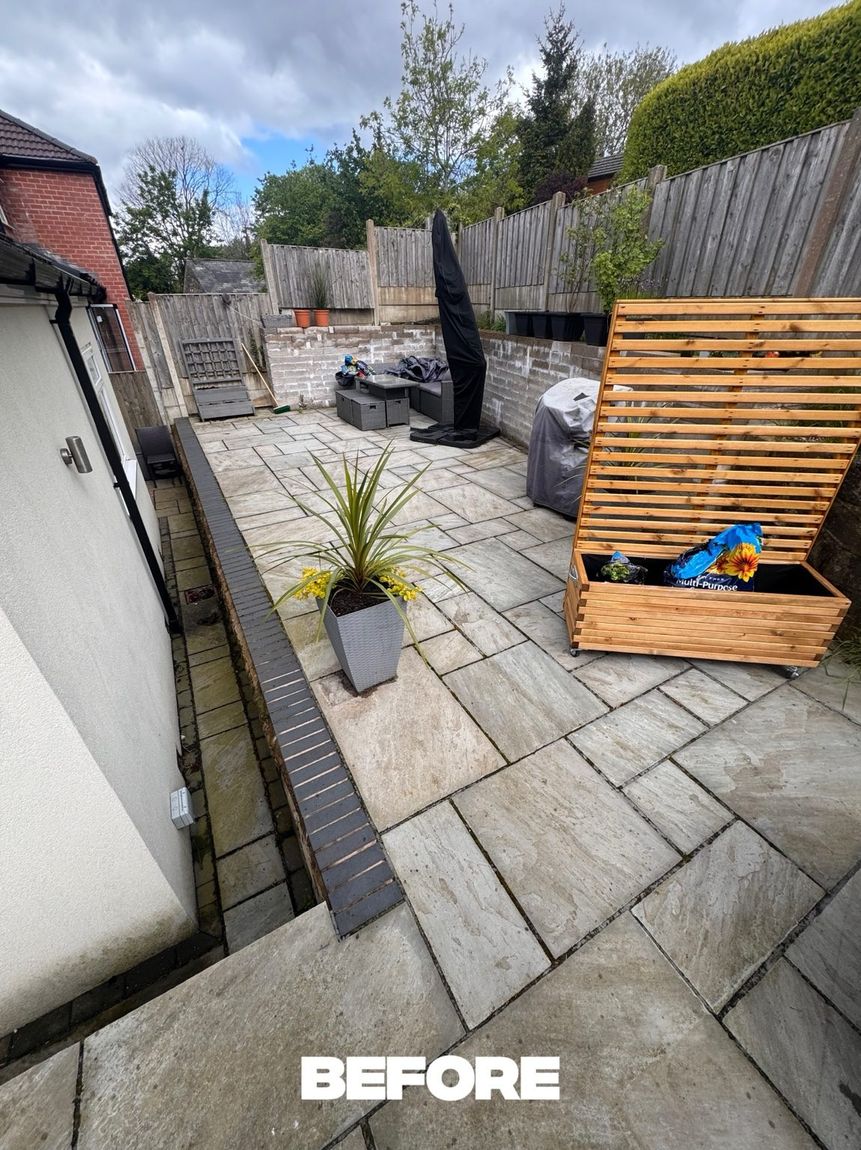
A typical porcelain patio before a professional clean — algae, traffic grime and grout discolouration.
Quick answer: The best way to clean porcelain slabs is a low-pressure rinse to remove loose debris, followed by a pH-neutral or alkaline cleaner applied with a stiff brush, then a careful pressure wash at no more than 1500 PSI using a wide fan jet. Avoid acid cleaners and turbo nozzles — they damage the surface and can lift grout.
Why Porcelain Needs a Different Approach to Other Paving
Porcelain is fired at extremely high temperatures during manufacture, which makes it dense and virtually non-porous. That's what gives it the stain resistance people pay for, but it also changes how cleaning products interact with the surface. On block paving or natural stone, a cleaning agent soaks in and gets to work at depth. On porcelain, it sits on top of the glaze. That's not necessarily a problem — it just means you're cleaning the surface rather than the material beneath — but it does mean the technique needs adjusting.
The density that makes porcelain stain-resistant also makes it less forgiving of aggressive cleaning. Block paving can take a rotary nozzle at close range and bounce back. Porcelain can't. The glaze will etch, the edges can chip, and the jointing compound between slabs can be blasted out entirely if you go in too hard. This isn't a material that rewards the approach of cranking the pressure up and standing close. It rewards the opposite.
It's also worth understanding that the grout or pointing between porcelain slabs behaves completely differently to the tiles themselves. The tiles are almost impervious; the jointing compound is not. Any cleaning method you use has to be safe for both, and that rules out some of the stronger chemicals that work perfectly well on other surfaces. For context, if you're curious how different the process is, our guide on patio cleaning covers the broader range of surfaces and why each one needs its own method.
The Right Equipment: Pressure, Jets and Nozzles
The single most common mistake people make when cleaning porcelain slabs is using too much pressure, usually because they've used the same machine on their driveway and assume the same settings will carry over. For porcelain, you want to stay below 1500 PSI, and you want a wide fan jet — a 25 to 40 degree nozzle. This spreads the force across a larger area and cleans without concentrating energy on one spot. A 0 or 15 degree pencil jet, or a turbo/rotary nozzle, is too aggressive. Those nozzles are useful on concrete or tarmac; on porcelain they'll etch the glaze and undercut the joints.
A surface cleaner attachment is worth considering if you've got a decent-sized area to cover. It works by spinning two or more jets inside a shroud, which keeps the spray at a consistent distance from the surface and distributes the pressure evenly. You get a more uniform result and you're far less likely to cause damage from hovering in one spot too long. It also keeps overspray down, which matters if you're working near rendered walls or fencing.
Whatever equipment you use, keep the nozzle around 30 cm from the surface and keep it moving. Stopping in one place, even briefly, concentrates the force and risks leaving marks. If your machine doesn't give you enough confidence over the pressure settings, that's usually a sign that a professional clean is worth considering — the cost of getting it wrong on porcelain tiles can be significant.
Which Cleaning Products Are Safe on Porcelain
The chemistry here is simpler than people often expect. You want a pH-neutral or mildly alkaline cleaner. Sodium percarbonate-based products — which release hydrogen peroxide when they dissolve in water — are effective on algae, green mould and most organic staining. Dedicated porcelain patio cleaners are widely available from builders' merchants and online, and most are formulated to be safe on both the tile and the grout. Products like Wet & Forget are popular because they're genuinely low-effort and work over time without needing pressure washing at all — useful for maintenance cleans rather than initial restoration.
What to avoid is equally clear: anything acidic. Hydrochloric acid-based cleaners, which are sometimes marketed for removing efflorescence or patio black spot, are not suitable for porcelain installations. The tile itself might survive, but the grout and jointing compound will not. Acid strips out the cementitious binder in the joints, which means you end up with loose, crumbling pointing — an expensive problem to fix. The same applies to some natural stone cleaners, which are formulated for different chemistry than porcelain requires.
Always do a small test patch with any new cleaner — apply it to an inconspicuous corner, leave it for the recommended dwell time, then rinse and check both the tile surface and the grout lines before committing to the full area.
Step-by-Step: How to Clean Porcelain Slabs Properly
Start with a low-pressure rinse — a garden hose is fine for this stage — to clear loose debris, leaves and surface dirt. Decomposing leaf matter is particularly worth removing before you apply any chemical, because it can interfere with how the cleaner works and it smears across the surface under pressure. Once the patio is rinsed, apply your chosen cleaner evenly across the slabs and leave it to dwell for ten to fifteen minutes. Don't let it dry out on the surface — if it's a warm day, mist it lightly to keep it active.
After the dwell time, work over any stubborn patches with a stiff-bristle brush — not a wire brush, which will scratch the glaze and damage the grout. Then come in with the pressure washer at the settings described above: wide jet, below 1500 PSI, 30 cm from the surface, slow overlapping passes. Work methodically in one direction where possible, pushing the dirty water off the patio rather than across it. When the whole area is done, finish with a clean water rinse to remove any residual cleaner.
Let the patio dry fully before inspecting the joints. Wet jointing compound can look worse than it is, and you'll get a much clearer picture of whether any re-pointing is needed once the surface is dry. If the joints have thinned out or have gaps, leaving them open will just accelerate the return of algae and weeds. This is the best way to clean porcelain slabs in a way that actually lasts — the rinse and inspection step at the end is where a lot of DIY cleans fall short.
Common Problems: Grout Haze, Algae and Efflorescence
Grout haze is the milky or cloudy film that sometimes covers porcelain slabs after installation, where grout residue has dried across the tile surface. It's one of the more frustrating problems because pressure washing alone won't shift it — you need a specialist grout haze remover, applied carefully according to the manufacturer's instructions. These products are formulated to dissolve dried grout residue without attacking the tile, but they're not the same as general patio cleaners and they're not interchangeable.
Green algae and black spot lichen are the most common complaints from homeowners across Greater Manchester, and both respond well to a sodium percarbonate treatment with adequate dwell time. Black spot in particular needs time — it roots into the surface and a rushed clean will shift the visible growth without killing it, meaning it returns within weeks. For heavy lichen, a second treatment after a few days often gives noticeably better results. This is essentially the same principle used in softwashing, where chemical dwell time does the real work rather than raw pressure.
White efflorescence — the powdery or crystalline white deposits that appear on grout lines — is mineral salt migrating up through the substrate as moisture moves through. The instinct is to blast it off at high pressure, but that tends to push it back into the surface or damage the grout. The better approach is to dry brush it off first, then clean normally. It often recurs in the first year or two after installation as the substrate dries out, and usually settles down on its own over time.
Should You Seal Porcelain Slabs After Cleaning?
Because porcelain is non-porous, the tiles themselves don't need sealing in the way that sandstone, limestone or block paving does. A sealer applied to the tile surface will sit on top of the glaze and peel off over time — it's not doing anything useful and it can actually make the surface more difficult to clean. This is a point worth understanding clearly before spending money on a surface sealer that isn't going to help.
The grout lines are a different matter. Unsealed grout is porous and absorbs staining readily — tea, algae, iron deposits from furniture, all of it. Sealing the grout lines after a thorough clean significantly slows down re-contamination and makes routine maintenance much easier. An impregnating grout sealer — one that soaks into the material rather than sitting on top — is what you want. Apply it carefully to the joints only, wipe any excess off the tiles before it dries, and reapply every couple of years. For comparison, sealing is a bigger decision on block paving, and our separate guide on block paving sealing covers that in more detail.
When to Call in a Professional Instead of DIYing It
There are a few situations where it's genuinely worth handing the job over. If the slabs are heavily coated in established algae or lichen, if the jointing compound has broken down significantly, or if you're not confident about the pressure settings on your machine, the risk of causing damage starts to outweigh the saving from doing it yourself. Porcelain tiles aren't cheap to replace, and if you've voided the manufacturer's warranty through incorrect cleaning, that cost lands entirely with you.
A professional clean on porcelain patio slabs will typically cost less than replacing even a small number of damaged tiles, and a good operator will spot jointing issues or other problems while they're there. C&C Precision Pressure Washing covers Greater Manchester and the surrounding towns, and the quickest way to get a realistic quote is to send a couple of photos over WhatsApp — one of the full area and a close-up of the worst patches. Most quotes come back the same day.
If the job extends beyond the patio itself — a driveway that needs attention at the same time, or block paving that's lost its jointing sand — it usually makes sense to address everything in one visit. You can see the full range of services at our services page to get a sense of what's typically covered in a single clean.
Quick Maintenance Routine to Keep Porcelain Looking Good
The biggest factor in how quickly a porcelain patio deteriorates is how much organic debris is allowed to sit on it. Decomposing leaves are one of the main staining agents — they release tannins that discolour both the tile surface and the grout lines, and under wet conditions that process happens fast. A regular sweep or blow with a leaf blower through autumn and winter removes the problem before it starts. It takes ten minutes and it makes a noticeable difference to how the patio looks by spring.
A light clean with a garden hose and a stiff brush every few months is usually enough to prevent significant build-up between more thorough annual or biannual cleans. You're not trying to restore the surface at this stage — just removing the layer of organic material that algae uses as a foothold. If you notice green growth starting to return in corners or along the north-facing edges of the patio, a diluted sodium percarbonate treatment applied early on will stop it from establishing before it becomes a full clean's worth of work.
Keeping on top of the maintenance in this way is genuinely the best way to clean porcelain slabs over the long term — not in the sense of a single deep clean, but as a routine that keeps the intervals between major cleans longer and the results when you do clean more consistent.
Frequently asked questions
Can you pressure wash porcelain slabs?
Yes, but you need to keep the pressure below 1500 PSI and use a wide fan jet rather than a turbo or pencil nozzle. Too much pressure — or the wrong nozzle — will etch the surface and blow out the jointing compound between the slabs. A surface cleaner attachment is ideal for larger areas.
What is the best cleaner for porcelain patio slabs?
A pH-neutral or mild alkaline cleaner is the safest choice — sodium percarbonate-based products work well on algae and organic staining, and dedicated porcelain patio cleaners are widely available. Avoid anything acidic, including patio black spot removers designed for natural stone, as they will damage the grout even if the tile itself survives.
Why do my porcelain slabs go green so quickly after cleaning?
Algae and green mould return fast in the UK climate, especially in shaded or north-facing areas. Regular removal of leaves and organic debris helps slow it down, as does treating the surface with a diluted sodium percarbonate solution every few months. Sealing the grout lines also reduces the foothold algae needs to establish itself.
How much does it cost to have porcelain slabs professionally cleaned in Greater Manchester?
The price depends on the size of the area, the condition of the slabs and how accessible they are. The easiest way to get an accurate figure is to send a couple of photos — ideally one of the full area and one close up of the worst patches — over WhatsApp and we'll give you a straight quote, usually the same day.
Got a porcelain patio that needs sorting?
Send a couple of photos over WhatsApp and we'll come back to you with a fast, no-fuss quote — usually same day.