The front of a house does a lot of work. It's the first thing a neighbour sees, the first thing a buyer notices, and — if you're a landlord — the first thing a prospective tenant judges before they've even knocked on the door. Driveway kerb appeal upgrades don't have to mean expensive landscaping or new block paving. In most cases, the surfaces you already have are perfectly good — they're just buried under a few years of Greater Manchester weather. This guide covers the practical steps that actually make a difference, in a sensible order, with honest notes on what to expect from each one.
The North West is hard on exterior surfaces. Between October and April, driveways, paths, and rendered walls barely dry out. That sustained moisture feeds algae, accelerates moss growth, and works into the joints of block paving in ways that cause real structural damage over time — not just cosmetic problems. Most of what follows is about reversing that process, surface by surface, and understanding which upgrades give you the most visible return for the least outlay.
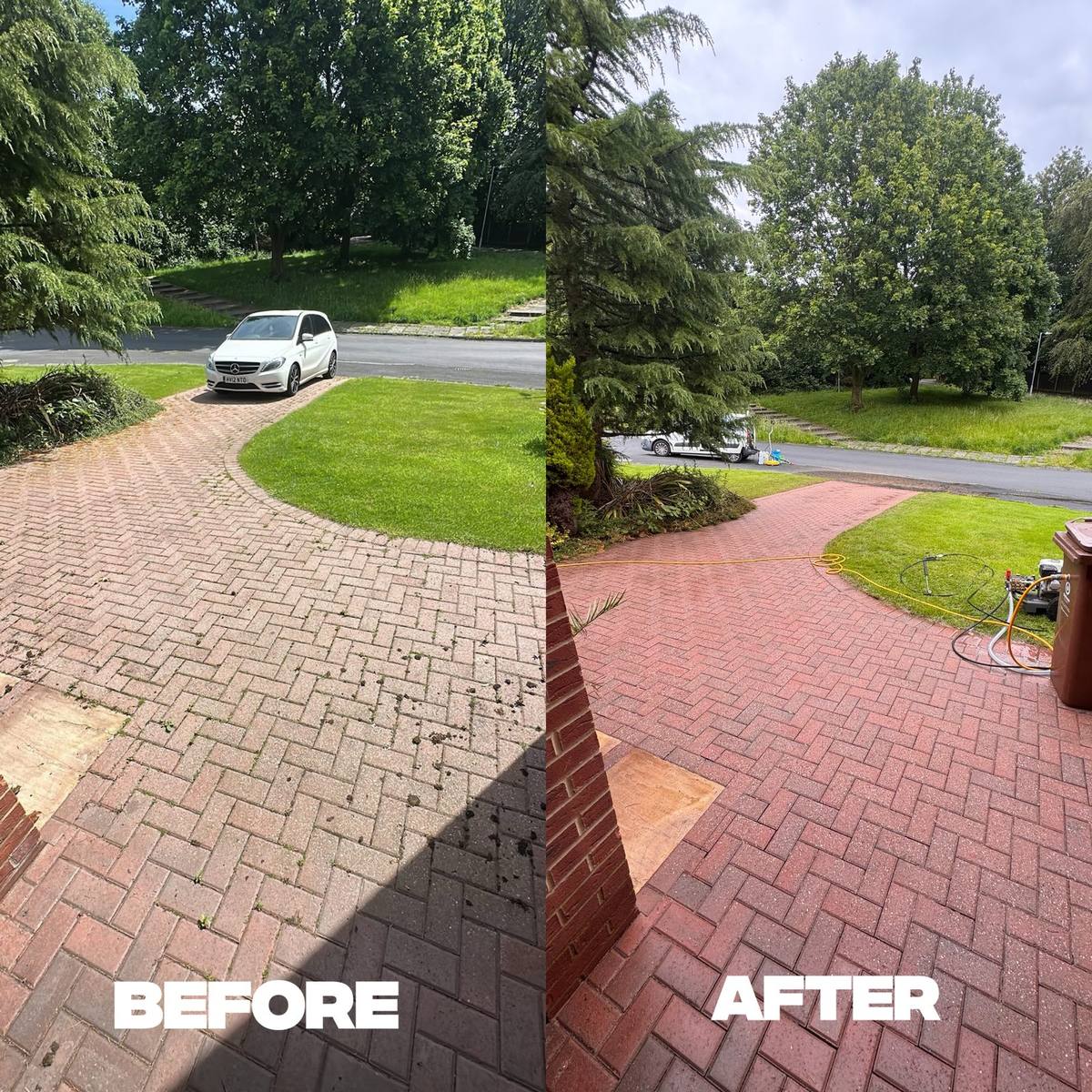
A single professional clean can add years to how a driveway looks — this red block paving job took less than a day.
Quick answer: The best driveway kerb appeal upgrades include professional pressure washing, block paving re-sanding, render softwashing, weed removal, joint sealing, edge restoration, path and wall cleaning, and fresh gravel topping. Most cost far less than replacement and can transform a property's exterior in a single day.
1. Professional Pressure Washing — the Single Biggest Return
A professional clean is almost always the highest-impact step in any driveway kerb appeal upgrade, and usually the lowest cost relative to the transformation it produces. Over three or four years, block paving and concrete accumulate a layer of compacted algae, organic debris, and ingrained dirt that home cleaning simply can't shift. A commercial rotary surface cleaner — the kind of equipment a professional uses — works at consistent, calibrated pressure across the whole surface, stripping that layer back evenly without leaving the tiger-stripe marks that a handheld lance produces.
The results regularly surprise homeowners. A driveway that looked like it needed replacing turns out to be in sound condition underneath. Colours that had faded to a uniform grey come back. Oil stains are worth a separate mention here — some lighten significantly, particularly older ones treated with a dedicated degreaser before washing, but deep-set oil staining into porous concrete or sandstone doesn't always vanish entirely. A reputable contractor will tell you that upfront rather than promising a result they can't guarantee. You can read more about what the process involves on the driveway cleaning page.
For most standard double driveways, a professional clean is also genuinely affordable — block paving cleaning runs from around £3.50/m² for a straightforward clean, so a 40m² driveway might cost between £140 and £170. That's meaningful change for what is often the most dramatic single improvement to a property's frontage.
2. Block Paving Re-Sanding With Kiln-Dried Sand
Re-sanding is the step most homeowners overlook, and it's the one that separates a driveway that looks clean from one that looks restored. When block paving is pressure washed, the jointing sand — which was already depleted through weathering and weed growth — gets flushed out further. Without fresh sand in the joints, the blocks have no lateral stability, water pools in the gaps, and weeds re-establish quickly. Kiln-dried sand is brushed in dry, worked into the joints, and left to settle and bind.
The visual difference is significant. Full joints give block paving a structured, finished appearance — the kind that looks deliberate rather than neglected. It also makes the surface easier to keep clean going forward because there are fewer open voids for debris and seed material to settle into. Re-sanding is almost always worth doing at the same time as cleaning rather than as a separate job later, both for cost efficiency and because the joints are cleanest immediately after washing. The block paving re-sanding page covers the process in more detail, including the difference between kiln-dried sand and a jointing compound for more heavily trafficked areas.
Pricing for re-sanding on its own starts from around £2.00/m², but a full restoration — clean, chemical treatment, and re-sanding — typically comes to around £5.50/m². That's the comprehensive route for a driveway that needs bringing back properly, rather than a cosmetic tidy.
3. Weed and Moss Removal From Joints and Edges
Weeds in block paving joints are often written off as a cosmetic nuisance, but they cause structural problems over time. As roots grow and expand, they lift individual blocks, introduce voids beneath the surface, and retain moisture in exactly the places you don't want it. In Greater Manchester's wet climate, a driveway with established weed growth in the joints can deteriorate noticeably within a few seasons if it's left untreated.
Pressure washing removes the visible plant material, but the roots and spores remain unless the surface is treated with a suitable biocide. A post-clean treatment applied with proper dwell time — the period the chemical needs to remain on the surface to be effective — kills off the organic matter at the root rather than just topping it. This is particularly relevant for moss, which returns quickly on shaded or north-facing driveways if it's only physically removed without any chemical treatment. If your driveway sits under trees or faces away from direct sun, expect to manage moss on a recurring basis rather than treating it once and considering it done.
If moss on the driveway is connected to a broader problem on the roof or in gutters, it's worth looking at the full picture. The guide on slippery driveways explains how algae and moss build up creates a genuine safety hazard beyond just the appearance.
4. Render and Fascia Softwashing to Freshen the Whole Frontage
A clean driveway next to a rendered wall covered in green algae or black mould streaks still looks tired. The frontage reads as a whole, and the contrast between a freshly cleaned driveway and a stained wall can actually make the wall look worse than it did before. Render is one of the most common exterior surfaces across Greater Manchester — pebbledash, smooth sand-and-cement, monocouche — and almost all of it is susceptible to algae and mould growth, particularly on north or east-facing elevations.
High-pressure washing is the wrong tool for render. It can force water behind the surface, crack weaker areas, and strip the finish — problems that cost significantly more to repair than the clean would have saved. Softwashing uses sodium hypochlorite at the correct dilution, applied at low pressure with adequate dwell time, to kill the organic growth at the root and rinse away cleanly. The result lasts considerably longer than pressure washing because the biocide continues working on residual spores after the job is done. The softwashing and render cleaning pages cover the chemistry and surface considerations in more detail.
Fascias, soffits, and downpipes are worth treating at the same time. They're quick to do and make a noticeable difference to the overall impression — particularly on older properties where plastic has started to discolour to a yellowish-grey.
5. Edge and Border Restoration — the Detail That Gets Noticed
The edges of a driveway accumulate soil, moss, and debris in a way that's easy to overlook — but which signals neglect immediately to anyone looking at the frontage. Kerb stones and border blocks get covered in a combination of compacted earth and biological growth that blurs the line between the driveway surface and the surrounding garden or pavement. Cleaning and defining those edges is a relatively small amount of work that has a disproportionate impact on how deliberate and well-maintained the whole surface appears.
It's similar to the difference between a room with freshly painted walls and scruffy skirting boards versus one where both have been done properly. The eye goes to the detail. Cleared, clean edges make block paving look set correctly, give concrete a defined perimeter, and prevent the soft ingress of soil that contributes to weed establishment along margins. It's rarely a significant addition to the cost of a clean but it's consistently one of the things that makes the finished result look professional rather than rushed.
If you're cleaning a driveway ahead of a house sale or rental, pay particular attention to the kerb stones and the strip of paving nearest the public footpath. That's the first few metres a viewer sees when they approach, and in a lot of cases it's the most weathered part of the surface.
6. Path, Wall, and Gate Cleaning to Complete the Picture
Kerb appeal is a whole-frontage impression, not just the driveway in isolation. A driveway that's been professionally cleaned but leads to a dirty front path, a stained garden wall, or a grimy gate undercuts the result. Buyers and tenants read the entire frontage — and a single neglected element creates the impression that maintenance has been selective rather than consistent.
Cleaning paths, boundary walls, and gates as part of the same job makes both financial and visual sense. A contractor already on site with equipment running can typically add a path or garden wall for a fraction of what a return visit would cost. Brick and stone walls respond well to pressure washing when done carefully, and wrought iron or timber gates clean up considerably with the right approach. If your property has a stone boundary wall that's looking particularly weathered, the stone cleaning page has detail on surface-appropriate methods.
For landlords, letting agents, and housing associations managing multiple properties across Greater Manchester, this kind of whole-frontage approach is also relevant at scale. Consistent exterior maintenance across a portfolio protects against void periods and damp-related damage. The commercial pressure washing page covers what that looks like operationally.
7. When to Call a Professional Rather Than Hiring a Pressure Washer
Hiring a pressure washer is a reasonable option for some jobs, but it has real limitations that aren't always obvious until the damage is done. Domestic and hire machines typically run at inconsistent pressure and lack the rotary surface cleaner head that's essential for block paving — without it, you end up with visible lance marks and, worse, joints eroded unevenly across the surface. Once sand is blasted out unevenly, the paving loses stability and water channels in ways that accelerate future deterioration. Re-sanding after a DIY clean is possible, but it's rarely as effective as following a professional clean where the joints have been cleared properly to an even depth.
Render, as covered above, should not be pressure washed at all with a hire machine. The same applies to soft sandstone, some forms of York stone, and any painted surface. Without the ability to softwash — which requires specific chemical handling knowledge and appropriate dilution ratios for sodium hypochlorite — organic staining on these surfaces either won't shift or will be driven deeper. Reading the surface correctly before applying pressure or chemical is something that takes experience to get right, and the cost of getting it wrong (cracked render, etched stone, lifted paving) tends to significantly exceed the cost of calling someone in from the start.
C&C Precision Pressure Washing covers Greater Manchester — Oldham, Rochdale, Bury, Bolton, Tameside, Stockport and surrounding areas — and quotes are typically given from photos sent on WhatsApp, which keeps the process straightforward. You can read how that works on the WhatsApp quote guide.
8. Prioritising Your Upgrades — a Practical Order of Work
The logical sequence for driveway kerb appeal upgrades is clean first, then re-sand and treat joints, then tackle surrounding surfaces. This order matters more than it might seem. Sealing block paving before cleaning traps dirt and biological material beneath the sealant — a mistake that's expensive to reverse. Applying jointing compound to joints that haven't been properly cleared will fail quickly. And treating render or fascias before the driveway is clean means overspray and run-off from the driveway clean may mark surfaces you've already finished.
If budget means phasing the work, the priority order is generally: driveway clean and re-sand first (highest visual return, prevents further joint damage), then surrounding paths and kerbs, then render and fascias. If you're considering sealing after cleaning, read the block paving sealing guide first — sealing isn't right for every surface or situation, and the decision is worth making with accurate information rather than a blanket assumption that it's always beneficial.
A realistic budget for a full front-of-house refresh on a standard semi-detached property — driveway clean with chemical treatment, re-sanding, and softwashing the rendered frontage — is typically in the range of £300 to £500 depending on size and condition. Done in phases, the driveway element alone is usually £150 to £250. Neither figure is insignificant, but set against the cost of replacing block paving, or against the impact on a property's marketability, it tends to represent straightforward value.
Frequently asked questions
How much do driveway kerb appeal upgrades cost in Greater Manchester?
A professional driveway clean typically starts from around £80–£150 for a standard single or double driveway, depending on size, surface type, and condition. Adding re-sanding or weed treatment increases the cost but is usually worth doing at the same time. Send photos on WhatsApp and we'll give you a straight price without the need for a site visit in most cases.
Is it worth cleaning a driveway before selling a house?
Yes — first impressions genuinely influence perceived value, and a clean, well-maintained driveway signals a cared-for property before buyers even reach the front door. A professional clean costs a fraction of what a dirty exterior could knock off an offer. It's one of the highest-return things you can do before listing.
How long does a professional driveway clean last before it needs doing again?
Most driveways in Greater Manchester need cleaning every one to two years, depending on how much tree cover, shade, and foot traffic they get. Re-sanding after a clean and applying a joint stabiliser can slow the return of weeds significantly. In wetter, shadier spots you'll be closer to the one-year mark.
Can you pressure wash all driveway surfaces, or are some unsuitable?
Most concrete, tarmac, and block paving surfaces are suitable for pressure washing when the right equipment and technique are used — a rotary surface cleaner gives an even clean without streaking. Render, painted surfaces, and some softer stone types should never be high-pressure washed and need softwashing instead. If you're unsure about your surface, send a photo and we'll tell you straight.
Want to know what your driveway upgrade would cost?
Send a couple of photos on WhatsApp and we'll come back to you with a fast, honest price — no sales call, no obligation.