If you've noticed a green, spongy layer creeping across your driveway, you're not alone. Moss on driveways is one of the most common exterior cleaning problems across Greater Manchester, and the question of how to clean a mossy driveway comes up regularly — particularly after a long damp winter. The good news is that it's a manageable job if you go about it the right way. The bad news is that done carelessly, it can damage your surface or leave you back to square one within a few months.
This guide walks through the whole process honestly — what kit you'll need, how to apply a biocide correctly, how to pressure wash without causing damage, and what to do afterwards to slow the return of moss. There are also a few points where DIY genuinely has its limits, and it's worth knowing those before you start.
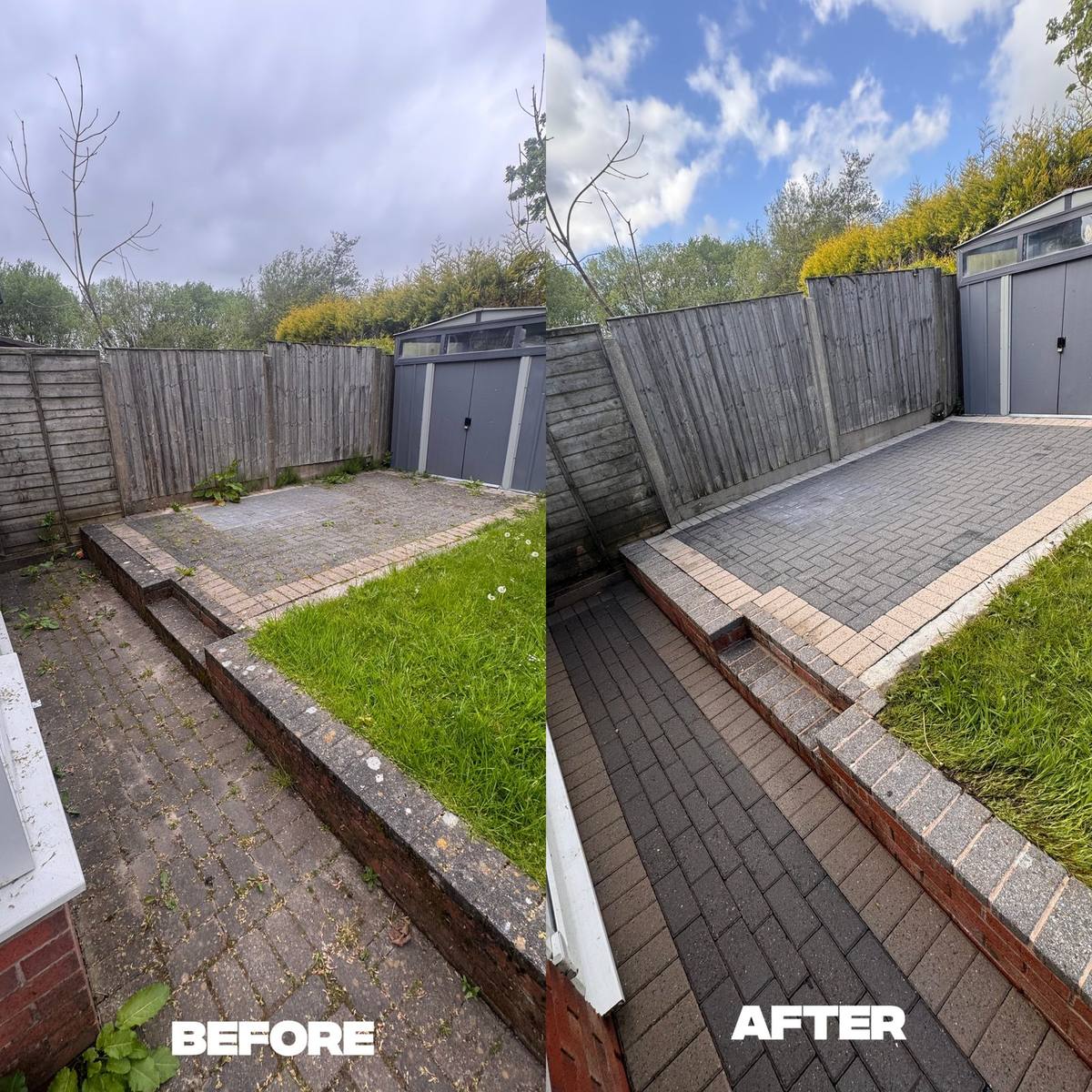
A typical mossy block paving job we cleaned in Greater Manchester — grime and moss fully removed in one visit.
Quick answer: To clean a mossy driveway safely, remove loose moss manually first, then apply a biocidal treatment or diluted sodium hypochlorite solution to kill the roots. Once dead, pressure wash at the correct pressure for your surface type. Seal or re-sand block paving afterwards to slow moss regrowth.
Why Moss Grows on Driveways in the First Place
Moss is a primitive plant that needs very little to survive — moisture, shade, and a foothold. Driveways provide all three, especially in the north of England where the climate does the rest. Greater Manchester sits in one of the dampest parts of the country, and extended periods of wet weather between October and April give moss exactly the conditions it needs to establish itself.
North-facing driveways are particularly susceptible because they dry out slowly — sometimes not at all during a grey November week. Block paving and concrete both have textured surfaces with plenty of small gaps and joints where organic debris collects: leaf mulch, soil, wind-blown seeds. That debris sits damp in the joints and becomes the growing medium moss needs. Poor drainage makes things worse, pooling water where it has no business sitting.
Overhanging trees and shrubs accelerate the problem significantly. They drop organic matter directly onto the surface, create shade that prevents drying, and drip condensation long after rain has stopped. If you have a moss problem on your driveway, there's usually a combination of these factors at work rather than just one.
Is Moss on a Driveway Actually Dangerous?
The most immediate risk is practical: moss becomes extremely slippery when wet. Unlike dry concrete or tarmac, a wet mossy surface has almost no grip, and a fall on a hard driveway is a serious injury. That risk is higher in autumn and winter when the surface rarely dries out between rainfall, but a damp spring morning is enough. If elderly relatives, children or delivery drivers use your driveway, this is worth taking seriously rather than putting off.
Beyond slip risk, moss causes slower but real structural damage. The rootlets — technically called rhizoids — work their way into joints and small cracks. In block paving, this gradually displaces joint sand and can cause blocks to rock or shift. In concrete or tarmac, it widens existing cracks. Water gets in, and in winter, freeze-thaw cycles do the rest: water expands when it freezes, and cracks that started small become noticeably larger over several winters.
Water retention is a related problem. A thick moss layer acts almost like a sponge, holding moisture against the surface rather than letting it drain away. That constant damp accelerates deterioration in pointing, grout, and the surface material itself. Getting on top of a moss problem sooner rather than later is genuinely cheaper in the long run.
What You'll Need Before You Start
For a DIY clean, the basics are a stiff-bristled brush, a garden sprayer (a standard pump-action one works fine), a biocide or appropriately diluted sodium hypochlorite solution, a pressure washer, and proper PPE — at minimum waterproof gloves and eye protection. Sodium hypochlorite is an irritant and you don't want it splashing into your eyes or sitting on your skin while you work.
The pressure washer matters more than people often realise. A domestic machine with a turbo or rotary nozzle can easily strip the kiln-dried sand from block paving joints if you hold it too close, and high-pressure zero-degree nozzles can etch concrete or tarmac surfaces. A fan nozzle at around 25–40 degrees, held at a consistent distance of 20–30 cm, is a much safer starting point. If you're working on block paving, be particularly careful — the joints are the most vulnerable part of the surface and losing the sand means the blocks can start to flex underfoot.
Pattern-imprinted concrete (also called printed or stamped concrete) needs even more care. The surface sealant that gives it its colour and sheen can be damaged by aggressive pressure washing, so lower pressure and wider nozzle angles are essential. If you're not sure what material your driveway is, it's worth finding out before you start rather than discovering the hard way.
Step-by-Step: How to Clean a Mossy Driveway
Start by brushing off as much loose and thick moss as you can with a stiff broom. This isn't just tidying up — removing the bulk of the growth means your biocide or chemical treatment can penetrate properly rather than sitting on top of a thick mat of dead organic matter. Bag up the debris and bin it rather than leaving it on the lawn, where spores can spread.
- Apply your biocide or diluted sodium hypochlorite solution using a garden sprayer. If you're using bleach, a dilution of roughly 1 part bleach to 5–10 parts water is a reasonable starting point for most surfaces — but check the product guidance. Wet the whole surface evenly and avoid overspray onto plants, borders or painted surfaces.
- Allow proper dwell time. This is the step most people skip, and it's the most important one. Leave the solution to work for at least 24–48 hours. It needs time to kill the moss at the root rather than just the surface growth. You'll often see the moss turning brown or black — that's what you want.
- Pressure wash the surface using the correct nozzle for your surface type, working in consistent overlapping passes. Keep your distance even, don't linger in one spot, and work with any natural drainage slope so you're pushing water and debris away from the property.
- Rinse thoroughly, particularly around borders, drains and any areas where run-off could affect plants or enter drainage. Sodium hypochlorite dilutes rapidly but concentrated run-off can still harm garden plants if you're not careful.
Surface-specific differences are worth noting. Tarmac is relatively forgiving but can be marked by very high pressure — keep the nozzle moving. Concrete can handle more pressure but is prone to surface etching if you use a zero-degree nozzle at close range. For block paving specifically, a professional driveway clean often involves a surface cleaner attachment rather than a lance, which delivers even pressure across a wider area and reduces the risk of stripping joints unevenly.
Apply your biocide or bleach solution on a dry day with no rain forecast for at least 24 hours. Rain immediately after application simply washes the chemical away before it has time to work, and you'll have wasted both product and effort. Check the forecast before you start.
Common Mistakes That Damage Your Driveway
The most frequent mistake is using too much pressure too close to the surface. It feels satisfying to blast moss off quickly, but a domestic pressure washer on full power with a narrow nozzle held 10 cm from block paving will strip the joint sand out in one pass. Those empty joints then fill with water and organic debris, and the moss returns faster than before. It also causes the blocks to become unstable over time.
Using neat bleach without dilution is another common error. Undiluted bleach can cause permanent staining on lighter block paving colours, damage nearby plants, and in some cases react badly with certain surface sealants. Always dilute, always rinse run-off. Related to this — rushing straight to the pressure washer without applying a biocide first, or not waiting for dwell time, means you're just mechanically moving moss and spreading spores around rather than killing it. The results are worse and moss returns more quickly. If you want to understand more about what actually kills algae and moss chemically rather than just removing it physically, the guide on what actually removes algae from paving covers this in more detail.
Finally, many people forget about run-off. Chemical solutions draining into flower borders or sitting in drains are worth thinking about before you start, not after. Move pots, cover borders if needed, and rinse the surrounding area thoroughly once you've finished pressure washing.
When to Call a Professional Instead of DIYing It
There are situations where the DIY approach either won't achieve a good result or risks making things worse. Large driveways — anything over 60–70 square metres — will generally exceed what a domestic pressure washer can handle efficiently in terms of flow rate and cleaning power. A professional machine operates at much higher flow rates, which makes a meaningful difference to the quality of the clean, not just the speed.
Block paving that needs re-sanding after cleaning is another case where professional help makes sense. Re-sanding correctly involves brushing kiln-dried sand into the joints evenly and compacting it properly — it's more involved than it sounds, and doing it badly can leave joints uneven or cause sand to wash out quickly. If you're looking at block paving restoration rather than just a surface clean, that typically covers cleaning, re-sanding and sealing as a package, and the pricing reflects the multiple stages involved.
Heavy black lichen — the dark, encrusted patches that are different from ordinary green moss — is genuinely difficult to shift without the right chemistry and equipment. It bonds to surfaces much more firmly than moss, and a domestic pressure washer alone won't remove it. The same is true of pattern-imprinted concrete, where pressure control really matters to avoid damaging the surface seal. C&C Precision covers all of these scenarios across Oldham, Rochdale, Bury, Bolton, Manchester, Tameside and Stockport — quotes are straightforward, just send a few photos on WhatsApp and you'll usually have a price the same day.
How to Stop Moss Coming Back
Re-sanding block paving joints after cleaning is probably the single most effective thing you can do to slow moss regrowth. Empty joints are open invitations — they collect debris, retain moisture and provide the foothold moss needs to re-establish. Fresh kiln-dried sand packed into the joints removes that foothold, improves the stability of the blocks, and makes a real difference to how long the clean lasts. This is why block paving re-sanding is often done as part of a full clean rather than as a separate job.
Sealing is worth considering but isn't always necessary. A penetrating sealant reduces the porosity of the surface, making it harder for moss spores to grip and easier to clean in future. It works better on some surfaces than others — concrete and natural stone tend to respond well, while tarmac is generally left unsealed. If you're considering sealing, it's worth doing proper research first, as the wrong sealant type on certain surfaces can cause discolouration or trap moisture beneath the surface.
Practical maintenance makes a difference too. Keep gutters and downpipes clear so water isn't dripping or sheeting directly onto the drive. Trim back overhanging trees and shrubs where possible — even reducing shade by a small amount improves drying time significantly. Be realistic about expectations, though: in the north of England, moss will return eventually. With good aftercare, a properly cleaned and re-sanded driveway in Greater Manchester can stay clear for two to four years. That's a reasonable result given the climate, not a failure.
Frequently asked questions
Can I use bleach to clean a mossy driveway?
Yes, but it needs to be properly diluted — neat bleach can stain block paving, kill nearby plants and damage the surface. Sodium hypochlorite at the right concentration is exactly what professionals use, and it's effective at killing moss and algae at the root. Always rinse run-off away from borders and drains.
Will a pressure washer alone remove moss from a driveway?
A pressure washer will blast visible moss off, but it won't kill the spores left behind, so moss tends to return faster. For a lasting result you should apply a biocide or diluted bleach solution first, let it dwell, then pressure wash. This kills the roots rather than just moving the problem around.
How much does it cost to have a mossy driveway professionally cleaned in Greater Manchester?
Price depends mainly on the size of the driveway and the condition it's in — a heavily mossy drive with compacted joints takes longer than a lightly marked one. The quickest way to get an accurate figure is to send a couple of photos on WhatsApp; C&C Precision typically comes back with a price within the hour.
Do I need to re-sand my block paving driveway after cleaning?
In most cases, yes — pressure washing removes a lot of the kiln-dried sand from the joints, and those empty joints are exactly where moss and weeds take hold again. Re-sanding with fresh kiln-dried sand after cleaning locks the blocks together, improves stability, and significantly slows the return of moss. It's a worthwhile step if you want the results to last.
Want a Mossy Driveway Sorted Without the Hassle?
Send a couple of photos on WhatsApp and we'll come back with a straight price — usually within the hour.