Choosing the right porcelain patio cleaner is genuinely more complicated than it looks. Porcelain has become one of the most popular paving choices across Greater Manchester over the last decade, and for good reason — it's hard-wearing, frost-resistant, and holds its colour well even through the kind of persistent damp weather we get here in the North West. The problem is that its density and glazed surface, which make it so attractive, also mean it responds very differently to cleaning products than natural stone or concrete does. Get the chemistry wrong and you can dull the surface, attack the pointing, or strip the glaze — sometimes without even realising it until the damage is done.
This guide runs through the main product types available, when each one is appropriate, and where the line sits between a sensible DIY clean and a job that's better left to someone with the right equipment. The honest answer is that most porcelain patios can be maintained fairly easily with the right approach — but heavy staining, failed grout, or a large area done badly will always cost more to fix than it would have to sort properly in the first place.
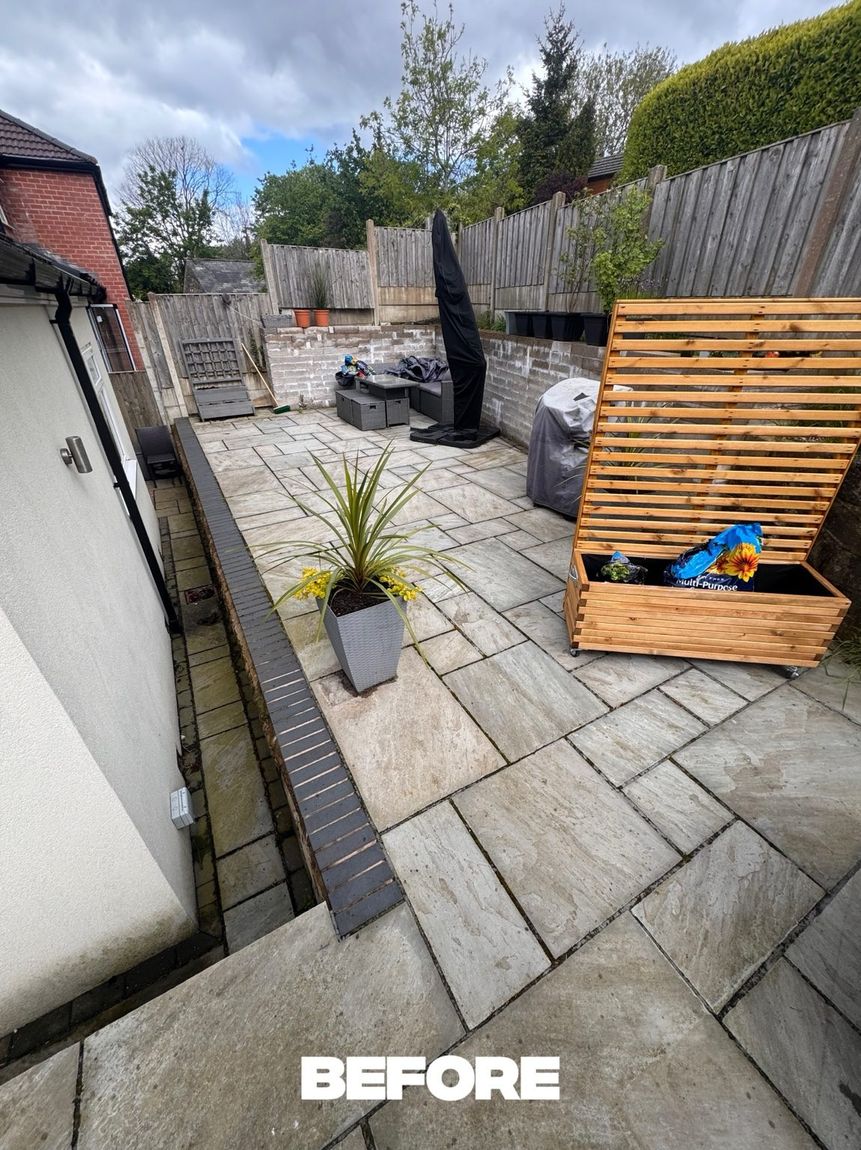
A typical porcelain patio job before we started — green algae and traffic grime built up over two seasons.
Quick answer: The most effective porcelain patio cleaner depends on what you're removing. For algae and general grime, a pH-neutral cleaner with low-pressure washing works well. For stubborn stains or grout haze, a diluted acidic cleaner may be needed — but high pressure and harsh chemicals can damage the glaze permanently.
What Makes Porcelain Different From Other Paving?
Porcelain is fired at much higher temperatures than ceramic or standard clay-based tiles, which drives out nearly all the moisture and creates an extremely dense, low-porosity material. The factory-applied glaze on top seals it further. That combination is what gives porcelain its smooth, near-maintenance-free reputation — water and most contaminants sit on the surface rather than soaking in, which is why it performs so well in wet climates like ours.
That same density is why you can't treat it like Indian sandstone or concrete. Sandstone is porous enough to absorb a sealer or accept a stronger cleaning solution without surface damage. Porcelain largely isn't. Anything aggressive — high-concentration acid, alkaline degreasers formulated for concrete, or abrasive cleaners — risks etching the glaze or dulling the surface finish. On lower-quality porcelain tiles, the damage shows quickly. On premium tiles it may take longer, but it still happens.
The grout or pointing between the tiles is a different material entirely — usually cement-based and far more porous — and it behaves differently under cleaning chemicals. A product that's perfectly safe on the tile face can still damage the pointing, which is where most of the problems come from when people use the wrong cleaner without thinking about the whole surface.
pH-Neutral Cleaners: The Safe Starting Point
For routine maintenance and light biological growth, a pH-neutral porcelain patio cleaner is the correct first step. Products like Lithofin KF, Fila Cleaner, or their various trade and own-brand equivalents are formulated specifically to clean hard surfaces without attacking the glaze, the grout, or any surrounding materials. They're widely available from tile suppliers and most builders' merchants in the Greater Manchester area.
Applied with a stiff brush or a soft rotary brush attachment, and rinsed off with a garden hose or low-pressure rinse, a pH-neutral cleaner will handle most light soiling, surface algae, and general grime without any real risk of damage. It's also the safest option if your patio is close to planted beds — neutral chemistry won't harm soil biology or kill off plants if a small amount washes off the edge.
The limitation is that pH-neutral cleaners won't shift everything. Mineral deposits, efflorescence, or cement haze from installation are alkaline or calcium-based, and a neutral cleaner simply doesn't have the chemistry to break them down. If your patio still looks grey or hazy after a thorough neutral clean, you're likely dealing with something that needs a different approach.
Acidic Cleaners: When They Help and When They Don't
Diluted acidic cleaners — phosphoric acid solutions or citric acid-based patio products — are the right tool for mineral deposits, efflorescence, and cement grout haze. These are calcium-based problems, and acid dissolves calcium. Used at the correct dilution and rinsed off within the recommended dwell time, they're effective and reasonably safe on quality porcelain tiles.
The dwell time instruction on the label matters more than most people realise. Acid cleaners work by reacting with the mineral deposits on the surface — leave them too long and they start reacting with the grout or pointing instead, which softens and degrades it. On lower-quality porcelain, particularly textured or matte-finish tiles, extended contact with acid can also affect the surface itself, leaving it with a slightly dulled or patchy appearance that can't easily be reversed.
Always test in a hidden area first — a corner behind a planter or along the back edge of the patio — and check after 24 hours before treating the full surface. If you're not sure whether your tiles are high enough quality to handle an acidic cleaner safely, the manufacturer's technical documentation will usually specify. If you can't find it, err on the side of caution and start with neutral.
Bleach and Sodium Hypochlorite on Porcelain: What You Need to Know
Diluted bleach or sodium hypochlorite will kill biological growth — moss, algae, lichen — on porcelain effectively. The tile surface itself is highly resistant to sodium hypochlorite at the concentrations used for exterior cleaning, so the concern isn't the tiles. It's everything around them. SH will bleach timber decking, damage paintwork, and kill plants quickly if it runs off without being properly managed, and in a typical back garden in Oldham or Rochdale that's a very real risk.
Dwell time here works in your favour — sodium hypochlorite needs to sit on biological growth for 15 to 30 minutes to do its job properly, which is why professional soft washing uses it diluted and applied carefully rather than blasted on at high pressure. But that same dwell time increases the risk to pointing material and anything nearby. If you're using it yourself, protect garden beds, fence panels, and timber with plastic sheeting beforehand, and rinse the area thoroughly when the dwell time is done.
One more thing worth saying clearly: bleach doesn't clean porcelain, it disinfects and kills growth. If the surface has physical dirt or mineral staining underneath the biological layer, the bleach won't address that. You'll often need to follow up with a neutral cleaner and a scrub once the biological matter has been killed and rinsed away.
Pressure Washing Porcelain: Technique Matters More Than the Cleaner
Most damage to porcelain patios isn't caused by the wrong chemical — it's caused by too much pressure applied too close to the surface. A domestic pressure washer used carelessly, particularly with a turbo or pencil-jet nozzle, will chip tile edges, erode grout lines, and blast out the pointing between tiles. Repointing a porcelain patio is time-consuming and not cheap, so it's worth being clear about this before you start.
The correct approach is a rotary surface cleaner attachment at controlled pressure — generally under 1,500 PSI — which distributes the pressure evenly and moves constantly across the surface rather than concentrating it in one place. A fan nozzle kept moving at a consistent distance works too. What you want to avoid is holding the lance stationary, using a narrow-angle nozzle at close range, or cranking the pressure up because the surface isn't coming clean fast enough.
If your porcelain patio has recently been laid and still has pointing that hasn't fully cured — usually anything less than four weeks old — don't pressure wash it at all yet. The mechanical action will pull out the jointing compound before it's had time to harden properly. Let it cure fully, then start with gentle cleaning methods only.
It's also worth reading our guide on sealed vs unsealed paving if you're unsure whether your porcelain has been treated with any kind of surface coating — some anti-slip coatings applied after installation can be sensitive to pressure washing in a way that plain glazed porcelain isn't.
When to Call a Professional Instead of DIYing It
There are situations where DIY cleaning on porcelain is the right call, and there are situations where it isn't. Heavy biological staining that's worked its way into failed pointing, grout haze left over from installation, or a large patio where doing half the job and stopping would leave an obvious tideline — these are all cases where professional equipment and product knowledge will get a better result than a domestic pressure washer and a bottle of supermarket cleaner.
A professional will also have access to trade-grade chemical concentrations, surface cleaners that maintain consistent pressure across the whole head, and the experience to read a surface and know which chemistry to use without testing to destruction. If your patio is under a manufacturer guarantee, it's worth checking the small print too — many specify that cleaning must be carried out within certain pressure and chemical parameters, and a botched DIY attempt can void coverage that would otherwise pay for repairs.
C&C Precision Precision Washing covers patio cleaning across Greater Manchester — including Oldham, Rochdale, Bury, Bolton, and Stockport — and quotes are straightforward: send photos over WhatsApp and you'll get a clear price back quickly. If you want to see what professional results actually look like, the before and after results page gives a realistic picture.
Practical Takeaway: Matching the Right Cleaner to Your Problem
Start with a pH-neutral porcelain patio cleaner and low pressure for anything that falls into routine maintenance — surface algae, general grime, light soiling. That handles the majority of what a patio in the North West accumulates over a season without putting anything at risk. Step up to a diluted acidic product only when you're dealing with specific mineral or cement-based staining, always at the manufacturer's recommended dilution, and always test in a hidden area first.
If you're dealing with heavy moss or biological staining, sodium hypochlorite at low concentration with proper dwell time is effective — but manage the runoff carefully and follow up with a neutral clean once the biology is dead. And whatever product you're using, keep pressure low and keep the nozzle moving. The surface cleaner attachment on a good pressure washer is worth the cost of hiring one for a day if you're covering a large area.
The broader point is that porcelain is more forgiving of the wrong chemistry than natural stone — but it's not indestructible, and the pointing between tiles absolutely isn't. If at any stage you're unsure what you're dealing with, stop. A question asked before you start costs nothing. Damage to a recently installed porcelain patio can cost several hundred pounds to put right, and some of it — etched glaze, chipped edges — can't be fully reversed at any price. For related reading on maintaining hard surfaces in wet conditions, the guide on why driveways become slippery covers the same underlying biology and chemistry in a different context.
Frequently asked questions
Can I use a pressure washer on a porcelain patio?
Yes, but technique is everything. Keep pressure under 1500 PSI, use a fan nozzle or rotary surface cleaner, and never hold the lance in one spot. Too much direct pressure chips edges and blasts out pointing, which is expensive to repair.
Will bleach damage my porcelain patio tiles?
Porcelain itself is highly resistant to diluted bleach and sodium hypochlorite, so the tiles are generally safe. The risk is to the pointing material between them and to any surrounding plants, timber or paintwork — so rinse thoroughly and protect anything nearby before you apply it.
Why does my porcelain patio still look dirty after cleaning?
The most common cause is grout haze — a film of cement residue left over from installation that ordinary cleaning won't shift. It needs a diluted acidic cleaner applied carefully and then thoroughly rinsed. If the tiles themselves look dull rather than hazy, check whether the surface has been scratched by previous cleaning attempts.
Does porcelain paving need sealing after cleaning?
Generally no — porcelain is non-porous, so sealers can't penetrate the tile surface and usually just sit on top, creating a film that looks patchy and attracts dirt. The exception is the pointing or grout between tiles, which can benefit from a joint sealant to stop weeds and biological growth taking hold.
Not sure what's safe to use on your porcelain patio?
Send a photo of your patio over WhatsApp and we'll give you a fast, honest quote for a professional clean.