Most people use the terms interchangeably, but gutter clearing vs cleaning is a genuine distinction that affects what you actually get done and whether your gutters are left in good working order afterwards. It sounds like a minor point, but if you book the wrong service — or a contractor doesn't explain the difference — you can end up with gutters that are technically unblocked but still draining poorly, still staining your fascia, and still likely to cause problems further down the line.
This guide explains what each service involves, which one your property is likely to need, and how to judge what's appropriate before you pick up the phone or send a message. It's written for homeowners and landlords across Greater Manchester, where the climate means gutters tend to need attention more regularly than most people plan for.
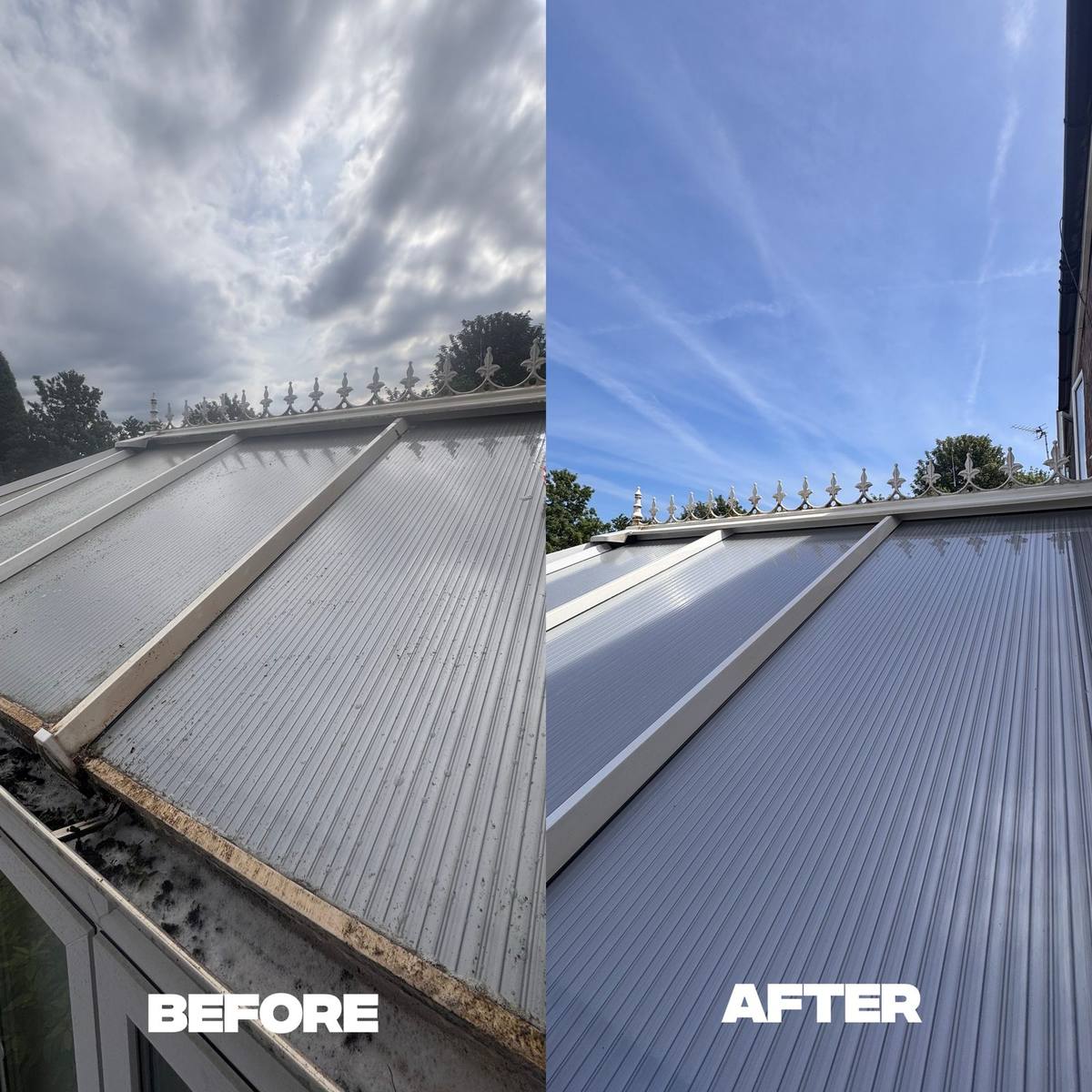
Moss and debris blocking the gutter line — a clear example of why clearing and cleaning are two separate jobs.
Quick answer: Gutter clearing removes blockages — leaves, debris and compacted muck — so water can flow freely. Gutter cleaning goes further, flushing out residue, scrubbing interior surfaces and checking downpipes. Most homes need clearing annually and a deeper clean every two to three years.
What Does Gutter Clearing Actually Mean?
Clearing is the reactive end of the job. It means physically removing whatever is causing the blockage — compacted leaves, clumps of moss that have worked their way off the roof, twigs, bird nesting material, or just years of organic matter that has built up and compacted into a solid mass. The goal is straightforward: get the debris out so water can move through the gutter channel again.
It's the service most people need when they notice gutters visibly overflowing during rain, or when they spot a heap of debris sitting in the channel from the ground. It's also the most common emergency call — someone notices water cascading down the side of their house during a downpour and wants it sorted quickly. In that situation, clearing is the right first step.
What clearing doesn't necessarily include is any flushing of the channel, removal of the silt layer that settles beneath the debris, or checking that downpipes are clear all the way to ground level. You might get all of that, or you might not — it depends entirely on the contractor and what they've agreed to do. That ambiguity is exactly why understanding the difference matters.
What Does Gutter Cleaning Involve?
Cleaning is the more complete version of the job. Once the bulk debris is removed, the inside of the gutter channel is flushed with water to shift the remaining silt, algae residue, and any finer material that clearing alone won't shift. Any green or black biological growth on the interior surfaces gets scrubbed away, and the downpipes are checked and flushed to confirm water is running freely from gutter to drain.
The end result is a gutter system that's functioning properly, not just unblocked. The water flows at the right rate, drains quickly after rain, and isn't being slowed by a layer of compacted silt sitting at the bottom of the channel. That distinction matters more than it sounds, because slow-draining gutters — ones that always have a puddle sitting in them — create the conditions algae and moss need to grow back faster.
Cleaning also gives the contractor a proper look at the condition of the gutters themselves. Cracked joints, failing brackets, or sections that have dropped slightly and are holding water rather than draining it are much easier to spot when the debris is out and the channel is flushed. Catching a cracked joint early is a cheap repair; leaving it until it's causing damp to the wall behind it is considerably more expensive.
Why the Difference Matters for Your Property
A gutter that's been cleared but not cleaned can still be half-full of silt and biological growth. That's enough to cause slow drainage, and slow drainage means water sitting against the fascia board and the back of the gutter — which over time leads to fascia rot, paint failure, and in older properties, damp patches appearing on the external wall. It also means the gutter refills with debris faster, because the organic residue left behind is exactly what new growth needs to take hold.
Understanding the gutter clearing vs cleaning distinction stops you from either paying for more than you need or being undersold a job that leaves the underlying problem in place. If your gutters were cleared last year and you're already seeing slow drainage or green staining running down the fascia, it's likely that a full clean — including a flush — is overdue. If your gutters are structurally fine and just visibly blocked after a heavy autumn, clearing may be all that's needed right now.
This connects to broader exterior maintenance decisions too. If you're already dealing with algae growth on render or moss on the roof, the gutters are often part of the same problem — debris from the roof feeds the gutters, and overflow from the gutters stains the walls. A softwash treatment on the render or a roof clean and moss removal job alongside gutter maintenance can break that cycle rather than just treating each symptom separately.
How Often Do Greater Manchester Homes Need Each One?
Greater Manchester's climate is the relevant factor here. It's one of the wetter parts of England, and the combination of regular rainfall, mild temperatures, and heavy tree cover across suburbs like Saddleworth, Royton, and Shaw means gutters block faster than in drier parts of the country. Organic matter doesn't dry out and blow away — it sits damp and compacts quickly, and biological growth establishes itself fast in those conditions.
For most properties in the region, clearing once a year makes sense — ideally in late autumn, after the main leaf fall is done but before the worst of the winter rain arrives. That timing means you're going into the wetter months with clear gutters rather than trying to clear them in the middle of January when they're already overflowing. A full clean, including flushing and downpipe checks, is worth doing every two to three years for most properties — more frequently if there are trees directly overhead or if the roof has significant moss coverage.
For landlords and housing associations managing multiple properties across areas like Rochdale, Bury, or Tameside, the economics of combining gutter maintenance with other planned exterior work often make more sense than treating each property reactively. If you're already arranging commercial pressure washing for a block of flats or a retail unit, adding gutters to the same visit is straightforward. The commercial pressure washing checklist covers how to structure that kind of planned maintenance properly.
Signs Your Gutters Need Clearing vs a Full Clean
Overflowing gutters during rain are the most obvious sign that clearing is needed — water spilling over the front edge of the channel means something is stopping it from flowing through. Visible plant growth, such as grass or weeds rooted in accumulated debris, points to the same issue. Sagging sections, where the weight of wet, compacted debris has pulled the gutter away from its brackets, are another clear sign that clearing is overdue.
If the gutters drain reasonably well but you're seeing persistent damp patches on external walls, green or brown staining running down the fascia, or the kind of slow low-level overflow that only appears during heavy rain, that usually points to a cleaning job rather than a simple clearing. The channel itself is likely coated in silt and algae that's narrowing the effective drainage capacity without completely blocking it.
A useful rule of thumb: if you can see debris from the ground, you need clearing. If the gutters look empty from below but are still draining slowly or staining the fascia, you need cleaning. The two problems look different and need different approaches.
When to Call in a Professional
For single-storey sections — a garage roof, a bay window, a low-level extension — some homeowners are comfortable working safely from a stepladder. Anything above that, particularly two-storey or three-storey gutters, is a different matter. The height alone creates real risk, and if the ladder needs to be positioned on uneven ground or near a corner, the margin for error narrows further. A professional with the right access equipment — whether that's a scaffold tower, a sectional ladder system, or a vacuum clearing rig — can work safely at height in a way that a standard extending ladder simply doesn't allow.
If the gutters are heavily overgrown, connected to a flat roof section, or haven't been maintained in several years, a professional inspection as part of the job is also worth having. A contractor who's flushing the downpipes and checking joints will spot a cracked section or a failing bracket before it becomes a water ingress problem. C&C Precision Precision Pressure Washing covers gutter clearing and cleaning across Greater Manchester — the quickest way to get a quote is to send a couple of photos over WhatsApp, which means we can give you a straight answer without needing to visit first.
It's also worth considering what else might be due at the same time. If moss is coming off the roof and feeding directly into the gutters, clearing the gutters without addressing the roof means you'll be back in the same position within a year. Similarly, if driveway cleaning or patio cleaning is on your list, combining jobs on the same day is usually more cost-effective than separate visits.
Practical Advice: Getting It Right First Time
The timing of the job matters more than most people realise. Booking in late November, once the bulk of leaf fall is done, means you're clearing the full season's debris rather than clearing early and finding the gutters blocked again by February. It also means going into the wettest months — typically December through February in Greater Manchester — with a system that's ready for the volume of water it's going to handle.
When you're getting quotes, ask specifically whether the job includes a flush of the downpipes. If it doesn't, you're getting clearing only. That's not necessarily wrong — it may be all that's needed — but you should know what you're getting. The gutter clearing vs cleaning question is worth raising directly with any contractor, because the answer tells you a lot about whether they're being straight with you.
The fastest way to get an accurate quote is to send a couple of photos showing the gutters, the roofline, and the height of the property. A decent contractor can work out what's involved from photos in most cases, which saves time on both sides. If you're also thinking about surface cleaning — whether that's block paving cleaning or stonework — the driveway kerb appeal upgrades guide is worth a read for context on what makes a real difference to how a property looks from the street.
Frequently asked questions
Is gutter clearing the same as gutter cleaning?
No. Clearing removes the physical blockage — leaves, debris, and compacted moss — so water can flow again. Cleaning goes further by flushing the gutters, removing silt and algae residue, and checking the downpipes are clear. You might need one or both depending on the condition of your gutters.
How much does gutter clearing cost in Greater Manchester?
Price depends on the size of your property, how many storeys it is, and how blocked the gutters are. A standard semi-detached will typically cost less than a large detached with a complex roofline. The quickest way to get an accurate figure is to send photos — we can usually quote from those without needing to visit first.
Can blocked gutters cause damp inside the house?
Yes, and it happens more often than people expect. When gutters overflow, water runs down the external wall repeatedly rather than being channelled away. Over time that saturates the masonry, and damp can work its way through — particularly on older solid-wall properties common across Greater Manchester.
Do you offer gutter clearing as a standalone service or only combined with other work?
We offer it as a standalone service — there's no obligation to book anything else alongside it. That said, if we're already on site for a roof clean or softwash, combining jobs usually works out cheaper per job than booking them separately, so it's worth mentioning everything you need upfront.
Not sure which one your gutters actually need?
Send a photo of your gutters on WhatsApp and we'll tell you straight what's needed and what it'll cost.