If you've noticed your driveway turning green, black, or just generally grim over the past year or two, you're not imagining it. Driveway cleaning in Uppermill is something we get called out for regularly, and the results are usually striking — not because we do anything dramatic, but because the surfaces underneath are often in decent shape once the organic growth is removed. The problem isn't the paving; it's the climate and the shade that Saddleworth's elevated position creates.
This guide covers everything you'd reasonably want to know before booking a clean or picking up a pressure washer yourself — what causes the build-up, how different surfaces are treated, what re-sanding involves, and what a realistic price looks like. If you're already familiar with the basics and just want a quote, you can send photos over WhatsApp and we'll come back to you the same day.
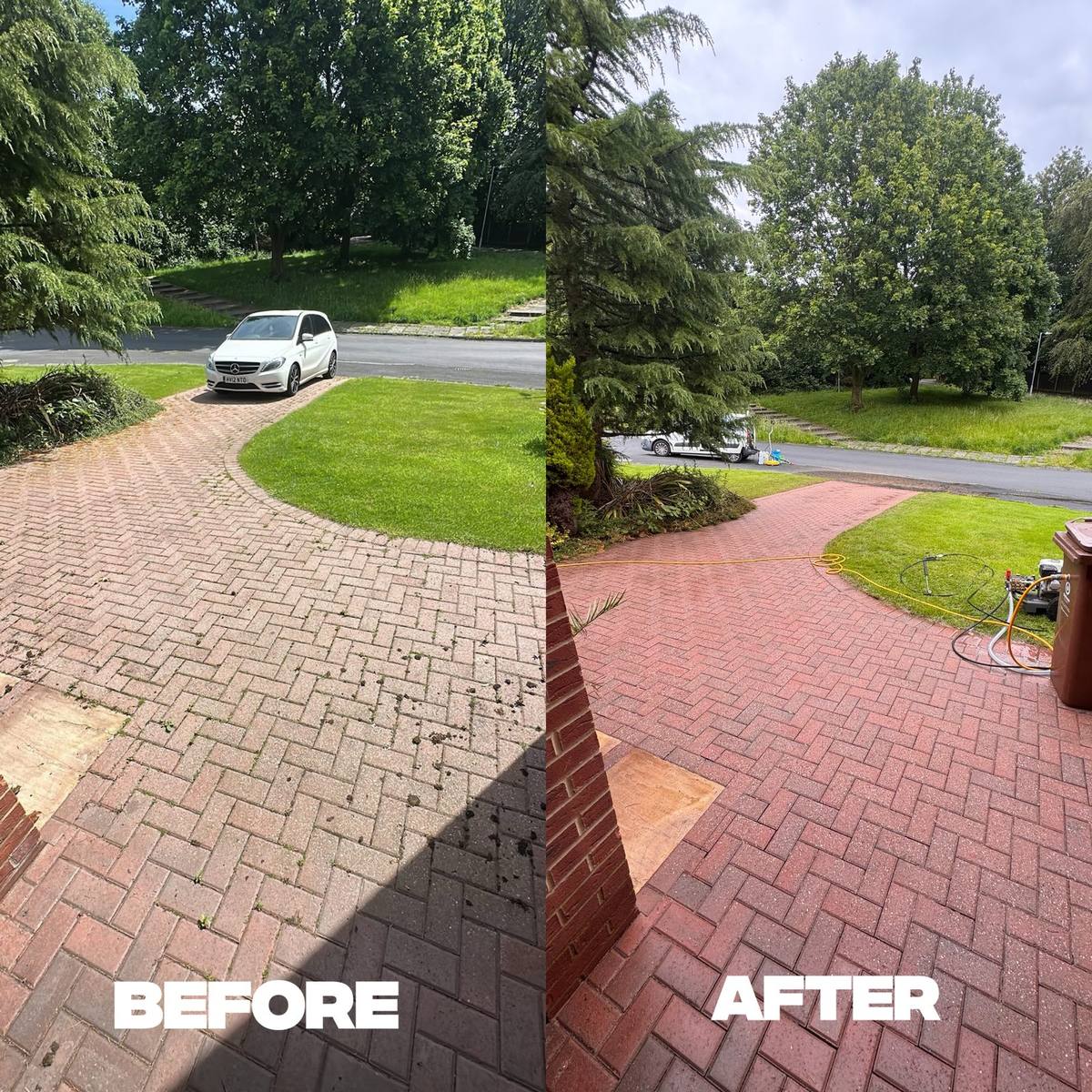
Block paving driveway — before and after a full clean. Results typical of Saddleworth jobs we carry out regularly.
Quick answer: Driveway cleaning in Uppermill typically involves pressure washing to remove moss, algae, and grime from block paving, concrete, or stone surfaces. Most Saddleworth driveways take two to four hours and cost between £80 and £250 depending on size and condition. Re-sanding block paving afterwards is strongly recommended.
Why Uppermill Driveways Get Dirty So Fast
Saddleworth sits at the eastern edge of Greater Manchester, up on the Pennine fringe, and the difference in rainfall compared to lower parts of the region is noticeable. The area catches weather coming in off the moors and tends to stay damp for longer after rain. That persistent moisture, combined with the shade cast by stone walls, mature trees, and north-facing aspects on many older properties, creates near-perfect conditions for moss, algae, and lichen to take hold on paving surfaces.
Algae and black spot (a form of cyanobacteria) are particularly stubborn because they don't need much light to thrive — they just need damp. Once a thin biofilm establishes itself in the texture of a block or slab, it absorbs more moisture, and the colony grows. Left for a season or two, what started as a slight discolouration becomes a slippery, deeply embedded layer that no amount of garden-hose rinsing will shift. Moss follows a similar pattern, rooting into jointing sand and gradually pushing blocks out of level.
The elevation also means Uppermill sees more freeze-thaw cycles through winter than somewhere like Stockport or south Manchester. Water works into cracks, expands, and opens them up further. So by spring, many driveways here are carrying not just surface growth but structural movement in the paving itself — something worth factoring in before any cleaning starts.
Common Driveway Surfaces in Uppermill and How Each One Cleans
Block paving is probably the most common driveway surface across Saddleworth, particularly on housing built from the 1980s onwards. It responds well to pressure washing, but the process strips out the kiln-dried jointing sand between the blocks — which is expected and manageable, but needs to be addressed afterwards (more on that below). The surface itself is robust, and a rotary surface cleaner at the right pressure will bring it up cleanly without damaging the blocks. You can read more about the full process on our block paving cleaning page.
Natural stone — sandstone, granite, and Yorkshire stone in particular — is common on older Saddleworth properties, and it needs more care than concrete-based surfaces. Softer sandstones can etch or scuff if the pressure is set too high, and some imported Indian sandstone is quite porous, meaning it holds moisture and biological growth more stubbornly. The correct approach involves lower pressure, appropriate dwell time on any pre-treatment, and patience. Our stone cleaning work covers this in more detail. Concrete driveways are generally straightforward — they handle higher pressure well and clean up quickly. The main issue is that bare concrete can look patchy after cleaning if it was already weathered unevenly, which is worth knowing in advance. Tarmac is the surface that requires the most restraint — too much pressure or too close a distance and you'll strip the surface aggregate. It cleans best with a wide fan, lower pressure, and a biocide pre-treatment where moss is established.
What a Professional Driveway Clean Actually Involves
The job starts before the pressure washer comes out. Where there's heavy moss or algae, a pre-treatment solution is applied and left to dwell — typically 10 to 20 minutes depending on the growth and the product being used. This breaks down the biological material at the root rather than just blasting the surface layer off. Skipping this step means you're working harder with the pressure washer than you need to, and you'll likely see regrowth faster because you haven't treated the underlying spores.
Once pre-treatment has done its work, a rotary surface cleaner — not just a lance — does the main cleaning. A rotary head spins two jets in a contained housing, which means even coverage, no streaking, and consistent pressure across the whole surface. Edge work is done by hand with a lance, getting into the kerb lines and any areas the rotary head can't reach cleanly. The surrounding path, steps, or garage door threshold usually gets a clean-down as part of the job too, so the driveway doesn't look clean while everything around it looks tired.
For a standard domestic driveway in Uppermill, the result is a surface that looks dramatically better — usually close to the original colour of the block or stone. Honest expectation: some deep staining from oil or rust may lighten rather than fully disappear. Old oil stains that have cured into the surface for years are not always fully removable, and anyone who tells you otherwise isn't being straight with you. We'll flag anything like that when we see your photos.
Block Paving Re-Sanding: Why It Matters After Cleaning
Pressure washing block paving removes the kiln-dried sand from the joints between blocks. That sand is structural — it locks the blocks together, prevents lateral movement, and closes the joints against weed seed germination and ant colonies. Leave a block paved driveway without re-sanding and within a season you'll have weeds threading up through every joint, ant hills appearing under the blocks, and paving that starts to rock underfoot.
Re-sanding involves sweeping kiln-dried jointing sand across the dry surface, working it into the joints with a stiff brush, compacting it with a plate compactor if needed, and then topping up until the joints are fully filled. It sounds simple, but the surface needs to be completely dry for the sand to settle properly — rushing this on a damp Saddleworth afternoon will leave you with compacted wet sand that doesn't fill correctly. If you're curious about the warning signs that your existing paving is already past due for this work, our guide on top signs your paving needs resanding is worth a read.
For anyone weighing up whether to go a step further with sealing after a clean and re-sand, the guide on block paving sealing: is it worth it covers that honestly. In short — it can help on the right surface in the right circumstances, but it's not universally necessary and it's not a substitute for regular maintenance.
How Much Does Driveway Cleaning Cost in Uppermill?
Pricing for driveway cleaning is based on surface area, surface type, and the condition of the driveway. For block paving, a clean alone starts from around £3.50/m². If the job includes a chemical pre-treatment for heavy algae or black spot, expect around £4.25/m². A full restoration — clean, re-sand, and joint fill — runs from £5.50/m². If your paving was recently cleaned but just needs the joints topped back up, re-sanding only is around £2.00/m².
To give you a rough sense of what that means in practice: a small terrace driveway of around 25m² cleaned and re-sanded would be in the region of £135–£150. A medium semi-detached driveway of 40–50m² with moderate moss and full re-sanding would typically be £220–£275. A larger detached property with a double-width drive, heavy soiling, and a full restoration would often fall between £350 and £500 depending on condition and access. These are honest ballpark figures — the final price depends on what we see in your photos.
What drives cost up: extensive moss growth that needs pre-treatment and longer dwell time, difficult access, block paving that's badly sunken or disturbed (which may need a stonemason rather than a cleaning crew), and larger areas. What keeps cost down: recently laid paving with light soiling, good site access, and a straightforward rectangular layout without awkward corners or planted beds to work around.
Send photos of your driveway over WhatsApp before committing to anything. A quick look at the surface, the size, and the condition gives a much more accurate quote than any price-per-square-metre guide can — and it takes about two minutes on your end.
When Should You Call a Professional Instead of DIY?
Renting a consumer pressure washer and having a go yourself is a reasonable option for light soiling on a fairly modern concrete or block paved drive. The results can be decent, and if you're careful with the pressure and work methodically you'll make an improvement. The limitation is that domestic hire machines often lack the consistent flow rate of trade equipment, which means you can end up with uneven results and longer time on site for a finish that's still not quite right.
The situations where calling a professional makes more sense are fairly clear. If you have heavy moss that's established over several years, you need a biocide pre-treatment and the right dwell time, not just higher pressure. If you have natural stone — particularly softer sandstone — the margin for error is small and an expensive driveway can be permanently marked by the wrong approach. If your block paving needs re-sanding afterwards, a hire machine won't come with that service, and leaving the joints empty defeats the purpose of the clean. C&C Precision covers all of this as part of a single job, which is why most customers in Saddleworth find it simpler to just book a professional rather than piece it together themselves.
If you're looking at other surfaces around the property — render, roof moss, or a soiled garden wall — our softwashing service uses sodium hypochlorite to safely treat biological growth on surfaces that can't take direct pressure, and our roof cleaning and moss removal work operates on the same low-pressure principle.
How to Keep Your Driveway Cleaner for Longer
The single most effective habit is brushing organic debris off the surface regularly — autumn leaves in particular. Decomposing leaf matter is a food source for moss and algae, and if it sits in the joints or corners of your paving through the wet months, you're accelerating the growth cycle significantly. A stiff outdoor broom once a fortnight through October and November makes a real difference to how long a cleaned driveway stays looking good.
Keeping the edges of the drive clear matters too. Where grass or planted borders butt up against paving, moisture and organic material migrate inwards. Cutting a clean edge between the lawn and the paving reduces that transfer. On block paving specifically, a quality sealant applied after a thorough clean can slow moss and algae regrowth by reducing the surface porosity and making it harder for spores to establish. It's not a permanent fix and it does need reapplying every few years, but on a well-maintained driveway it's worth considering.
In Saddleworth's climate, most driveways benefit from a maintenance clean every 12 to 18 months. Leaving it to every three or four years means you're dealing with ingrained growth rather than surface growth, which takes longer and costs more to remove. A lighter clean on a regular cycle is almost always more cost-effective than a full restoration after years of neglect. If you're thinking about kerb appeal more broadly — perhaps ahead of a sale or a property refresh — the guide on driveway kerb appeal upgrades that actually work has some practical, unsentimental suggestions worth looking at.
Frequently asked questions
How long does driveway cleaning take in Uppermill?
Most standard driveways take between two and four hours on site. A heavily soiled driveway with deep moss or a large area of block paving that also needs re-sanding can take a full day. We'll give you a realistic time estimate when you send your photos over.
Will pressure washing damage my block paving or stone driveway?
Used correctly, pressure washing is safe on block paving, concrete, and most natural stone. The risk comes from using too high a pressure on softer sandstone or from stripping jointing sand without re-sanding afterwards. A professional sets the right pressure for each surface and deals with the re-sanding as part of the job.
Do you need to use chemicals or is water pressure enough?
For most driveways, a rotary surface cleaner with clean water is sufficient to get a great result. Where there's a heavy algae or black spot problem — common on shaded Saddleworth driveways — a pre-treatment biocide helps break down growth before pressure is applied. We'll tell you upfront if it's needed.
Do you cover Uppermill and the rest of Saddleworth?
Yes — Uppermill, Delph, Greenfield, Diggle, Dobcross and the surrounding Saddleworth villages are all areas we cover regularly from our base in Oldham. Travel to these locations is included in the quote with no added call-out fee.
Want a price for your Uppermill driveway?
Send a couple of photos on WhatsApp and we'll come back with a fast, honest quote — no need for a site visit first.