Lees is a quiet part of Oldham — terraced streets, semis from the interwar years, and a fair number of newer builds tucked in around the older housing stock. What ties most of them together is the North West weather: persistent damp, low winter sun and the kind of slow-growing algae and moss that turns a driveway from clean to green without anyone really noticing until it's quite far gone. If you've been looking into driveway cleaning in Lees, this guide covers what's involved, what it costs, and what to watch out for depending on the surface you've got.
There's no shortage of pressure washing services around Oldham, but the quality varies considerably. A proper clean isn't just about shifting surface dirt — it's about treating the underlying growth, using the right equipment for the surface, and leaving the drive in a condition that stays cleaner for longer rather than greening back up within a few months. What follows is an honest account of how the work is done and what you can reasonably expect from it.
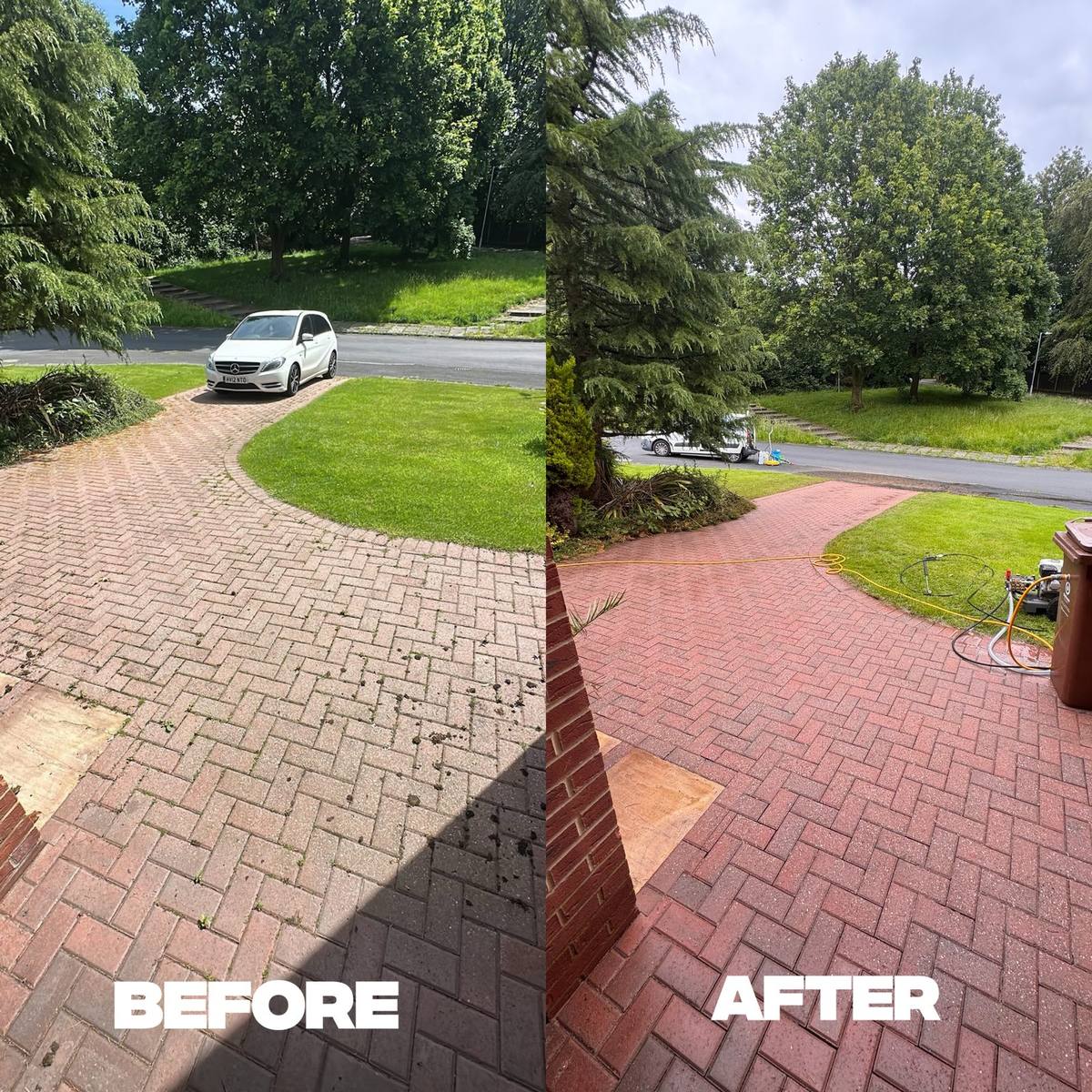
Block paving driveway in Greater Manchester — same surface, two hours of work, completely transformed.
Quick answer: Driveway cleaning in Lees typically costs £80–£250 depending on size and surface type. A professional uses a rotary surface cleaner and pre-treatment to remove algae, moss, oil and staining. Most driveways are done in a few hours, left same-day dry, and look noticeably better immediately.
What Driveways in Lees Are Actually Made From
Lees has a fairly typical mix of Greater Manchester housing stock. Older semis and terraces often have concrete drives — sometimes original, sometimes resurfaced at some point — while tarmac is common on properties from the 1970s and 80s. Newer builds and those that have had driveways replaced in the last twenty years are more likely to have block paving, and pattern imprinted concrete (sometimes called PIC or decorative concrete) shows up across the area too, particularly on drives laid between roughly 2000 and 2015.
Each surface needs a different approach. Concrete and tarmac are generally the most straightforward — pre-treat, pressure wash, rinse. Block paving needs jointing sand managed carefully throughout the process. Imprinted concrete has a sealed surface that complicates things further, because the condition of that sealer affects what cleaning can safely achieve. Knowing what you've got before booking anyone in saves time and avoids mismatched expectations.
Natural stone flags occasionally appear on older properties and in rear yards across Lees. These can be pressure washed, but stone varies significantly — some flags are quite porous and soft, others are dense and hardwearing. For anything that looks like genuine sandstone or limestone, it's worth mentioning this when getting a quote, since overly aggressive cleaning can cause surface erosion on softer materials.
What a Professional Driveway Clean Actually Involves
A proper driveway cleaning job starts before any water is applied. A pre-treatment solution — typically a biocide or a surfactant-based cleaner, depending on the surface and level of contamination — is applied and left to dwell. Dwell time matters: ten to twenty minutes is usually enough to break down algae, lichen and organic matter so the pressure washing phase is doing the final removal rather than fighting the growth in real time. On heavily contaminated drives that haven't been touched in several years, a stronger pre-treatment and a longer dwell is the norm.
The cleaning itself is done with a rotary surface cleaner — a shrouded spinning head that keeps pressure consistent across the surface and stops the fan marks and streaking you get when someone runs a lance back and forth across a drive. Edges, steps and anything the surface cleaner can't reach are done by hand with a lance at a controlled angle and distance. Once the main area is cleaned, everything is rinsed down thoroughly so no residue is left sitting on the surface.
The finish you get depends on the starting condition and the surface type. Most drives come up very well; years of green algae and grey grime clear off to reveal the original colour beneath. Some deep oil stains — particularly old ones that have fully cured into concrete — lighten rather than disappear completely, and it's worth knowing that going in rather than being disappointed afterwards. Honesty about what's achievable is part of getting the brief right from the start.
How Much Does Driveway Cleaning Cost in Lees?
A standard single driveway in Lees — say, enough for one car, in reasonable condition — typically comes in between £80 and £150. That range accounts for variations in size, surface type and how bad the contamination is. A double driveway or a long drive serving a detached house will naturally sit higher, and anything that needs additional treatment — chemical application for heavy algae, re-sanding after cleaning, or a reseal on imprinted concrete — adds to the total.
For block paving specifically, cleaning starts from around £3.50 per square metre for a basic clean. A clean with chemical pre-treatment for heavily contaminated surfaces runs from about £4.25/m². Full restoration including re-sanding comes in from £5.50/m², and re-sanding on its own — if the drive has already been cleaned — is around £2.00/m². These figures give a useful ballpark, but the most accurate way to get a quote for driveway cleaning in Lees is to send a few photos over WhatsApp. You'll usually get a figure back the same day without needing a site visit for a standard driveway. For guidance on how the quoting process works in practice, this piece on how exterior cleaning quotes actually work is worth a read.
Block Paving: Cleaning and Re-Sanding
Block paving is the most common driveway surface on newer and updated properties around Lees, and it needs the most aftercare of any drive type. The jointing sand between the blocks does an important structural job — it keeps individual blocks stable, prevents lateral movement and acts as a partial barrier against weed seed germination in the joints. Pressure washing removes a proportion of that sand, and if it isn't replaced, blocks can start to rock slightly and weeds will be back within a single growing season.
Re-sanding uses kiln-dried sand, which is dry and fine enough to flow into the joints properly rather than sitting on top. It's swept in after cleaning, worked into the joints with a brush, and the excess is cleared away. It's not a complicated process but it makes a real difference to how long the clean results last. Block paving re-sanding is worth building into the quote from the start rather than treating as an optional extra — on most block drives that haven't been maintained regularly, it's the right thing to do.
Weeds in joints before cleaning are worth dealing with as part of the job too. The pre-treatment biocide kills off existing growth and slows regrowth, but if there's a significant weed problem established in the joints, it's a sign the sand has already degraded. There's a more detailed look at this in the guide on how to remove weeds from block paving.
Pattern Imprinted Concrete: A Different Beast
Imprinted concrete is poured, textured and then sealed — the sealer is what gives it that slightly glossy finish and the vivid colour when it's new. The problem is that sealer doesn't last indefinitely. UV exposure, traffic and the freeze-thaw cycle in a damp climate like Greater Manchester's all break it down over time. When the sealer starts to fail, the surface goes dull and grey, and in worse cases the sealer turns milky or begins to flake, which looks far worse than an unsealed surface.
Cleaning an imprinted concrete drive helps, but what it can achieve depends heavily on the sealer condition. If the sealer is still largely intact, a professional clean will brighten the surface noticeably. If the sealer has failed or is failing, cleaning will remove surface dirt but the underlying deterioration remains. A full clean and reseal restores the original colour and re-establishes the protective layer — without it, the concrete itself is exposed to the elements and the deterioration accelerates.
One thing worth knowing: applying a new sealer over a failed or partially flaking one doesn't work well. The surface needs to be clean and sound for the new sealer to bond properly. This is one area where getting a professional view on the condition of the surface before doing anything is genuinely useful rather than just a sales pitch.
When to Call a Professional Instead of Hiring a Karcher
A domestic pressure washer — the sort available from DIY sheds or hired for a weekend — runs at significantly lower flow rates than trade equipment. That means it takes longer, cleans less thoroughly, and is more likely to leave visible fan marks on the surface because the operator is compensating for lack of power by getting closer or working in inconsistent strokes. On block paving, a domestic machine strips sand unevenly and is harder to control around joint edges. On imprinted concrete with a failing sealer, forcing water under the surface at close range can lift the sealer further. There's a fuller look at where DIY pressure washing makes sense and where it doesn't in this guide: DIY pressure washing — is it actually worth it?
If the drive is lightly dirty and was cleaned within the last year or two, a domestic machine in competent hands can maintain it reasonably well. If it's heavily green, hasn't been done in several years, or needs re-sanding or resealing alongside the clean, professional equipment and the right pre-treatments will produce a substantially better result and save a fair amount of frustration. The pre-treatment chemical work alone — applied correctly and left to dwell — does a job that a domestic washer without it simply can't replicate.
C&C Precision Precision Pressure Washing covers Lees and the wider Oldham area as part of their core working patch, with trade rotary equipment, biocide treatments and full public liability insurance to £1,000,000. If you're unsure whether a job warrants professional help, sending a photo over WhatsApp gives you a quick honest answer without any obligation.
Practical Tips Before Booking a Driveway Clean in Lees
Clear the drive before the team arrives — bins, plant pots, ornaments and any parked vehicles. It sounds obvious, but arriving to a partially blocked drive either delays the job or means part of it gets missed. If there's a car that can't be moved, mention it when booking so the team can plan around it rather than finding out on the day.
Check your block paving joints before getting a quote. Press a finger into a joint — if it feels hollow, crumbles easily or there's very little sand visible, factor re-sanding into the price from the start. It's far easier to do it as part of the clean than to come back for it separately, and it significantly extends how long the results last.
Timing matters more than most people realise. Spring and early autumn are generally the best windows for driveway cleaning in Lees — temperatures are moderate, surfaces dry reasonably quickly, and you're either clearing a winter's worth of growth before summer or tidying up before the darker months set in. Midsummer in a dry spell is also fine; the main thing to avoid is booking on a day when frost is forecast overnight, particularly if any sealer work is planned. Finally, if you're thinking about sealing the surface yourself after a clean, get a professional opinion first — not all surfaces benefit from sealing, and applying the wrong product to block paving or stone can cause problems that are harder to fix than the original staining.
Frequently asked questions
How long does driveway cleaning take in Lees?
Most standard driveways are finished in two to three hours. Larger or heavily soiled surfaces can take longer, and if re-sanding or resealing is included, allow most of the day. The drive can usually be walked on within an hour of finishing and driven on the same day.
Will pressure washing damage my block paving or imprinted concrete?
Done correctly with the right equipment and pressure settings, it won't. The risk comes from using a domestic washer at too close a range, which can etch surfaces or force sand out unevenly. A rotary surface cleaner distributes pressure evenly and avoids the streaking you often get with a lance alone.
Do I need to resand my block paving after it's cleaned?
In most cases, yes — pressure washing removes a proportion of the jointing sand. Without it, blocks can shift slightly and weeds establish themselves much faster. Kiln-dried sand is swept in after cleaning and compacted into the joints; it's not expensive and makes a noticeable difference to how long the results last.
Do you cover Lees and the surrounding parts of Oldham?
Yes — Lees sits right in our core working area. We cover the whole of Oldham along with Rochdale, Bury, Bolton, Tameside, Stockport and central Manchester. If you're not sure whether we reach your postcode, just drop us a message and we'll confirm straight away.
Want a fast quote for your Lees driveway?
Send a couple of photos over WhatsApp and we'll come back with a price the same day — no need for a site visit first.