If you've been searching for driveway cleaning in Ashton-under-Lyne, chances are you've noticed what most homeowners here already know: driveways in this part of Tameside can look tired and green within a year or two of being laid or last cleaned. That's not a reflection of how well you look after your home — it's simply the environment. The combination of the North West's persistent damp, relatively low winter sun and the close-packed terraced streets that characterise much of Ashton means organic growth rarely gets a chance to dry out and die off on its own.
This guide covers everything practical: why it happens, what a professional clean actually involves, how much it costs, and when it's genuinely worth calling someone in rather than hiring a machine and doing it yourself. The aim is to give you enough information to make a confident decision, whatever you end up doing.
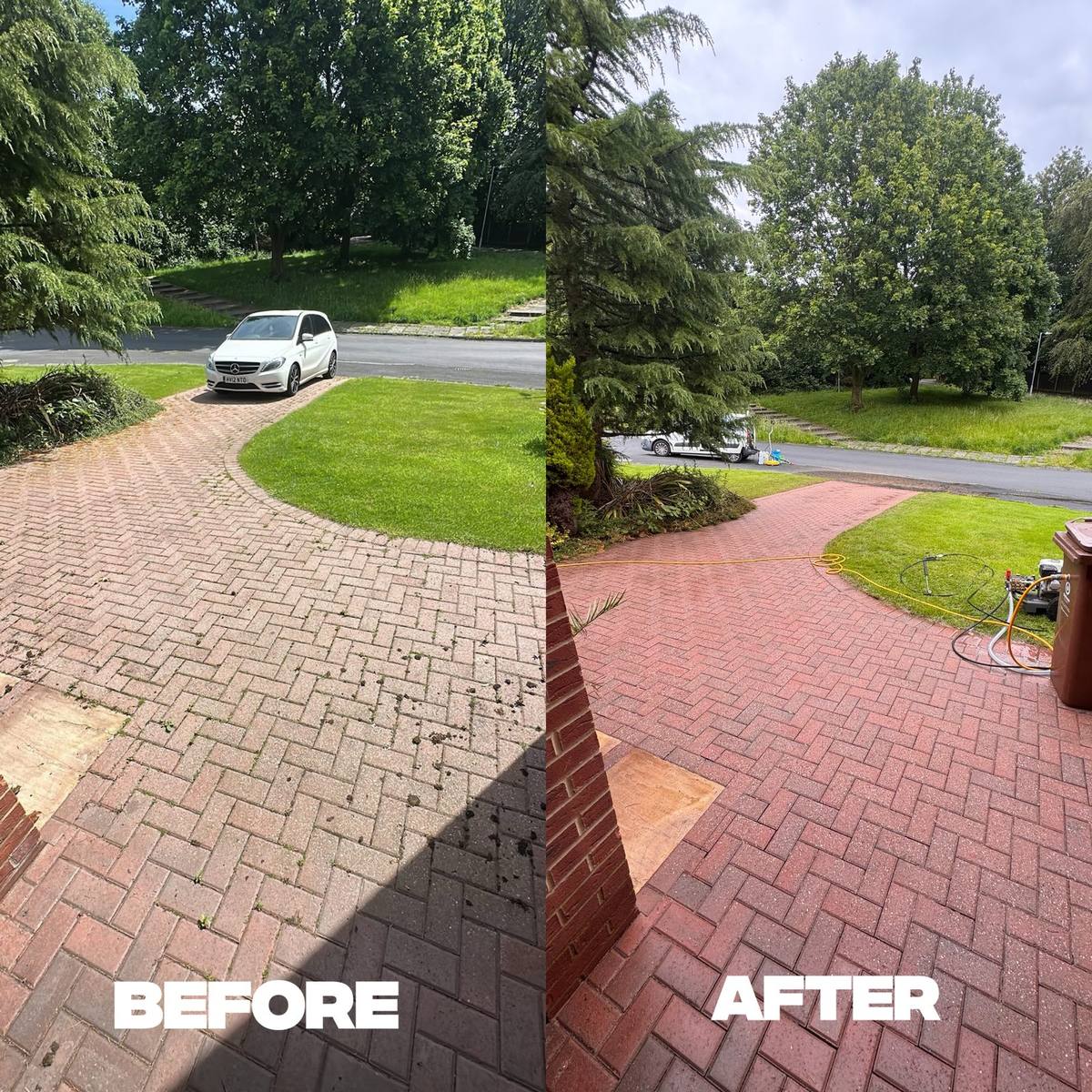
Block paving driveway — before and after a full clean by C&C Precision.
Quick answer: Driveway cleaning in Ashton-under-Lyne typically costs £80–£250 depending on size and surface type. A professional uses a rotary surface cleaner and hot or cold pressure washing to remove moss, algae, oil stains and dirt, leaving the surface safe and presentable. Most jobs are completed in a single visit.
Why Ashton Driveways Get Dirty So Quickly
Greater Manchester sits in one of the dampest corners of England, and Ashton-under-Lyne is no exception. Annual rainfall is consistent enough that external surfaces rarely go more than a few days without moisture. That sustained damp is exactly what algae, lichen and moss need to establish themselves, and once they do, they spread. The dark green or black film you see creeping across block paving or concrete isn't just cosmetic — it's a biological mat that retains moisture against the surface, accelerating deterioration over time.
Traffic makes things worse. Oil drips from stationary vehicles, tyre rubber deposits, and general foot traffic all leave residue that binds with organic matter and atmospheric dirt. In shaded spots — which are common in Ashton's older terraced streets, where neighbouring properties block low winter sun — the surface may barely dry out between autumn and spring. Black spot, which is a particularly stubborn form of algae that embeds itself into porous surfaces rather than sitting on top, becomes almost impossible to shift with ordinary cleaning methods once it's established.
None of this is avoidable. It simply means that driveway maintenance is a practical necessity in this climate rather than something you do purely for appearances. Leaving heavy organic growth in place long-term can cause joint erosion in block paving and surface degradation in tarmac and concrete, so keeping on top of it protects the surface as much as it improves the look.
Driveway Surfaces We Clean in Ashton
Ashton-under-Lyne has a varied mix of driveway surfaces. Older properties tend to have plain concrete or tarmac; more recently built or renovated homes often have block paving or imprinted concrete. Some properties, particularly on the more affluent streets toward Hurst and Waterloo, have natural stone — sandstone, granite setts or Indian sandstone.
Each surface behaves differently under pressure and responds to different chemical treatments. Block paving is porous and tolerates a rotary surface cleaner well, but the joints need care. Imprinted concrete has a decorative pattern and a surface sealant — too much pressure strips the sealant and ruins the finish, so a lower-pressure approach with appropriate pre-treatment is needed. Tarmac is soft and can be damaged by high-pressure nozzles held too close. Natural stone varies enormously — sandstone is delicate and will pit if treated carelessly, while granite is extremely hard-wearing. Stone cleaning on heritage or more expensive materials is a different discipline from standard concrete or block paving work, and it's worth making sure whoever does the job understands the difference.
This is part of why a single per-square-metre price for all driveways doesn't really work. Surface type, condition, and what needs to be done beyond the basic wash all affect the time and method involved. A photo sent over WhatsApp tells far more than a postcode and a rough size.
The Driveway Cleaning Process Step by Step
A professional driveway clean isn't just pointing a pressure washer at the surface and working across it. The job starts with an assessment of what's there — the type of surface, how bad the organic growth is, whether there are oil or rust stains that need targeted pre-treatment, and the condition of any joints or edges.
Heavy moss or lichen is usually treated first with a biocide or a diluted sodium hypochlorite solution, which is left to dwell. Dwell time matters — giving the chemical time to break down and kill the organic matter before any pressure is applied makes the cleaning far more effective and reduces the risk of simply spreading live spores around the surface. Pre-treating oil stains with a degreaser at this stage also gives better results than trying to lift them with pressure alone.
The main clean uses a rotary surface cleaner — a shrouded spinning head that moves evenly across the surface at consistent pressure. This is what gives a professional result the even, streak-free finish that a hand lance rarely achieves. Edges and the narrow strips along walls or borders are then done by hand. Waste water — which carries removed organic material, dirt and any chemical residue — is managed carefully and not left to pool where it can stain adjacent surfaces or drain into a neighbour's property. When the job is done, the surface should be clean uniformly rather than patchy, and joints in block paving should be intact, not blown out.
Block Paving: Cleaning and Re-Sanding
Block paving is the most common driveway surface we deal with across Ashton and the wider Tameside area, and re-sanding is probably the question we get asked most often. The short answer is: yes, re-sanding after pressure washing is almost always recommended, and here's why.
The joints between block paving units are filled with kiln-dried sand. That sand keeps the blocks locked in position, prevents lateral movement underfoot or under vehicle weight, and reduces the gap through which weed seeds can find a foothold. Pressure washing — even done at the right pressure with a surface cleaner — removes a significant proportion of that sand. Leaving the joints empty or half-filled after cleaning means weeds will return faster, blocks may begin to rock, and the structural integrity of the surface gradually weakens. You can read more about the full process in our guide on block paving re-sanding.
Re-sanding is done on the same visit, once the surface has had a chance to dry enough to accept the new sand properly. Fresh kiln-dried sand is brushed in across the surface and compacted into the joints. Some customers also ask about sealing at this stage, which is a sensible option — a quality penetrating or surface sealant applied after a thorough clean and re-sand can significantly slow the return of algae and weeds. It's not essential, but on a driveway that's had consistent moss problems, it's worth considering. For a broader look at the full block paving cleaning process, including what affects the outcome, that page has more detail.
How Much Does Driveway Cleaning Cost in Ashton-under-Lyne?
Pricing for driveway cleaning in Ashton-under-Lyne varies depending on surface type, size and condition. As a general guide, block paving cleaning starts from around £3.50 per square metre for a straightforward clean. If the surface has significant moss, algae or black spot requiring chemical pre-treatment, expect around £4.25 per square metre. A full restoration — clean plus re-sanding with kiln-dried sand — runs from around £5.50 per square metre. Re-sanding alone, if the surface has already been cleaned recently, starts from approximately £2.00 per square metre.
In practical terms, a small terraced driveway in Ashton of around 20–25 square metres for a basic clean and re-sand might come to somewhere in the region of £110–£150. A larger double-width block paved driveway of 50–60 square metres with heavy moss or oil staining could be £250 or more. These are honest ballparks — the actual figure depends on what's in front of us on the day. Oil staining, for example, takes significantly longer to treat than a surface with only organic growth, and that affects the time on site.
The fastest way to get an accurate quote for driveway cleaning in Ashton is to send a few photos over WhatsApp. That lets us see the surface type, approximate size, and condition, and give you a specific number rather than a wide range. There's no obligation and no sales process — just a straight answer.
Before you request a quote, take photos in decent light that show the full driveway, a close-up of the surface texture and joints, and any problem areas like oil stains or particularly heavy moss. The more we can see, the more accurate the quote will be — and it takes about thirty seconds.
When You Should Call a Professional Instead of DIYing It
There's a fair amount of guidance online suggesting that hiring a domestic pressure washer is a reasonable alternative to a professional clean. For some jobs — a small patio with light surface algae, for instance — that's broadly true. But there are real limitations to consumer machines that are worth understanding before you commit to a day's work and potentially cause damage you hadn't anticipated. If you want a balanced view, our guide on DIY pressure washing versus professional goes into the detail honestly.
The main issues with consumer machines are inconsistent pressure, the wrong nozzle angle for the surface, and the absence of a rotary surface cleaner. Without a rotary head, cleaning with a hand lance leaves fan marks — the characteristic tiger-stripe effect you see on driveways that have been DIY-washed. More seriously, using too high a pressure, or the wrong nozzle, on block paving blasts sand from the joints and can damage the surface of softer stones. On imprinted concrete, it strips the decorative sealant. On tarmac, it can physically erode the surface. Algae spores not killed by a chemical pre-treatment can also be spread rather than removed, meaning the green growth returns within weeks rather than months.
For heavy moss growth, large block-paved areas, any job involving re-sanding, oil staining, imprinted concrete, or natural stone, a professional result is genuinely worth the spend. C&C Precision Pressure Washing covers Ashton-under-Lyne and the surrounding Tameside towns, carries £1,000,000 public liability insurance, and works to a standard where re-treating a surface because it's been damaged isn't something we want to be doing any more than you want to pay for it. You can read what customers say on our reviews page.
How to Keep Your Driveway Cleaner for Longer
After a professional clean, there are some simple habits that extend the time before a full clean is needed again. The most straightforward is clearing leaf fall promptly in autumn. Decomposing leaves are one of the fastest ways to reintroduce organic matter and moisture to a cleaned surface — they mat down, retain damp and create the conditions that algae and moss need. A stiff brush or leaf blower once a week through October and November makes a noticeable difference.
For block paving specifically, sealing after a clean and re-sand is the most effective long-term measure available. A penetrating sealant — the type that soaks into the block rather than sitting as a film on the surface — reduces porosity, makes the surface less hospitable to algae, and helps the kiln-dried sand stay in the joints longer. It won't make the driveway maintenance-free, but it can realistically extend the gap between full professional cleans from twelve to eighteen months up to two to three years in normal conditions.
Realistically, most driveways in Ashton-under-Lyne and the surrounding area — given the climate — benefit from a full professional clean every one to two years. Driveways in particularly shaded positions, or those with recurring oil staining from a vehicle with a slow leak, may need more frequent attention. Keeping on top of it before growth becomes heavy is always cheaper than leaving it until the moss is thick and the black spot is embedded — that's where the time on site, and therefore the cost, increases significantly. If you're also thinking about the broader picture of your property's exterior, our guide on driveway kerb appeal upgrades that actually work covers what genuinely makes a difference.
Frequently asked questions
How much does driveway cleaning cost in Ashton-under-Lyne?
Most residential driveways in Ashton fall between £80 and £250 depending on size, surface type and condition. A small terraced block paving driveway will sit at the lower end; a large double-width with heavy moss or oil staining will be higher. The quickest way to get an accurate figure is to send photos over WhatsApp.
Do you need to re-sand block paving after pressure washing?
Yes, in most cases. Pressure washing removes the kiln-dried sand from the joints, and leaving them empty lets weeds take hold quickly and weakens the surface structure. Re-sanding with fresh kiln-dried sand after the clean is strongly recommended and is a service we offer as part of the same visit.
How long does a driveway clean take in Ashton?
A standard residential driveway takes between one and three hours depending on size and surface condition. Larger driveways or those with heavy organic growth or oil staining will take longer. We'll give you a realistic time estimate when you send your photos through.
Is it worth pressure washing a driveway before selling a house?
Absolutely — kerb appeal has a measurable effect on first impressions and how quickly a property sells. A clean driveway costs very little relative to the uplift in perceived value and costs nothing compared to replacing the surface. It's one of the best-value exterior improvements before going on the market.
Want a fast price for your Ashton driveway?
Send a couple of photos over WhatsApp and we'll come back to you with a quote — no faff, no sales calls.