If you've been searching for driveway cleaning Middleton and wondering why your driveway looks worse every year despite the occasional hosepipe, you're not imagining it. Middleton's position on the northern fringe of Greater Manchester means driveways here take a harder beating from the elements than most people realise, and the organic growth that builds up on block paving, concrete, and tarmac doesn't respond to half-measures.
This guide covers why driveways in Middleton deteriorate the way they do, what's actually growing on the surface, and what a proper clean involves — including the steps most people skip. If you want to understand what you're looking at before booking anyone, this should give you a straight answer.
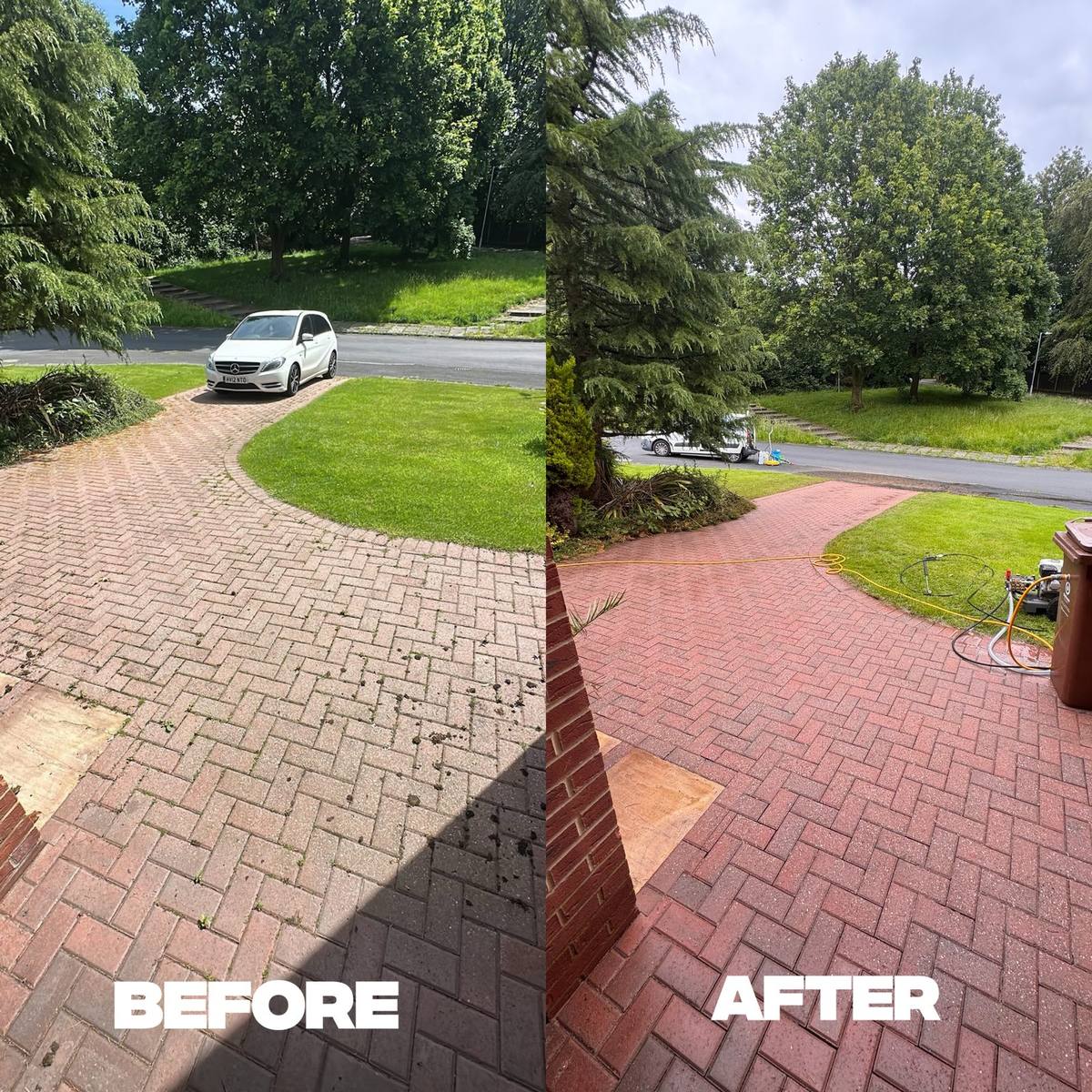
Block paving driveway cleaned by C&C Precision — typical of what we see on Middleton jobs.
Quick answer: Middleton driveways deal with heavy moss and algae growth due to the area's damp climate, combined with traffic grime, weed-filled block paving joints, and organic staining from overhanging trees. Professional pressure washing removes all of this safely, restoring the surface without damage.
Why Middleton Driveways Get So Dirty So Fast
Middleton sits at a noticeable elevation compared to central Manchester, catching the damp westerlies that roll in off the Pennines before they've had a chance to dry out. Annual rainfall across this part of Rochdale borough consistently runs higher than the national average, and more importantly, surfaces here stay wet for longer between showers. That persistent moisture is the single biggest driver of moss, algae, and lichen growth on driveways across the area.
It's not just the rain. The combination of north-facing aspects on many older terraced streets, tree cover from established residential planting, and the general chill that comes with elevation means driveway surfaces rarely get the sustained sun they'd need to dry out naturally. A driveway that stays damp for three days out of five is one that's constantly feeding the organic growth already embedded in its surface.
This is worth understanding because it sets realistic expectations. A driveway cleaning Middleton job done properly will produce a significant result, but the conditions that caused the problem don't go away — which is why aftercare and the occasional follow-up clean matter.
The Most Common Driveway Surfaces in Middleton
Block paving is the dominant surface across older estates — Alkrington Garden Village, Langley, and the streets around Middleton town centre are full of it. Much of this paving was laid in the 1980s and 1990s, which means it's now old enough to have lost jointing sand through multiple cycles of weed growth, frost heave, and surface wear. Concrete and tarmac are more common on newer builds and wider driveways where cost or practicality drove the choice.
Each surface needs a different approach. Block paving responds well to rotary surface cleaning at controlled pressures, but too much force strips the remaining jointing sand and leaves the blocks unstable. Tarmac is softer and can be marked by excessive pressure or the wrong nozzle type. Concrete is more forgiving but develops black algae staining that needs chemical pre-treatment to shift properly — you can read more about that in our guide to removing black spots from patios, where the same organisms are usually responsible.
Knowing your surface before any work starts isn't just good practice — it determines what equipment, what pressure, and what treatments are actually appropriate. A single approach doesn't work across all of them.
Moss, Algae and Weeds: What's Growing on Your Drive
Moss is the most visible problem on Middleton driveways and the one that does the most structural damage over time. It colonises block paving joints first, then spreads across the surface in a thick mat that holds moisture against the paving and gradually works deeper into the joints, displacing the sand that holds blocks in position. By the time moss is visible across the surface, it's often been working in the joints for a year or more.
Algae is the slippery green or black film that makes driveways genuinely hazardous in wet weather. It's a different organism from moss but thrives in the same damp, low-light conditions. The black variant — often called black spot algae — is particularly tenacious and bonds to concrete and stone surfaces in a way that makes it resistant to pressure alone. It needs a biocide treatment, typically sodium hypochlorite applied at the appropriate dilution with a proper dwell time, before washing will actually clear it. More detail on that process is in our guide on what actually removes algae from paving.
Weeds are the third part of the problem. Annual weeds seed into joints from above; perennial ones root from below through the sub-base. Pressure washing removes the visible growth, but it doesn't kill the root system — which is why a post-clean biocide application significantly extends how long the results last.
Traffic Grime, Oil and Rubber Staining
Driveways close to the A664 Manchester Road or the town centre routes pick up airborne road grime consistently, and it binds to damp surfaces far more readily than it would in drier climates. This shows as a general darkening of the paving that's easy to mistake for deeply embedded dirt — in many cases it is, but the source matters for choosing the right treatment.
Oil staining from slow leaks or top-up spillages is a different challenge. Fresh oil can be treated with a degreaser and hot water, but oil that's been sitting on block paving or concrete for months has partially polymerised into the surface. Professional equipment with genuine heat capacity and proper surface degreasers will shift most of it, but it's worth being honest: very old, heavy oil staining will often lighten significantly rather than disappear entirely. That's the nature of porous surfaces, not a failure of the cleaning process.
Rubber tyre marks — the arcing black streaks left by hard braking or tight turning — are common on smoother concrete and tarmac drives and don't respond to cold water at any pressure. Surface treatment first, then pressure rinsing, is the correct sequence for these.
Block Paving Joint Loss and What Happens If You Ignore It
This is the section most people skip when they're researching driveway cleaning, and it's the one that matters most for how long any clean actually lasts. Block paving relies on kiln-dried jointing sand packed tightly between each block to distribute load, lock the surface in place, and stop water tracking down in the wrong directions. When moss, weeds, and pressure washing (done without re-sanding afterwards) remove that sand, the blocks start to move.
Rocking blocks are more than an aesthetic problem. They create trip hazards, allow water to pool and penetrate the sub-base, and accelerate the frost damage that causes paving to lift in cold winters. Once the sub-base is disturbed, you're looking at re-laying rather than just cleaning. Our full guide to block paving restoration in Manchester covers what that involves, but the short version is that it costs considerably more than staying on top of the jointing.
Re-sanding after a clean is straightforward — kiln-dried sand is brushed into open joints across the dry surface and compacted in. Prices for re-sanding only typically start around £2.00/m², and it's included in full restoration packages. It's the step that turns a clean that lasts twelve months into one that lasts two or three years.
If your block paving has visible gaps between blocks, or blocks that move slightly underfoot, get the jointing sand replaced after cleaning — not before, and not instead of. Filling joints over moss and weed root systems doesn't fix anything. The correct order is clean, treat, dry, re-sand.
When to Call in a Professional for Driveway Cleaning in Middleton
A domestic pressure washer — the kind available from any DIY retailer — runs at a fraction of the pressure and flow rate of trade equipment, and it doesn't come with the surface-cleaning attachments that make block paving and concrete cleaning both effective and safe for the surface. Used without the right technique, a consumer machine can strip joints, etch tarmac, and spread algae spores to clean areas of the driveway. The surface looks better for a few weeks, then regrows faster than before because the root structure wasn't treated.
If the driveway is slippery underfoot, has significant joint loss, or has black staining that hasn't responded to previous cleaning attempts, it's the point where professional equipment and chemical knowledge genuinely changes the outcome. Professional driveway cleaning uses rotary surface cleaners at pressures calibrated to the surface type, pre-treatment chemicals with appropriate dwell times, and post-treatment biocides that slow regrowth. For block paving specifically, pricing typically starts from £3.50/m² for a standard clean, rising to around £4.25/m² where chemical treatment is included, and £5.50/m² for a full restoration with re-sanding.
C&C Precision Precision Pressure Washing covers Middleton and the wider Rochdale and Oldham area, and the quickest way to get a price is to send a couple of photos on WhatsApp — most quotes come back the same day. You can also see what the work looks like in practice on our reviews page.
What to Do After Your Driveway Has Been Cleaned
The period immediately after cleaning is when the decisions you make have the most impact on how long the results last. If you have block paving, the priority is re-sanding any open joints before foot traffic works debris back into them. The surface needs to be genuinely dry before kiln-dried sand goes in — damp sand clumps rather than settling into the joints properly, and it doesn't compact as it should. Our detailed guide to re-sanding block paving after cleaning covers the process in full if you want to understand exactly what's involved.
Sealing comes up in most conversations about driveway aftercare, and it's worth being clear about what it does and doesn't do. A sealant applied to a properly cleaned and re-sanded block paving surface can slow the rate at which moisture penetrates, which in turn slows algae and moss recolonisation. There are two main types — impregnating sealers, which soak into the paving and leave a natural finish, and surface sealers, which sit on top and give a wet-look sheen. Neither type is maintenance-free, and neither should be applied over an inadequately cleaned surface as a shortcut. Sealing over existing staining traps the problem rather than solving it.
For most Middleton driveways, the most practical aftercare is a biocide treatment applied after cleaning, re-sanding where needed, and a follow-up clean every two to three years depending on shade and tree cover. That's a realistic maintenance cycle for this climate — not a guarantee, but an honest one.
Frequently asked questions
How much does driveway cleaning in Middleton cost?
Most residential driveways in Middleton come in between £80 and £200 depending on size, surface type, and how much moss or weed growth is present. The quickest way to get an accurate price is to send a couple of photos on WhatsApp — we can usually give you a figure the same day.
Will pressure washing damage my block paving?
Done correctly with the right nozzle and pressure setting, no — it won't damage the blocks. The risk with block paving is using too high a pressure and blasting out the jointing sand, which is why re-sanding after cleaning is often recommended. We adjust the pressure to suit the surface on every job.
How long will a driveway clean last in Middleton's climate?
Realistically, a well-cleaned and re-sanded driveway will stay looking good for two to three years before moss and algae start to recolonise noticeably. Shaded driveways under trees will see regrowth faster. Some customers book us every couple of years as straightforward maintenance.
Do you clean driveways in Middleton all year round?
Yes, we work throughout the year across Middleton and the wider Rochdale and Oldham area. We avoid pressure washing in freezing conditions as water left in joints can cause damage as it expands overnight — but outside of a hard frost, we're generally good to go.
Want a fast price for your Middleton driveway?
Send us a couple of photos on WhatsApp and we'll come back to you with a straight price — no fuss, no sales call.