If you've noticed your driveway turning green faster than your neighbours' a few miles down the valley, you're not imagining it. Driveway cleaning in Uppermill comes with its own particular challenges — the elevation, the rainfall, and the way damp lingers here longer than it does in the lower parts of Greater Manchester all combine to make organic growth a persistent problem. Whether you've got traditional stone setts, block paving or a concrete drive, staying on top of it matters both for appearance and for the surface's long-term condition.
This guide covers what actually causes the build-up, how different surfaces clean up, what the work costs, and how to keep things looking right between cleans. It's written to give you straight answers rather than a sales pitch.
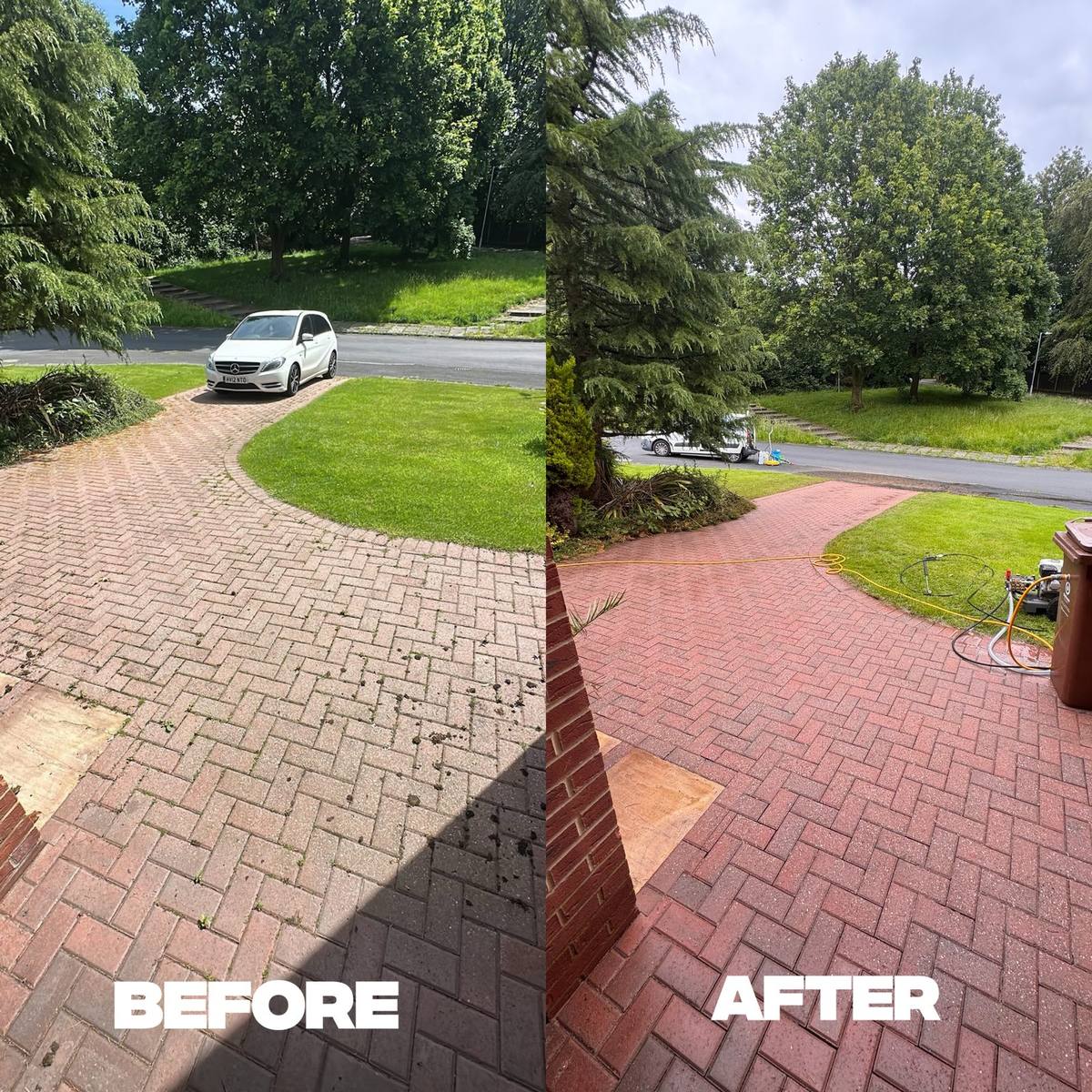
Block paving driveway cleaned by C&C Precision — typical result on Saddleworth properties.
Quick answer: Driveway cleaning in Uppermill typically costs £80–£200 depending on size and surface type. Most Saddleworth driveways — block paving, stone setts, concrete — need professional pressure washing every 1–2 years due to heavy moss and algae growth in the damp Pennine climate.
Why Uppermill Driveways Get Dirtier Faster
Uppermill sits on the eastern edge of Greater Manchester, climbing into the Pennine foothills at elevations where rainfall is noticeably higher and temperatures run cooler than in the city. That combination — persistent moisture, reduced sunlight in sheltered spots, and the kind of damp that settles in rather than dries out — creates near-ideal conditions for moss, algae, lichen and black spot to establish themselves on hard surfaces. A driveway that might need cleaning every couple of years in Stretford or Salford will often need attention every twelve months up here.
Algae colonises first — you'll see it as a slippery green or grey-green film across the surface. Moss follows in the joints and any slightly recessed area where grit and moisture collect. Lichen takes longer to establish but is considerably harder to shift once it does, partly because it anchors into the surface itself rather than just sitting on top. Black spot — a particularly stubborn type of algae that penetrates porous stone and concrete — is common on Saddleworth driveways that have been left for a few years. It doesn't always disappear completely with a single clean; sometimes it lightens significantly on the first visit and fades fully over the weeks that follow as the residual treatment continues working.
The moss and algae issue isn't purely aesthetic either. Green algae makes paving slippery in wet conditions, which in a climate like Uppermill's means it's a hazard for much of the year. That's worth keeping in mind if you've been putting the job off.
Common Driveway Types in Saddleworth — and How Each One Cleans
Saddleworth properties span several centuries of building, which means there's a wide variety of driveway surfaces in use. Older homes in the village centres often have traditional stone setts — Yorkshire sandstone or reclaimed granite — which require a measured approach. These surfaces respond well to professional driveway cleaning, but they need lower operating pressures than concrete or brick. Too much pressure on sandstone setts risks surface erosion over time, so the equipment settings and technique matter considerably more than they would on a modern block paving driveway.
Block paving is the most common surface on properties built from the 1980s onwards, and it's also the surface that generates the most questions. It cleans up well with a surface cleaner head — much better than a standard lance, which leaves streaking — but the cleaning process washes out the kiln-dried sand from the joints. That needs replacing afterwards, which is covered below. Concrete driveways are generally the most straightforward to clean: they tolerate higher pressure and show results quickly, though deeply embedded black spot may need a chemical pre-treatment to shift properly. Tarmac requires a gentler approach to avoid disturbing the surface, and gravel driveways generally aren't pressure washed at all — the value there is in treating surrounding edging and any hard surfaces rather than the gravel itself.
If your property has stone walls, a rendered facade or roof tiles showing heavy moss, it's worth knowing that those can be dealt with at the same time. Softwashing with sodium hypochlorite is the appropriate method for render and roof surfaces rather than high-pressure washing, which can cause damage.
What Does Driveway Cleaning in Uppermill Actually Cost?
Pricing depends on size, surface type, how much organic growth is present and whether any additional work — like re-sanding — is needed. As a general guide, a small single driveway in reasonable condition starts from around £80. A typical block paving driveway of average size, say 40 to 60 square metres, will generally come in between £120 and £180. Larger driveways, or those with heavy moss, ingrained algae or lichen that needs pre-treatment, can reach £250 or more. If you want a more detailed breakdown of what affects the final price, the guide on how much driveway cleaning costs covers it thoroughly.
For block paving specifically, most contractors price by the square metre. Basic cleaning runs from around £3.50/m², cleaning with a chemical biocide treatment from £4.25/m², and a full restoration including re-sanding from £5.50/m². Re-sanding on its own, if the cleaning has already been done, is around £2.00/m². Those figures give you something to compare against, though the actual quote for your job will depend on what's in front of us.
Access also affects price in a practical way. Driveways with awkward access, low gates, or vehicles that need working around take longer. Being upfront about that when you send photos means the quote reflects reality rather than needing adjustment on the day.
Block Paving Re-Sanding: Why It Matters After a Deep Clean
This is the part of block paving maintenance that gets skipped most often, and it's usually why people find the moss and weeds return quickly after a clean. Pressure washing is effective at removing organic growth and staining, but the water also lifts the kiln-dried sand that sits in the joints between blocks. Those joints aren't just cosmetic — they lock the blocks together, stabilise the surface, and when filled correctly, reduce the space available for weed seeds to germinate and moisture to sit.
Once the jointing sand has been washed out and not replaced, the paving becomes noticeably less stable underfoot and significantly more vulnerable to rapid re-colonisation by moss and weeds. Replacing it properly involves brushing dry kiln-dried sand across the surface and working it into the joints until they're packed, then compacting it. Polymeric jointing compounds are also available and bond more firmly, though they're a more involved process and not always necessary. The full picture on this is in the guide to block paving restoration in Manchester.
Block paving re-sanding done at the same time as a clean is straightforward because the surface is already prepared and the joints are open. Doing it as a separate return visit later is less efficient and costs more overall. If you have block paving, it's worth including in the same job.
If your block paving has visible gaps between blocks, weeds pushing through, or blocks that rock slightly when walked on, that's a sign the jointing sand has broken down. A clean on its own won't fix that — re-sanding needs to be part of the job.
How to Get an Accurate Quote Without a Site Visit
Most jobs can be quoted accurately from a couple of photos, which means there's no need to book a visit just to get a price. Send two or three photos over WhatsApp — one showing the full driveway, one showing the worst-affected area, and one showing any tight access points if relevant — and a price can usually come back the same day. This saves time on both sides and means you're not waiting around for someone to come out before you know what you're looking at financially.
The photos give enough information to assess the surface type, approximate size, density of organic growth, and whether any additional treatment is likely to be needed. If something isn't clear from the photos, a quick message back and forth is usually enough to clarify. It's a more practical way of working than formal site visits for most residential driveway jobs.
When Is It Worth Calling in a Professional?
A hired jet wash from a local hire shop will shift loose surface dirt reasonably well, and if that's all you're dealing with, DIY is perfectly sensible. The problems start when the growth is more established. Algae has a waxy outer layer that water pressure alone doesn't reliably break down — it tends to smear and redistribute rather than being fully removed. A professional clean uses a biocide pre-treatment with sufficient dwell time to break down the organic matter before the pressure washing starts, which is what produces a genuinely clean result rather than a temporarily improved one. There's more detail on this in the guide on what actually removes algae from paving.
Hired equipment also tends to run at a fixed high pressure with a standard lance, which risks blasting jointing sand out of block paving and can streak natural stone. Professional equipment uses rotary surface cleaner heads that clean evenly at controlled pressures appropriate to the surface in question. The difference in the finished result is obvious, particularly on stone setts and older block paving. On top of that, spreading weed seeds through high-pressure spray is a real risk — the water disperses whatever's on the surface, and if moss spores or weed seeds are present, they end up in every joint and crack across the driveway.
For ingrained moss, lichen, black spot, or any block paving that needs re-sanding afterwards, a professional result is genuinely worth it. C&C Precision Pressure Washing covers Uppermill and the wider Saddleworth area as a regular part of its work across Greater Manchester and is fully insured with £1,000,000 public liability cover. For straightforward light cleaning on a surface in good condition, hiring a machine and doing it yourself is a reasonable choice — just be honest with yourself about what you're actually dealing with.
Keeping Your Uppermill Driveway Clean for Longer
Given the climate in Saddleworth, most driveways benefit from a professional clean every twelve to eighteen months. Leaving it longer than that allows moss and lichen to become deeply embedded, which makes the job harder and increases the likelihood that some staining will remain even after treatment. Annual cleaning is also easier on the surface itself — there's less need for aggressive treatment when growth is caught at an earlier stage.
Whether sealing is worth doing depends on the surface and your expectations. A good quality sealant can help repel moisture and slow the re-establishment of algae and moss, and it makes the surface somewhat easier to clean between professional visits. It's not a permanent fix — it needs reapplying every few years — and it doesn't prevent growth entirely in a climate like this. If you're considering it, the guide on sealed versus unsealed paving covers what actually changes in practice. On stone setts particularly, sealing is a decision worth thinking through carefully because it alters the appearance and is difficult to reverse.
Between professional cleans, keeping gutters and downpipes clear so water doesn't pool at the base of the driveway makes a real difference. Sweeping back fine debris — particularly from overhanging trees — reduces the organic matter available for moss and algae to feed on. A dilute sodium hypochlorite solution brushed over affected areas can slow regrowth, though mixing and applying it correctly matters — it needs appropriate dilution and ideally a calm, dry day with no rain expected for several hours. None of this replaces a proper clean, but it's worth doing in the intervals between.
Frequently asked questions
How much does driveway cleaning cost in Uppermill?
Most Uppermill driveways cost between £80 and £200 to clean professionally, depending on size and how much moss or algae has built up. Block paving jobs that also need re-sanding with kiln-dried sand will sit at the higher end. Send a couple of photos on WhatsApp and we can give you an accurate price the same day.
How often should I have my driveway cleaned in Saddleworth?
Given Uppermill's elevation and rainfall, most driveways benefit from a professional clean every 12 to 18 months. Leave it much longer and moss and algae become deeply embedded, making the job harder and more expensive. Annual cleaning also keeps block paving joints in better condition.
Will pressure washing damage my block paving or stone setts?
Done correctly, no — but the technique and equipment matters. High-pressure surface cleaners are used at appropriate settings for each surface type, and rotary heads avoid the streaking that a standard lance causes. The main risk with DIY jet washing is blasting out the jointing sand, which is why re-sanding afterwards is often needed.
Do you cover Uppermill and the surrounding Saddleworth villages?
Yes — we cover the whole OL3 area including Uppermill, Greenfield, Dobcross, Delph, Diggle and Springhead as part of our regular work across Greater Manchester. We're based in Oldham so Saddleworth is a straightforward local job for us.
Want a quick price for your Uppermill driveway?
Send a couple of photos over WhatsApp and we'll come back to you with a fast, no-nonsense quote — usually same day.